In the rapidly evolving food manufacturing sector, change is the only constant. Mid-sized and large manufacturers alike face shifts on multiple fronts: from consumer habits and dietary psychology, to disruptive technologies, to new regulatory and sustainability imperatives. Effectively navigating these changes demands more than ad hoc reactions, it requires a deep and structured approach to change management.
For a company like Beyzon Foodtek that works with food manufacturers, helping clients embed change management into their operational DNA is as important as the hardware or software they deploy. This article explores why change management matters in food manufacturing, what kinds of changes are pressing today and how companies can prepare their people, processes and systems to adapt.
Why Change Management Matters
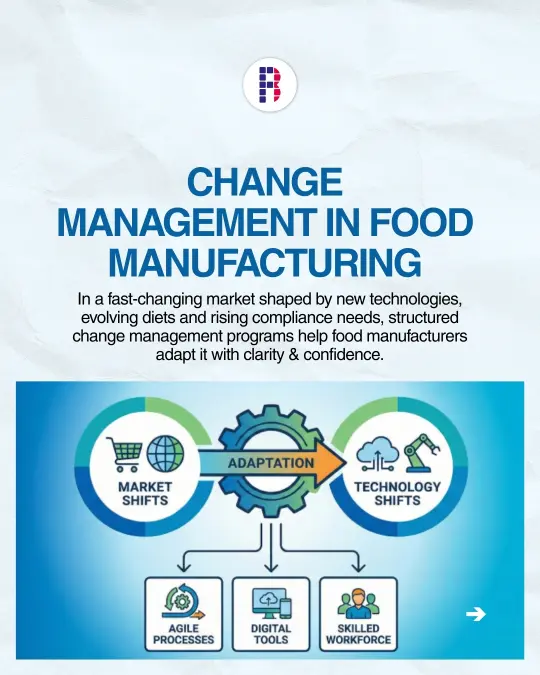
Change management is defined as “a structured approach to transitioning individuals, teams and organizations from a current state to a future state.” In the food manufacturing world that means everything from shifting workforce roles, upgrading technology systems, adapting process flows, to responding to fast-changing consumer demands.
Since the food processing industry is tightly regulated, high volume, and subject to supply-chain fragility, the cost of getting change wrong can be steep: product recalls, regulatory non-compliance, low employee morale, increased waste and downtime. In contrast, those that manage change well can achieve faster ROI on technology investment, agile responses to market shifts and stronger staff engagement. For mid-sized food manufacturers especially, change management becomes a strategic differentiator.
Key Market & Technological Shifts Food Manufacturers Must Address
Below are some of the most significant shifts driving the need for change management:
1. Consumer & Consumption Psychology
Consumers today demand more than just “food”. They care about health, sustainability, transparency and experience. A comprehensive review shows that global dietary patterns are diversifying and people are eating fewer staples, more varied items while being influenced by urbanization, income changes and marketing. For instance, the shift to “clean-label”, “plant-based”, “functional foods” and “personalised nutrition” are no longer niche. They are mainstream.
Manufacturers must therefore change their mindset: from mass production of standard SKUs to flexible platforms capable of smaller batches, more variants, greater traceability and faster reaction to consumer signals. That means change in sourcing, recipe design, packaging, quality systems. Beyzon Foodtek’s change-management frameworks often start with translating consumer signals into operational imperatives.
2. Technology & Automation Trends
The food manufacturing sector is undergoing a major technology wave: AI, IoT, robotics, predictive analytics, digital twins, blockchain, and more. For example, reports suggest the global food-technology market is expected to grow from USD 229.49 billion in 2025 to USD 538.47 billion by 2034 at nearly 10% CAGR. Another source outlines how IoT sensors, AI-powered quality inspection and digital-thread manufacturing are becoming mainstream.
For food manufacturers, this means not merely buying new machines but changing workflows, data culture, training, maintenance regimes and even organisational roles.
A technology project without accompanying change management is likely to under-deliver.
3. Supply Chain Resilience & Sustainability
The pandemic and global disruptions exposed many weaknesses in food manufacturing supply chains. Companies now must build resilience; flexible sourcing, localised production, traceability, environmental compliance, waste reduction. Trend-reports show that food processing in India, for example, is expected to grow substantially (US$ 336.4 billion in 2023 to US$ 735.5 billion by 2032) and technology adoption is part of that. For manufacturers, this means change in raw-material sourcing, vendor management, logistics, packaging and regulatory approach.
4. Changing Workforce Dynamics & Organisational Culture
Technology, new product formats, global supply-chain demands and regulatory rigour all place new demands on the workforce. Traditional roles are shifting: operators become data-monitors, maintenance staff become predictive-analytics specialists, quality teams engage with digital dashboards. But without change management viz. training, communication, role clarity- these transitions fail.
A Change Management Framework for Food Manufacturers
Here is a step-by-step framework that Beyzon Foodtek uses with its clients to manage change effectively. It is tuned to food manufacturing realities, where safety, compliance, waste, uptime and quality are critical.
Step 1: Define the Vision & Strategic Imperative
Start with a clear articulation of why change is needed: e.g., “reduce scrap by 15% in 12 months”, “launch plant-based snack line within 18 months”, “achieve 98% audit compliance”, or “connect all process lines with IoT within 24 months”. Linking the vision to measurable business outcomes aligns all stakeholders.
Step 2: Assess the Current State
Map existing processes, technology, skills, culture, organisational structure and performance metrics. Identify capability gaps in people, process and technology. For example, maybe the line has old machines, no sensors, low data-visibility, and workers feel ambiguous about digital tools. Beyzon Foodtek’s baseline assessments help quantify the “as-is” state.
Step 3: Design the Future State & Roadmap
Define the target workflows, roles, processes, technologies and cultural attributes. Create a phased roadmap: pilot, scale, integrate. In food manufacturing, this could be: install sensors → train operators → integrate dashboard → link to maintenance system → scale to full plant. Emphasis on change behaviour as well as technical integration.
Step 4: Engage the Workforce & Manage Culture
Change fails when people feel left behind. Communicate early and often. Involve cross-functional teams: production, maintenance, quality, IT, HR. Provide role clarity, training, incentives. Cultural change is especially important when moving from manual processes to digital/automated ones. Beyzon Foodtek’s change-management modules include workshop facilitation and culture-building initiatives.
Step 5: Deploy, Monitor & Iterate
With pilots running, monitor KPIs: productivity, quality rejects, downtime, safety incidents, employee engagement, audit scores, ROI on technology. Use lessons-learned to refine rollout. Change is not “one-and-done” but an ongoing cycle of improvement.
Step 6: Sustain & Embed
Once new systems and behaviours are working, embed them into SOPs, performance review systems, training modules, leadership routines. Reinforce the new norms so the change sticks.
How Change Management Drives Tangible Benefits
When done right, change management unlocks major benefits:
- Faster ROI on technology investments (the difference between 30% success and 75%+ success rates in tech projects is often change-management effectiveness).
- Improved product quality, less waste and lower downtime due to integrated workflows and real-time data.
- Stronger employee engagement, as workers feel ownership of new ways and are trained and supported.
- Better market agility – the ability to launch new products (plant-based, clean-label, premium variants) faster in response to consumer shifts.
- Regulatory & sustainability readiness as companies adopt traceability, digital monitoring, sustainability KPIs and can respond to audits with data and culture aligned.
For food manufacturers, particularly mid-sized ones with budget constraints and competitive pressure, change management is what turns investments into transformation.
Common Pitfalls & How to Avoid Them
- Treating change as purely technological: many firms focus on machines or software, but neglect people/process change. The result: under-utilised systems, resistance, failure.
Avoidance: Integrate change management from the start inclusive of people, process, technology. - Lack of clear metrics or vision: without measurable goals, change becomes vague and drifts.
Avoidance: Set specific KPIs (e.g., scrap < 2%, audit score > 95%, changeover time reduced by X%). - Underestimating cultural shift: employees may resist new tools or workflows; old habits persist.
Avoidance: Workshop culture, role-maps, recognition for change champions, continuous training. - Phasing too big, too fast: trying to change the entire plant in one go leads to chaos.
Avoidance: Pilot, learn, scale. - Neglecting monitoring & adjustment: launch new system but don’t track performance or course-correct.
Avoidance: Establish dashboards, review cadence (weekly/monthly), feed back into roadmap.
Real-World Example: Mid-Sized Snack Manufacturer
Consider a hypothetical mid-sized Indian snack manufacturer aiming to launch a plant-based variant amid rising consumer demand. They decide to:
- Install IoT sensors on roasting/packaging lines (tech change)
- Up-skill operators in data-driven decision-making (people change)
- Redesign procurement and recipe workflows for new ingredient (process change)
- Set KPIs: launch within 9 months, waste reduction of 10%, audit compliance > 98%
With a change-management approach: vision defined, baseline assessed, pilot line selected, workers trained, KPIs monitored, system embedded. Result: plant launches new line in 8 months, waste drops 12%, audit score hits 99%, ROI achieved within 15 months.
Without change management, the same project might have faced delays, cost overruns, under-utilisation of sensors, and employee push-back.
Why Beyzon Foodtek Is a Valuable Partner
As food manufacturers strive to adapt, studying the evolving consumer psychology, to robotics and AI, to supply-chain shifts and sustainability demands. Beyzon Foodtek brings domain-specific expertise: combining food-industry process knowledge, technology roadmap experience, and change-behaviour frameworks. We help manufacturers not only select the right technologies, but ensure the organisation, culture and processes are aligned to make them work. That alignment is what turns investment into impact.
Conclusion
Market trends and technology shifts are accelerating in the food manufacturing space. Consumers demand transparency and personalisation, technology enables new ways of producing and monitoring and regulation and sustainability are rising in priority. But the differentiator between success and slow process is not just what you implement, it’s how you manage the change.
Effective change management embedded from vision through people, process, technology and culture is what enables food manufacturers to adapt, thrive, and lead. With the right partners, frameworks and disciplined approach, small shifts lead to big impact.