In food manufacturing, every deviation, whether a temperature drift, a mislabelled batch, a sanitation shortfall, or a missed verification reading, reveals a structural vulnerability. Small issues are never isolated; they are symptoms of deeper misalignments between people, equipment, processes, and monitoring systems. When deviations are treated casually, they return in cycles, eroding food safety, productivity, and audit confidence. But when addressed with rigour, they become valuable signals that strengthen the plant’s entire operational ecosystem.
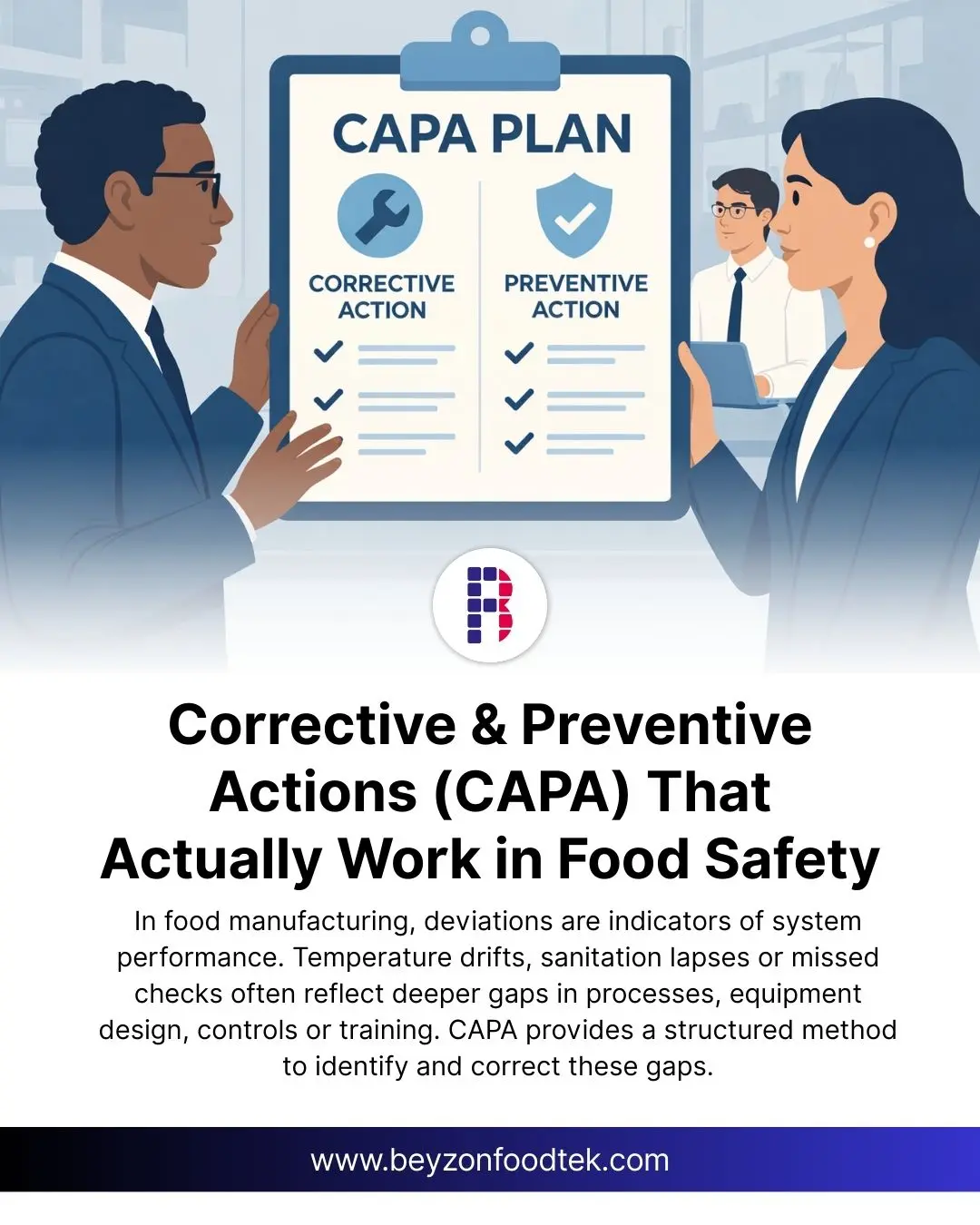
Corrective and Preventive Actions (CAPA) sit at the heart of this system-strengthening effort. Rather than being an administrative obligation, CAPA is a disciplined approach to identifying, analysing, and eliminating root causes so they never resurface. To make CAPA effective, manufacturers must approach it with clarity, curiosity, and a commitment to long-term improvement, not just quick fixes.
What CAPA Really Means in Food Safety
CAPA is often misunderstood or oversimplified. To be effective, it is important to clearly distinguish between its components:
- Correction: A correction is the immediate action taken to control a problem after it has been detected. This may involve segregating affected products, stopping a line, or re-cleaning equipment. Corrections are essential, but they only deal with the symptom.
Example: Holding or reworking affected products.
- Corrective Action: A corrective action goes deeper. It addresses the root cause of an identified non-conformance so that the same issue does not recur. If a sanitation failure occurs, the corrective action may involve redesigning the cleaning procedure, modifying equipment access, or adjusting cleaning frequency based on risk.
Example: Modifying a sanitation SOP to prevent repeated contamination.
- Preventive Action: A preventive action looks ahead. It is taken to eliminate the causes of potential non-conformances before they occur. Preventive actions often arise from trend analysis, changes in processes, or early warning signs within the system.
Example: Revising equipment design after trend analysis shows repeated hygiene risks.
When these are mixed up or poorly defined, CAPA becomes ineffective and repetitive.
Common Triggers for CAPA in Food Manufacturing
CAPA should be triggered by real signals from the system, such as:
- Internal and external audit non-conformances
- Customer complaints and product returns
- CCP (Critical Control Point) or OPRP (Operational Prerequisite Program) deviations
- Environmental monitoring failures
- Regulatory inspections
- Trend analysis of quality or hygiene data
An effective food safety system treats these triggers as opportunities for improvement, not blame.
Why CAPA Fails in Many Food Manufacturing Facilities
CAPA often breaks down due to systemic issues rather than intent. Common failure points include:
- Symptom-based fixes
Repeated cleaning without identifying why contamination occurred. - Superficial root cause analysis
Defaulting to “operator error” without evaluating training adequacy, workload, supervision, or layout. - Training as the only solution
Training cannot compensate for poorly designed processes or faulty equipment. - Unclear ownership
CAPAs without accountable owners and deadlines rarely deliver results. - No effectiveness verification
Closing CAPA based on action completion instead of evidence of sustained improvement.
Building a CAPA System That Actually Works
1. Start With a Strong Problem Statement
A well-defined problem statement sets the foundation for effective CAPA. It should clearly describe:
- What went wrong ?
- Where did it occur ?
- When was it detected ?
- How often does this happen ?
Vague descriptions lead to vague actions—and weak outcomes.
2. Perform Meaningful Root Cause Analysis
Effective CAPA begins with meaningful root cause analysis (RCA). In food manufacturing, true root causes are rarely individual mistakes. More often, they lie in process design, workflow complexity, equipment limitations, unclear instructions, or insufficient controls.
Practical tools such as the 5 Whys, Fishbone analysis, and process mapping are highly effective when applied honestly and collaboratively. The goal of RCA is not to assign blame, but to understand why the system allowed the failure to occur.
When root causes are identified correctly, corrective actions naturally shift from people-focused fixes to system-focused improvements.
3. Implement Corrective Actions That Control Immediate Risk
Effective corrective actions often include:
- Upgrading or recalibrating equipment to remove reliability issues
- Redesigning SOPs so instructions are clearer and easier to follow
- Adding verification or check steps to catch deviations earlier
- Reconfiguring workflows or material flows to reduce congestion or confusion
- Strengthening sanitation procedures where recurring contamination risks were found
These actions stabilise operations while long-term preventive measures are planned.
4. Implement Preventive Actions That Change the System
Preventive actions must alter the conditions that allowed the deviation to occur. This may include:
- Increasing the frequency of preventive maintenance for high-risk equipment
- Extending environmental monitoring into vulnerable zones
- Enhancing staff competency through targeted micro-trainings
- Digitising manual steps to reduce human dependency
If systems remain unchanged, recurrence is unavoidable.
5. Verification, Validation, and Confidence in Closure
A CAPA is not complete simply because actions were taken. Verification confirms that actions were implemented correctly such as SOPs updated, equipment repaired, and staff trained. Validation confirms that the action actually worked. This requires trend analysis including consistency in CCP readings, stability in environmental monitoring, absence of repeat deviations, or improved audit outcomes.
True CAPA closure only happens when validation proves long-term effectiveness.
6. Integrating CAPA Into Daily Operations
CAPA should be embedded into routine activities rather than treated as an audit-only requirement. Strong systems link CAPA with:
- Internal and GMP audits
- Deviations and near-miss reporting
- Customer complaints
- Hygiene and sanitation inspections
When teams see real improvements from reported issues, CAPA becomes part of food safety culture.
Final Thoughts
A well-executed CAPA system is one of the most powerful levers in modern food manufacturing. It transforms deviations into insights, insights into improvements, and improvements into consistent, safe, efficient operations. When viewed as an investment rather than an obligation, and supported by structured problem-solving, CAPA becomes a force multiplier for reliability and compliance.
With Beyzon Foodtek’s holistic approach, manufacturers can move beyond reactive CAPA closure to systems that continuously strengthen food safety, audit readiness, and operational resilience.
FAQs
1. What is CAPA in food manufacturing?
CAPA (Corrective and Preventive Action) is a structured approach to identify the root cause of deviations and eliminate them to prevent recurrence and future risks.
2. How is a correction different from corrective action?
A correction controls the immediate problem, while a corrective action removes the root cause so the issue does not happen again.
3. What usually triggers a CAPA?
CAPA is triggered by audit non-conformances, customer complaints, CCP deviations, environmental monitoring failures, or trend analysis of quality data.
4. Why does CAPA fail in many food plants?
CAPA often fails due to superficial root cause analysis, unclear ownership, over-reliance on training, and lack of effectiveness verification.
5. When can a CAPA be considered closed?
A CAPA can be closed only after actions are implemented and validated through data showing sustained improvement and no repeat deviations.