Introduction
In today’s highly competitive food manufacturing industry, setting up a greenfield food processing plant is not just about constructing infrastructure, it is about creating a future-ready, technology-driven and automated facility. The long-term success of any greenfield food project depends on selecting the right food processing technology, modern equipment, automation systems, and digital monitoring solutions.
Choosing the right technology for a food factory directly impacts production efficiency, product quality, food safety compliance, scalability, and overall profitability. Whether you are planning a spice processing unit, flour mill, ready-to-eat plant, or any other food manufacturing facility, technology and automation play a critical role in building a competitive and sustainable operation.
A well-planned technology and automation strategy helps food businesses:
- Improve operational efficiency
- Ensure consistent product quality
- Reduce manual dependency and errors
- Maintain FSSAI and quality compliance
- Enable traceability and digital monitoring
- Support future expansion and product diversification
On the other hand, selecting unsuitable processing technology or equipment can result in:
- High operational and maintenance costs
- Frequent machine downtime
- Inconsistent product quality
- Limited scalability for future growth
- Compliance and audit challenges
While feasibility studies, costing, and project execution form the base of any greenfield project, technology selection and automation planning are the key drivers of a successful and future-ready food processing plant.
In this blog, we explore how food businesses can make smart decisions in selecting food processing technology, equipment, automation, and digital systems to build efficient, scalable, and modern greenfield food manufacturing facilities.
1. Start with Product & Process Understanding
Before finalizing any machinery or automation system, it is essential to clearly define the product and process requirements.
A. Identify Product Category & Processing Needs
Each food category requires different technology and hygiene levels:
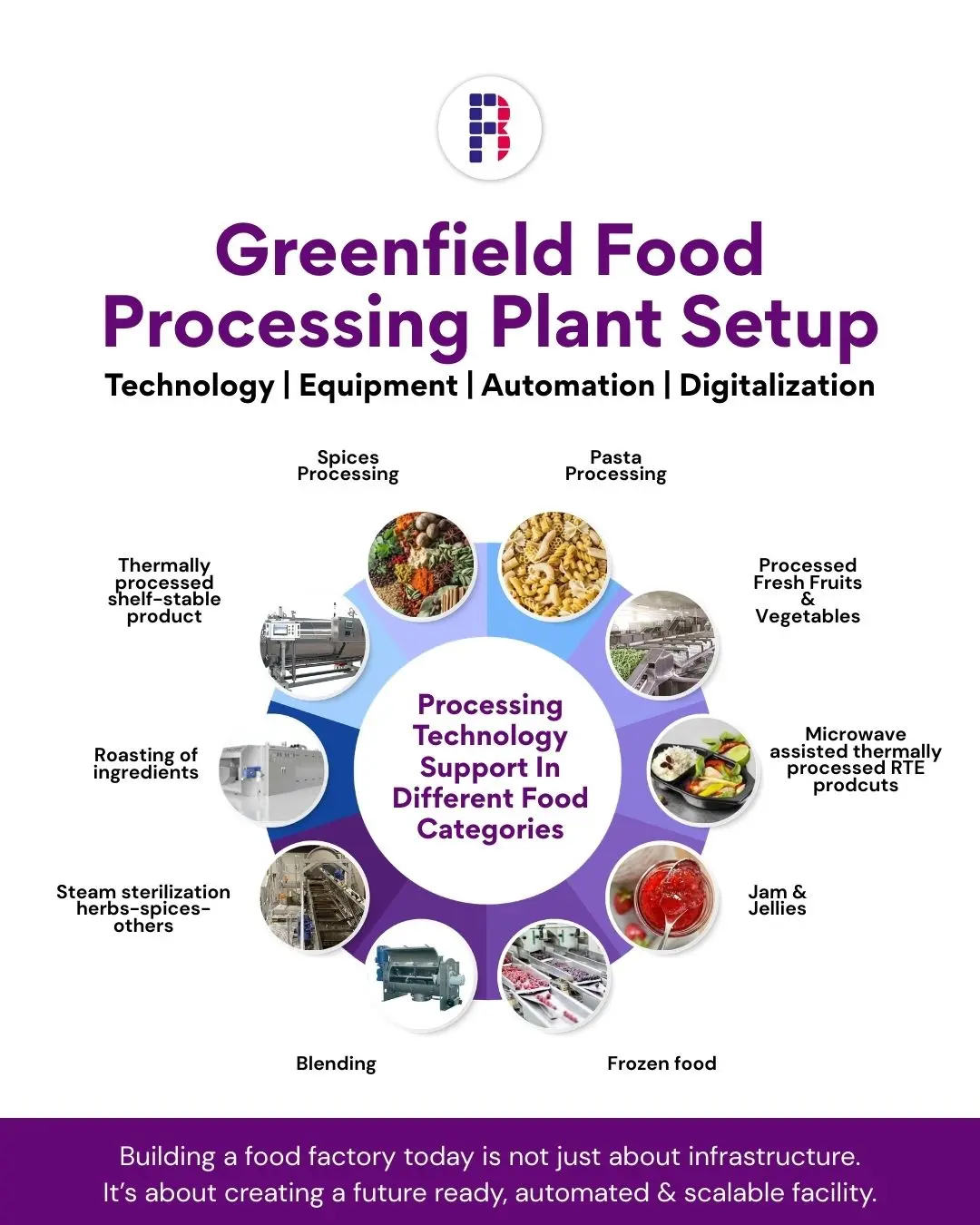
- Spices & dry foods: cleaning, grinding, blending, packaging
- Flour & grains: milling, sieving, storage, bulk handling
- Ready-to-eat foods: cooking, mixing, filling, sterilization
- Dairy & beverages: pasteurization, homogenization, cold chain
- Frozen foods: IQF, freezing tunnels, cold storage
The selection of processing technology depends on:
- Shelf-life requirement
- Moisture sensitivity
- Temperature control needs
- Contamination risk
- Packaging type
B. Production Capacity Planning
Technology selection must match production targets:
- Daily or hourly capacity
- Batch vs continuous processing
- Seasonal demand variation
- SKU variations
Overestimating capacity increases investment and underutilization.
Underestimating capacity creates bottlenecks and future expansion issues.
C. Compliance & Quality Standards
Technology must support compliance requirements such as:
- FSSAI guidelines
- HACCP/ISO standards
- Export compliance (BRC, USFDA etc.)
- Traceability and documentation
Selecting equipment that meets hygiene and audit standards avoids costly future upgrades.
2. Selection of Food Processing Technology
Processing technology defines how efficiently and consistently the product will be manufactured.
A. Conventional vs Advanced Technology
Businesses must choose between:
- Conventional/manual systems
- Semi-automatic processing lines
- Fully automatic PLC-controlled lines
- Smart processing systems with IoT integration
The choice depends on:
- Production scale
- Budget
- Product sensitivity
- Market positioning
High-value or export-oriented products generally require advanced and automated technology.
B. Key Factors for Technology Selection
When selecting processing technology, evaluate:
1. Product Quality Consistency
Technology should ensure:
- Uniform mixing/grinding/cooking
- Controlled temperature & moisture
- Standardized output
2. Yield & Wastage Control
Efficient technology reduces:
- Raw material loss
- Rework
- Over-processing
3. Energy Efficiency
Modern systems are designed to:
- Reduce electricity consumption
- Optimize steam and fuel usage
- Improve sustainability
4. Ease of Cleaning & Maintenance
Food plants must maintain hygiene:
- CIP (Clean-in-Place) systems
- Easy dismantling for cleaning
- Low maintenance downtime
C. Future-Ready Technology
Always select technology that:
- Allows capacity expansion
- Supports new product variants
- Integrates with automation and ERP
- Has upgrade options
Future-ready plants avoid major reinvestment later.
3. Selection of Food Processing Equipment
Equipment is the operational backbone of a food processing plant. The right equipment ensures reliability, hygiene, and long-term performance.
A. Core Equipment Categories
Depending on product type, typical equipment includes:
- Raw material cleaning & grading machines
- Grinding, roasting, mixing systems
- Cooking or processing units
- Conveying & material handling systems
- Filling & packaging machines
- Storage silos and bins
B. Key Parameters for Equipment Selection
1. Capacity & Throughput
Ensure equipment capacity aligns with:
- Production targets
- Peak demand
- Future expansion
Avoid bottlenecks by matching capacities across the process line.
2. Material of Construction
Food-grade materials are critical:
- SS304 for general food applications
- SS316 for corrosive or sensitive products
- Food-grade belts, gaskets, and contact surfaces
3. Hygienic Design
Equipment must support:
- Easy cleaning
- Minimal contamination risk
- Smooth surfaces & proper drainage
- Enclosed processing systems
4. Utility Consumption
Evaluate:
- Power consumption
- Steam requirement
- Water usage
- Compressed air requirement
Energy-efficient equipment reduces operating cost.
5. After-Sales Support & Spares
Vendor selection should consider:
- Service availability
- Spare parts availability
- AMC support
- Response time for breakdown
Reliable support ensures minimal downtime.
C. Vendor Selection Strategy
A structured vendor evaluation process is essential:
- Compare 2–3 suppliers
- Check installed projects
- Visit running plants if possible
- Request machine trials/demos
- Evaluate technical & commercial proposals
Selecting the cheapest machine often leads to higher maintenance and replacement costs later.
4. Role of Automation in Greenfield Food Plants
Automation has become essential for modern food processing facilities. It improves consistency, reduces manpower dependency, and enhances efficiency.
A. Benefits of Automation
Automation enables:
- Consistent product quality
- Reduced manual errors
- Higher production efficiency
- Lower wastage
- Real-time monitoring
- Improved safety
B. Levels of Automation
1. Basic Automation
- Motor controls
- Sensors
- Timers and relays
2. PLC-Based Automation
- Process control panels
- Automated batching
- Temperature & time control
3. SCADA Systems
- Central monitoring
- Real-time data display
- Alarm systems
- Production tracking
4. Fully Integrated Smart Plants
- Machine integration
- ERP connectivity
- IoT-based monitoring
- Remote access dashboards
C. Critical Areas to Automate
Automation should focus on:
- Raw material handling
- Batch processing
- Temperature and process control
- Packaging and coding
- Utility monitoring
- Storage and dispatch
Proper automation reduces dependency on skilled manpower and ensures consistency.
5. Digitalization & Smart Food Factory Concept
Digitalization transforms a traditional plant into a smart, data-driven facility.
A. Digital Tools for Food Plants
Modern food plants use:
- ERP systems for production & inventory
- Batch tracking systems
- SCADA dashboards
- OEE (Overall Equipment Efficiency) monitoring
- Preventive maintenance software
- Quality data recording systems
B. Benefits of Digitalization
Digital systems help track:
- Production efficiency
- Machine downtime
- Material consumption
- Quality deviations
- Utility usage
- Maintenance schedules
This enables better decision-making and cost control.
C. Traceability & Compliance
Digitalization supports:
- Batch-wise traceability
- Recall readiness
- Audit documentation
- Quality records
- Compliance reporting
Traceability is especially critical for export-oriented food businesses.
6. Integration of Technology, Equipment & Automation
The success of a greenfield project depends on how well all systems are integrated.
Key integration areas:
- Smooth material flow between machines
- PLC connectivity across the line
- Central monitoring dashboard
- Utility integration with production
- Data connectivity with ERP
A well-integrated plant ensures:
- Higher efficiency
- Lower downtime
- Better monitoring
- Easy scalability
7. Common Mistakes to Avoid
Many greenfield projects face challenges due to poor technology decisions.
Avoid these common mistakes:
- Selecting machines only based on price
- Ignoring future expansion
- Over-automation or under-automation
- Poor layout integration
- No digital tracking systems
- Choosing vendors without service support
- Not considering maintenance and spare parts
Correct planning at the beginning saves significant cost later.
8. Importance of Expert Guidance: How Beyzon Foodtek Can Help
Technology selection and automation planning require technical expertise and industry experience.
Beyzon Foodtek provides end-to-end support for setting up modern and efficient greenfield food processing plants. We assist businesses in selecting the right processing technology, finalizing suitable food processing equipment, and planning automation and digital systems aligned with production and compliance requirements.
Our team works closely with clients to evaluate machinery vendors, design optimized plant layouts, integrate PLC/SCADA-based automation, and implement digital monitoring systems for better control and efficiency. We ensure that every plant is scalable, compliant, and future-ready.
From technology planning to execution support, Beyzon Foodtek helps food businesses build smart manufacturing facilities that deliver consistent quality, operational efficiency, and long-term growth.
Conclusion
A successful greenfield food processing plant is built on the foundation of:
- Right technology
- Reliable equipment
- Smart automation
- Strong digital systems
Investing in the right systems from day one ensures:
- Consistent product quality
- Efficient operations
- Compliance readiness
- Scalable growth
- Long-term profitability
In today’s competitive food industry, businesses that adopt advanced technology and digitalization early gain a strong operational advantage and sustainable growth.
FAQs
How should technology selection begin in a greenfield food project?
With a clear understanding of product requirements, capacity targets, and compliance needs.
Is full automation necessary in all food plants?
No. Automation levels should match production volume, hygiene sensitivity, and labour economics.
Why is digitalization important from the start?
Early digital adoption improves traceability, control, and scalability while reducing retrofit costs.
How can technology risks be minimised?
Through feasibility studies, vendor evaluation, trials, and phased implementation.
Who should be involved in technology selection decisions?
Operations, quality, engineering, finance, and compliance teams should all be involved.