Introduction
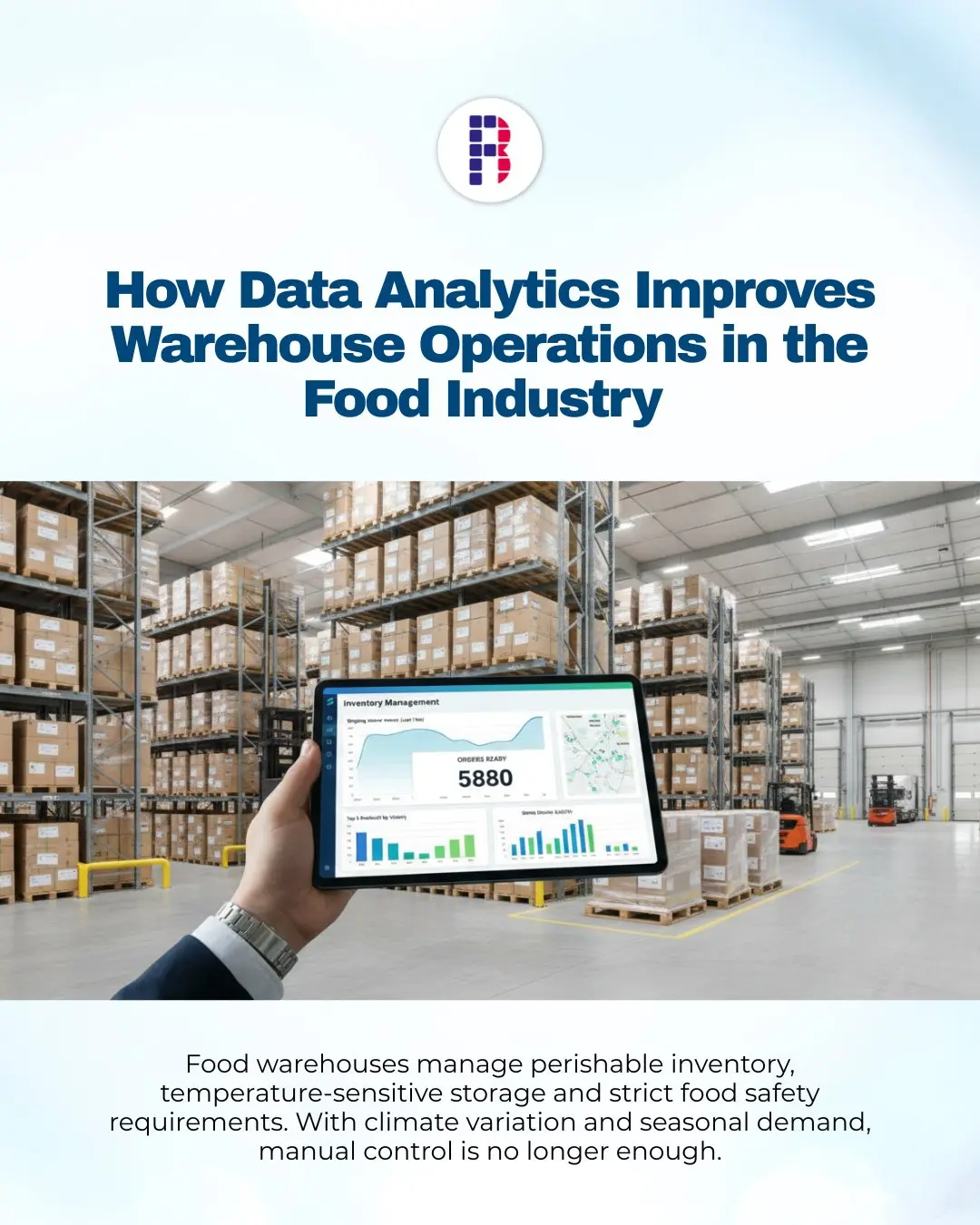
Warehouse operations in the food industry involve managing perishable products, temperature-sensitive storage, and strict food safety requirements. In regions with diverse climatic conditions and seasonal demand patterns, maintaining product quality while minimizing losses is a major operational challenge.
With regulatory authorities such as FSSAI emphasizing hygiene, traceability, and proper storage practices, food businesses can no longer rely on manual processes or static reports. Data analytics enables warehouses to gain real-time visibility, improve compliance, and drive efficiency across the supply chain.
Understanding Data Analytics in Food Warehousing
Data analytics in food warehousing refers to the collection and analysis of operational data generated during receiving, storage, handling, and dispatch activities. This includes inventory levels, batch numbers, expiry dates, storage conditions, and order movement data.
Analytics supports decision-making at three levels:
- Descriptive analytics – Reviewing historical performance such as wastage, stock ageing, and turnover
- Predictive analytics – Forecasting demand and identifying potential risks
- Prescriptive analytics – Recommending actions to optimize inventory, storage, and dispatch
When integrated with WMS, ERP systems, and digital compliance records, analytics becomes a foundation for efficient warehouse operations.
Key Challenges in Food Warehouse Operations
Food warehouses commonly face the following challenges:
- High risk of spoilage and expiry-related losses
- Inconsistent cold storage and temperature control
- Manual inventory tracking and limited visibility
- Complex FIFO and FEFO implementation
- Compliance with food safety and storage regulations
- Demand fluctuations driven by seasonality and market trends
These challenges highlight the need for data-driven warehouse management.
How Data Analytics Improves Warehouse Operations
- Inventory Control with FIFO and FEFO
Food safety guidelines require systematic stock rotation to prevent the sale of expired or near-expiry products. Data analytics enables real-time tracking of batch numbers, manufacturing dates, expiry dates, and inward movement of goods.
Automated FIFO (First-In-First-Out) and FEFO (First-Expiry-First-Out) logic ensures that stock is issued in the correct sequence without manual intervention. This reduces dependency on human judgment, minimizes handling errors, and ensures consistent adherence to food safety norms. Over time, it also improves inventory turnover and reduces write-offs caused by expired stock.
- Demand Forecasting and Stock Planning
By analysing historical sales data, seasonal trends, promotions, and consumption patterns, data analytics helps forecast demand more accurately. This allows warehouses to maintain optimal inventory levels, avoiding both excess stock and stock-outs.
Improved forecasting enables better coordination between procurement, production, and distribution teams. It also supports smarter reorder planning, shorter lead times, and improved supplier collaboration—resulting in a more balanced and responsive supply chain.
- Reduction in Food Wastage and Spoilage
Analytics plays a critical role in identifying slow-moving items, excess inventory, and storage inefficiencies at an early stage. By continuously monitoring shelf life, stock ageing, and movement velocity, warehouses can take timely corrective actions such as redistribution to high-demand locations, promotional clearances, or reprocessing where permitted.
This proactive approach not only reduces food losses but also improves margin control, sustainability performance, and regulatory compliance related to waste management.
- Optimised Warehouse Space Utilisation
Data analytics helps design efficient warehouse layouts by analysing product movement frequency, storage requirements, and handling patterns. Fast-moving SKUs can be positioned closer to dispatch areas, while long-shelf-life or low-velocity items are stored in secondary locations.
In temperature-controlled warehouses, analytics ensures optimal utilisation of cold storage capacity, reducing energy consumption and operational costs. Better space utilisation also supports scalability without immediate infrastructure expansion.
- Faster and More Accurate Order Fulfillment
Order processing and picking data provide valuable insights into operational bottlenecks, picking accuracy, and dispatch timelines. Analytics helps optimise picking routes, balance workloads, and reduce travel time within the warehouse.
As a result, order fulfillment becomes faster and more accurate, with fewer picking errors and returns. Improved service levels directly enhance customer satisfaction, strengthen distributor relationships, and support brand reliability.
- Strengthened Traceability and Compliance
Food safety regulations mandate detailed record-keeping and full traceability across the supply chain. Data analytics enables end-to-end, batch-wise tracking of products from inward receipt through storage, processing, and outward dispatch.
In the event of a quality deviation, customer complaint, or product recall, analytics allows warehouses to quickly identify affected batches, quantities, storage locations, and distribution channels. This ensures faster response, reduced business risk, and improved audit readiness.
Additionally, analytics supports the generation of digital records for inspections, internal audits, and regulatory reporting, reducing manual effort and improving data accuracy.
Role of Data Analytics in Cold Chain Management
Cold chain compliance is critical for dairy, frozen foods, seafood, meat, and ready-to-eat products. Analytics integrated with temperature and humidity sensors enables continuous monitoring of storage conditions.
Automated alerts help warehouse teams respond immediately to deviations, preventing quality deterioration and supporting compliance requirements.
Technology Enablers for Data-Driven Warehousing
Modern food warehouses rely on a combination of technologies, including:
- Warehouse Management Systems (WMS)
- ERP platforms integrated with compliance documentation
- IoT sensors for environmental monitoring
- Barcode and RFID systems for batch tracking
- Business Intelligence dashboards for reporting and analysis
Together, these tools create a centralized and transparent operational ecosystem.
Business Benefits of Data-Driven Warehouse Operations
Implementing analytics-driven warehouse management delivers measurable benefits:
- Reduced wastage and inventory losses
- Improved food safety compliance and audit readiness
- Lower operational and storage costs
- Higher order accuracy and service levels
- Better strategic and operational decision-making
How Beyzon Foodtek Pvt. Ltd. Supports Packaging Optimization
To improve finished goods inventory control and warehouse performance, a structured, data-driven approach is essential. At Beyzon Foodtek Pvt. Ltd., we support food manufacturers through the following focus areas:
- Assessment of FG inventory levels, ageing, ABC & SLOB analysis
- Inventory movement, volume handling & truck turnaround time (T-TAT) analysis
- Manpower mapping and time & motion study for loading/unloading
- Warehouse process optimisation to improve throughput and efficiency
- Warehouse mechanisation study, URS preparation & vendor finalisation
- Support in WMS implementation and system adoption
Conclusion
Data analytics is reshaping how food warehouses operate, shifting them from reactive environments into controlled, insight-driven systems. By improving inventory accuracy, strengthening environmental control, reducing damage, enhancing traceability, and supporting audit readiness, analytics addresses both efficiency and food safety objectives.
For food manufacturers, the real value of analytics lies not in dashboards but in better decisions, faster responses, and more stable operations. When data is used consistently and aligned with people and processes, warehouses become resilient links in the food supply chain rather than hidden risk zones and Beyzon Foodtek Pvt. Ltd. supports this shift by helping teams turn warehouse data into practical SOPs, measurable controls, and day-to-day operational discipline.
FAQs
How does data analytics improve food warehouse efficiency?
By identifying patterns in inventory movement, handling losses, and dispatch delays, analytics helps teams address root causes rather than symptoms.
Can analytics help reduce expiry-related losses?
Yes. Analysing ageing stock, dispatch patterns, and FEFO compliance allows proactive stock rotation and better planning.
Is data analytics only useful in large warehouses?
No. Even mid-sized warehouses benefit from analysing temperature trends, inventory accuracy, and handling data to improve control.
Does data analytics replace manual warehouse checks?
It complements them. Analytics highlights where attention is needed, while physical checks validate conditions on the ground.
How often should warehouse data be reviewed?
Operational data is most effective when reviewed daily or weekly, with deeper trend reviews conducted monthly or quarterly.