
Design & Build of a Food Factory
Establishing a greenfield manufacturing facility is one of the most ambitious and impactful steps a food processing company can take.
For Beyzon Foodtek, a pioneer in turnkey food processing projects and hygienic automation solutions, planning such a facility is not just about laying bricks and mortar- it’s about shaping the future of food technology.
With a chance to build from the ground up, greenfield facilities offer unmatched freedom in design, efficiency, and innovation.
This comprehensive guide outlines the critical factors to consider when planning a greenfield manufacturing facility, specifically in the context of the food and beverage sector.
From site selection to sustainability, and automation to compliance, each step plays a pivotal role in ensuring long-term success.
1. Strategic Site Selection
- Location and Logistics
Selecting the right location is foundational. The ideal site balances proximity to raw material sources, distribution hubs, and key markets.
In the food industry, time-sensitive logistics are paramount- being close to suppliers and consumers can reduce transportation costs, ensure product freshness, and enhance overall efficiency. - Infrastructure Access
The chosen site must have access to essential infrastructure: roads, railways, ports, and air transport for global reach.
Additionally, availability of utilities like clean water, uninterrupted electricity, natural gas, and waste management services is crucial.
- Workforce Availability
Access to a trained and semi-skilled workforce is another critical factor. Food manufacturing often requires staff familiar with hygiene protocols, machine operation, and safety standards. Consider the proximity to vocational institutes and training centers. - Regulatory and Environmental Factors
Study the local regulations regarding zoning, emissions, water usage, and waste disposal. Environmental impact assessments (EIAs) are mandatory in many regions and help avoid long-term legal and reputational risks. - Government Incentives
Many states and countries offer financial incentives to attract manufacturing investments. These may include tax holidays, subsidized land rates, grants, and easier compliance norms. Research and negotiate to optimize the financial viability of your site.

2. Facility Design and Layout
- Process Flow Optimization
A greenfield facility gives you a clean slate to implement lean manufacturing principles.
Any new greenfield project has phase wise implementation. Considering this aspect it is necessary to first work out the masterplan identifying various units taking into account capacity expansions and future product additions.The plant layout should reflect logical flow- from raw material, packaging material and semi finished goods intake to processing, packaging, and dispatch. The plant layout should ensure the adequate passages (3 meter in width) for material and man movement. This reduces bottlenecks, minimizes waste, and improves productivity.Also the manpower movement should be isolated from the materials movement.
- Zoning for Hygiene and Safety
In the food industry, hygienic zoning is crucial. Areas should be clearly demarcated based on contamination risk levels.
High-care zones must be physically separated from low-risk zones, with air handling, drainage, and personnel access managed accordingly.
- Future-Proofing
Design with scalability in mind. The facility should allow for future expansion, whether it involves increasing capacity, adding new product lines, or integrating new technologies.
Modular construction techniques can be especially helpful here. - Ergonomics and Work Safety
Create workspaces that support human efficiency and safety. Include ample lighting (500 – 550 lux level depending on the work being carried out), ventilated areas, ergonomic equipment, and clearly marked evacuation routes.
Automation should enhance, not replace, human roles. - Aesthetics and Branding
The external design of your facility plays a role in brand perception. For a company like Beyzon Foodtek, the facility itself should be a showcase of technological prowess and environmental responsibility.
3. Technological Integration and Automation

- Smart Manufacturing
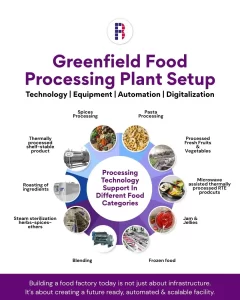
Industry 4.0 technologies, including IIOT (Industrial Internet of Things), AI (Artificial Intelligence), and ML (Machine Learning), should be part of the initial design. AI Power vision monitoring enables predictive maintenance, reduces downtime, and improves efficiency. - Automation for Precision
Integrating automation in food processing can significantly reduce human error, increase throughput, and ensure consistent quality.
From robotic arms to automated conveyor systems and smart packaging solutions, automation is no longer optional- it’s a competitive necessity. - SCADA and MES Systems
Supervisory Control and Data Acquisition (SCADA) systems and Manufacturing Execution Systems (MES) are essential for real-time data collection and decision-making.
These systems offer traceability, control, and analytics, all vital in food safety compliance. - Digital Twin Technology
A digital twin- a virtual replica of the facility- can help simulate different scenarios, optimize design, and detect flaws before construction.
This dramatically reduces costly errors during execution.
4. Regulatory Compliance and Food Safety
- Local and Global Standards
Your facility must comply with regional food safety standards like FSSAI (India), FDA (USA), and international certifications like HACCP, ISO 22000, and BRC.
From the start, ensure your design and operational plans align with these regulations. - Sanitation and Clean-in-Place (CIP) Systems
Incorporate CIP systems to clean processing equipment without disassembly. This saves time, reduces chemical usage, and ensures high sanitation standards. - Traceability and Documentation
Implement barcode systems, batch coding, and ERP integration to ensure end-to-end traceability. In the case of recalls or audits, documentation must be readily available and accurate. - Employee Training and SOPs
Food safety isn’t just about machines- it’s about people. Develop detailed standard operating procedures (SOPs) and invest in training programs to ensure employees understand hygiene protocols, emergency response, and handling of machinery.
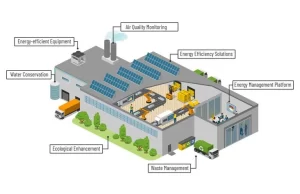
5. Sustainability and Environmental Responsibility
- Energy-Efficient Design
Design for natural lighting, efficient HVAC systems, and insulation. Choose energy-efficient motors, pumps, and variable frequency drives (VFDs).
Consider solar panels, biomass boilers, or wind turbines for renewable energy sourcing. - Water Management
In food processing, water is both a resource and a potential pollutant. Install systems for water reuse, rainwater harvesting, and effluent treatment.
A zero-liquid discharge (ZLD) policy can help meet stringent environmental regulations. - Waste Minimization
Plan for waste segregation and recycling from the outset. Organic waste can be converted into compost or bioenergy.
Packaging waste can be reduced through sustainable alternatives or take-back programs. - Green Building Certifications
Pursue green certifications such as LEED (Leadership in Energy and Environmental Design) or IGBC (Indian Green Building Council) or CII Greenco rating system.
These not only reduce your carbon footprint but also enhance brand reputation.

6. Project Management and Execution Strategy
- Feasibility Study
Begin with a thorough feasibility study that includes financial modeling, ROI calculations, and risk assessments. This step helps in aligning stakeholder expectations and justifying capital investment. - Partner Selection
Choose experienced design and construction partners. Beyzon Foodtek’s own expertise in providing turnkey solutions and project execution of green field projects can be invaluable here. - Project Timeline and Milestones
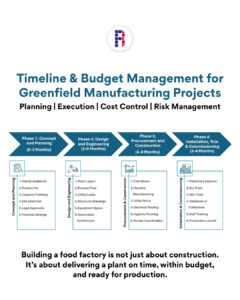
Break down the project into phases with clear milestones: site acquisition, design finalization, procurement, construction, equipment installation, trial runs, and commissioning. - Budget and Cost Control
Allocate a realistic budget with contingencies for unforeseen expenses. Use project management tools to track costs, timelines, and vendor deliverables. - Risk Management
Identify potential risks- from supply chain disruptions to regulatory delays- and develop mitigation strategies. A dedicated risk officer or team can be a strategic asset.
7. Supply Chain and Vendor Management
- Local Sourcing
Where possible, source materials and equipment locally. This not only reduces lead times but also builds goodwill in the community. - Cold Chain Infrastructure
For perishable goods, design for cold chain storage and transport. Integrated cold rooms, blast freezers, and refrigerated trucks should be part of the planning. - Inventory Management Systems
Use digital inventory systems to monitor stock levels, forecast demand, and automate reordering. This reduces wastage and ensures uninterrupted operations.

Let’s Conclude
Building a greenfield manufacturing facility is a milestone moment- a rare opportunity to redefine your company’s future without legacy constraints.
For a visionary organization like Beyzon Foodtek, this is not just a construction project but a strategic investment in innovation, efficiency, and sustainability.
By focusing on strategic location, smart technology, regulatory compliance, and green practices, companies can build world-class facilities that meet today’s standards and are ready for tomorrow’s challenges.
With the right planning and execution, your greenfield facility can become a model factory which is efficient, scalable, compliant, and future-ready.
FAQ’s
1. What is a greenfield manufacturing facility?
A greenfield manufacturing facility is a new plant built from scratch on previously undeveloped land. It allows complete control over layout, technology, and infrastructure.
2. How long does it typically take to build a greenfield plant?
The timeline varies based on complexity, but it generally takes 9 to 18 months from planning to commissioning.
3. What are the major cost components of a greenfield facility?
Key cost areas include land acquisition, construction, machinery and equipment, utilities setup, regulatory compliances, and operator training.
4. Why is hygiene zoning important in food manufacturing?
Hygiene zoning prevents cross-contamination by separating high-risk and low-risk areas, ensuring food safety and compliance with regulations.
5. How can sustainability be integrated into the facility design?
By using renewable energy, efficient water and waste systems, green building materials, and seeking eco-certifications like LEED or IGBC.