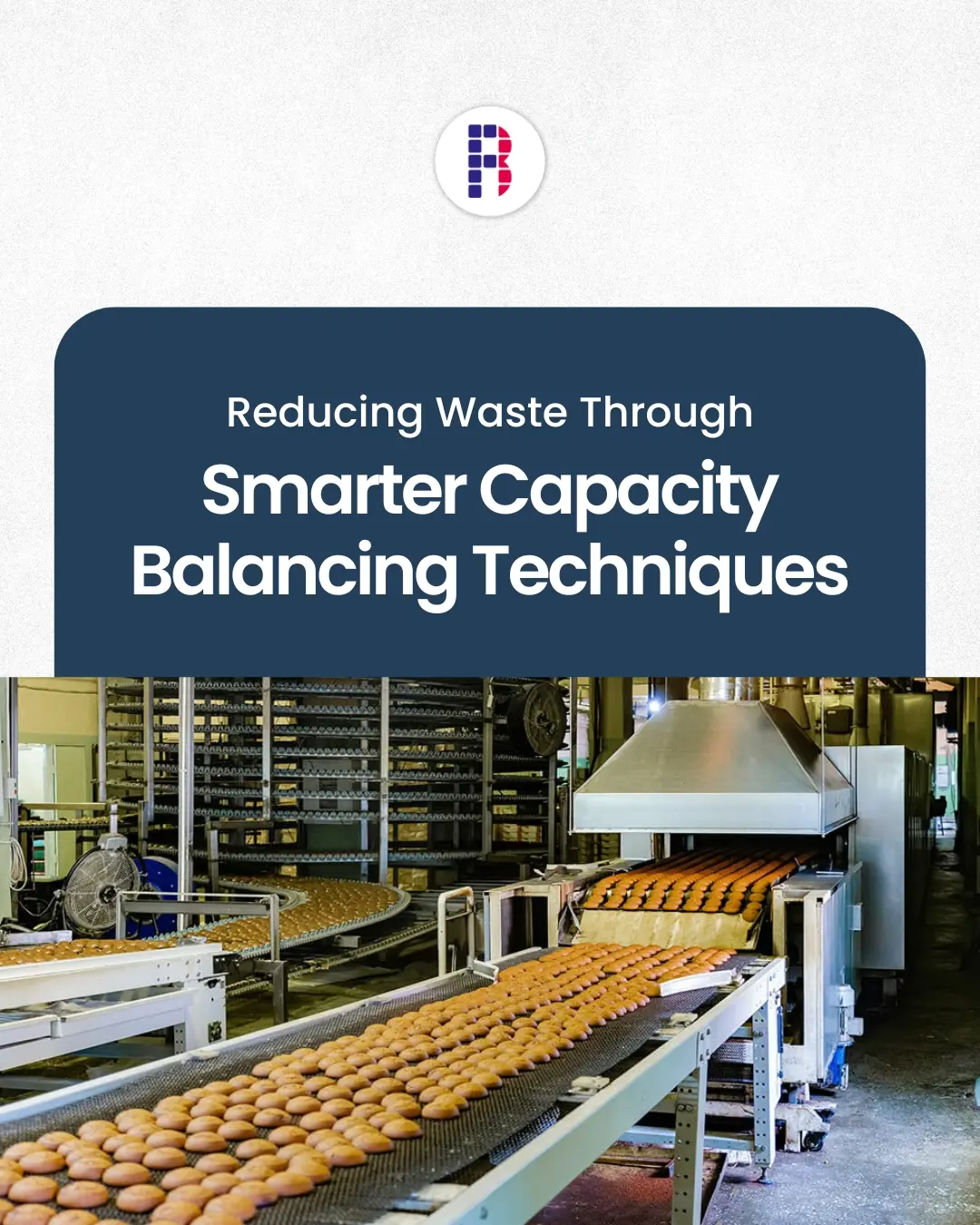
In food manufacturing, waste is often the silent drain on profitability and resources. When production stages are not in sync—when one process outpaces another, or equipment sits idle—waste manifests in many forms: raw materials spoiling, rework, energy losses, and excess labor idle time. Smarter capacity balancing techniques are a powerful strategy for minimizing these losses.
Beyzon Foodtek specializes in project execution, automation, digitalization, operations excellence, and food-safety interventions, capacity balancing is not just a technical exercise—it is a strategic lever linking quality, cost, and sustainability. Whether designing a greenfield plant or realigning an operating facility, applying capacity balancing techniques can significantly reduce waste and boost throughput.
Recognizing the Cost of Waste
Globally, inefficiencies in the production pipeline contribute heavily to waste. Studies estimate that up to one-third of all food produced is lost or wasted along the value chain—from farm to processing and distribution to consumption. (source – https://www.wri.org/insights/how-much-food-does-the-world-waste)
This reflects losses in raw materials, energy, and labor costs that never translate into saleable products.
Within manufacturing itself, unbalanced operations worsen the problem. When upstream steps produce faster than downstream processes can handle, intermediate inventory builds up, increasing risks of spoilage or quality degradation. When downstream processes lag, upstream machines may run idle, wasting capacity and energy. Addressing this misalignment can reclaim value that otherwise trickles away invisibly.
Mapping Capacity Imbalance
The first step toward smarter balancing is a diagnosis: mapping each stage’s capacity, identifying bottlenecks, and spotting underutilized equipment. Using real-time data from sensors and performance dashboards—part of the digitalization services offered by Beyzon Foodtek—plant managers can see precisely where production flow constraints are emerging.
For example, a mixing station might deliver at 10 tons/hour, but the cooking or forming line might reliably handle only 8 tons/hour. The mismatch will cause backlog or force mixers to slow down periodically, leading to idle energy and labor. By capturing cycle times, uptime, throughput, and variances, one can compute where imbalances lie.
Synchronizing Throughput Across Stages
Once imbalances are identified, the goal is to synchronize throughput across successive stages so that no process starves or overflows. That requires adjusting process speeds, buffer sizes, and workflows. In some cases, mechanical modifications or adding parallel lines may be justified, but often synchronization can be achieved through better staging logic, controlled buffers, or pacing mechanisms.
In this endeavor, Beyzon’s expertise in mechanisation, automation, and operations excellence plays a vital role. Automated feeders, synchronized conveyors, and modular buffer zones ensure smoother handoffs between processes. The result is less waiting, less intermediate storage, and less risk of spoilage or overprocessing.
Predictive Adjustments via Digital Tools
Capacity balancing cannot be static. As demand shifts, raw material quality varies, or machines age, the equilibrium point changes. This is where predictive digital tools become indispensable. Beyzon’s automation framework often embeds IoT sensors and dashboards that continuously monitor throughput, cycle time, downtime, and buffer levels.
With these metrics streaming live, operators can detect deviations—say a downstream slow-down—and adjust upstream speed or buffer allocations before waste accumulates. In one industry benchmark, adopting predictive capacity monitoring helped reduce unplanned downtime by 25 percent and decrease product waste by 18 percent relative to conventional operations. (source – https://www.jmco.com/articles/manufacturing/strategies-to-improve-productivity)
Balancing Capacity During Scale-Up
When facilities plan for expansion (scale-up), misalignments become more pronounced if not designed carefully. Simply increasing the throughput of one station without proportionally upgrading others often results in new bottlenecks, new idle times, and fresh waste.
Beyzon Foodtek’s capacity balancing and scale-up service models potential throughput scenarios using simulation software. Before new machines are installed, these models simulate how increased input would cascade through processing, packaging, and auxiliary systems. This helps ensure that added capacity complements existing workflows and avoids creating new inefficiencies.
In a real-world project, this approach enabled a facility to increase production by 30 percent while keeping resource consumption increases under 10 percent—delivering waste reduction and improved yield alongside growth.
Integrating Maintenance and Downtime Planning
Even a well-balanced plant falters when unplanned maintenance or breakdowns disrupt the flow. Idle machines upstream or downstream throw the entire chain out of sync, leading to excess waste or lost throughput. To counter this, maintenance planning must align with capacity strategy.
Beyzon’s operations management and excellence service incorporates metrics such as Mean Time Between Failures (MTBF) and Mean Time To Repair (MTTR) into production schedules so that preventive maintenance is timed during buffer slack or low-demand periods. This alignment ensures that capacity balancing remains robust even during maintenance windows.
Waste Reduction in All Dimensions
Capacity balancing helps reduce multiple types of waste. Material waste drops because overprocessing, spoilage, or rework are minimized. Energy waste falls because machines are used more consistently rather than in bursts. Labor waste decreases as staffing can be leveled rather than varying wildly around bottlenecks. Even space waste is reduced, since fewer large storerooms are needed for intermediate buffers.
Given that up to one-third of food is lost/wasted along the value chain, addressing waste in the manufacturing stage—which constitutes a meaningful portion of that loss—becomes essential to both profitability and sustainability.
Building a Culture of Adjustment
Smarter capacity balancing is not a one-time fix—rather, it must become part of how the plant operates. That means instituting regular reviews, cross-functional coordination, and continuous improvement habits. Production, maintenance, engineering, and supply chain teams should jointly monitor system metrics, flag emerging imbalance, and test minor adjustments before they escalate.
Beyzon Foodtek supports such a culture via periodic operations audits, digital dashboards, and change-management interventions. By democratizing performance data and emphasizing shared responsibility, teams become aligned to reduce waste proactively rather than reactively.
Final Thoughts
Reducing waste in a food manufacturing facility is not solely a matter of better recipes or improved material logistics—it is fundamentally a question of how well processes are balanced. Smarter capacity balancing aligns throughput across all stages, minimizing idle time, spoilage, rework, and energy inefficiency.
With its deep expertise across project execution, automation, digitalization, operations excellence, and cost control, Beyzon Foodtek helps food manufacturers embed capacity balance not only into plant design but into day-to-day operations. The result is a leaner, more resilient, and more sustainable production environment.
FAQs
Q. What is capacity balancing, and why does it matter?
Capacity balancing means aligning the throughput of every production stage so none starve or flood. When done well, it prevents bottlenecks and idle time, cutting waste in raw materials, energy, and labor.
Q.Can capacity balancing benefit existing facilities (brownfield)?
Absolutely. Even in older or complex plants, realigning speeds, buffers, or workflows can reclaim lost capacity without requiring full rebuilds.
Q. How frequently should you revisit capacity balance?
Teams should review monthly or quarterly, but digital tools can continuously flag deviations in real time for proactive adjustment.
Q. Is capacity balancing feasible during expansion?
Yes, with careful modeling. Scaling must be holistic. Beyzon’s scale-up services run simulations to ensure added capacity fits smoothly into the existing chain.
Q. How does Beyzon support capacity balancing?
Beyzon offers services in mechanization, automation, digitalization, operations excellence, and capacity scaling—linking them to create a balanced, low-waste production system.