A greenfield manufacturing project can define the long-term success of a business. However, many food manufacturing plant setups face delays, cost overruns, and execution gaps due to inadequate project planning and poor cross-functional coordination.
Effective timeline and budget management in greenfield manufacturing projects requires structured alignment between planning, engineering, procurement, construction, and commissioning teams. From land development to commercial production, every phase directly impacts project schedule, capital expenditure, and overall financial performance
In the food processing industry, delays and uncontrolled spending can significantly affect return on investment (ROI), working capital cycles, and speed to market. Without a structured project execution strategy, even well-funded manufacturing projects can struggle with extended timelines and escalating costs.
Strong governance, milestone-based monitoring, and financial oversight enable businesses to control project risks, minimize rework, and prevent cost escalation. Integrating schedule management and budget control mechanisms from the early planning stage is essential for delivering a manufacturing facility on time and within approved capital limits.
This blog outlines practical strategies for timeline management, budget control, and risk mitigation in greenfield manufacturing projects, with specific insights for food industry plant development.
A. Understanding the Typical Timeline of a Greenfield Manufacturing Project
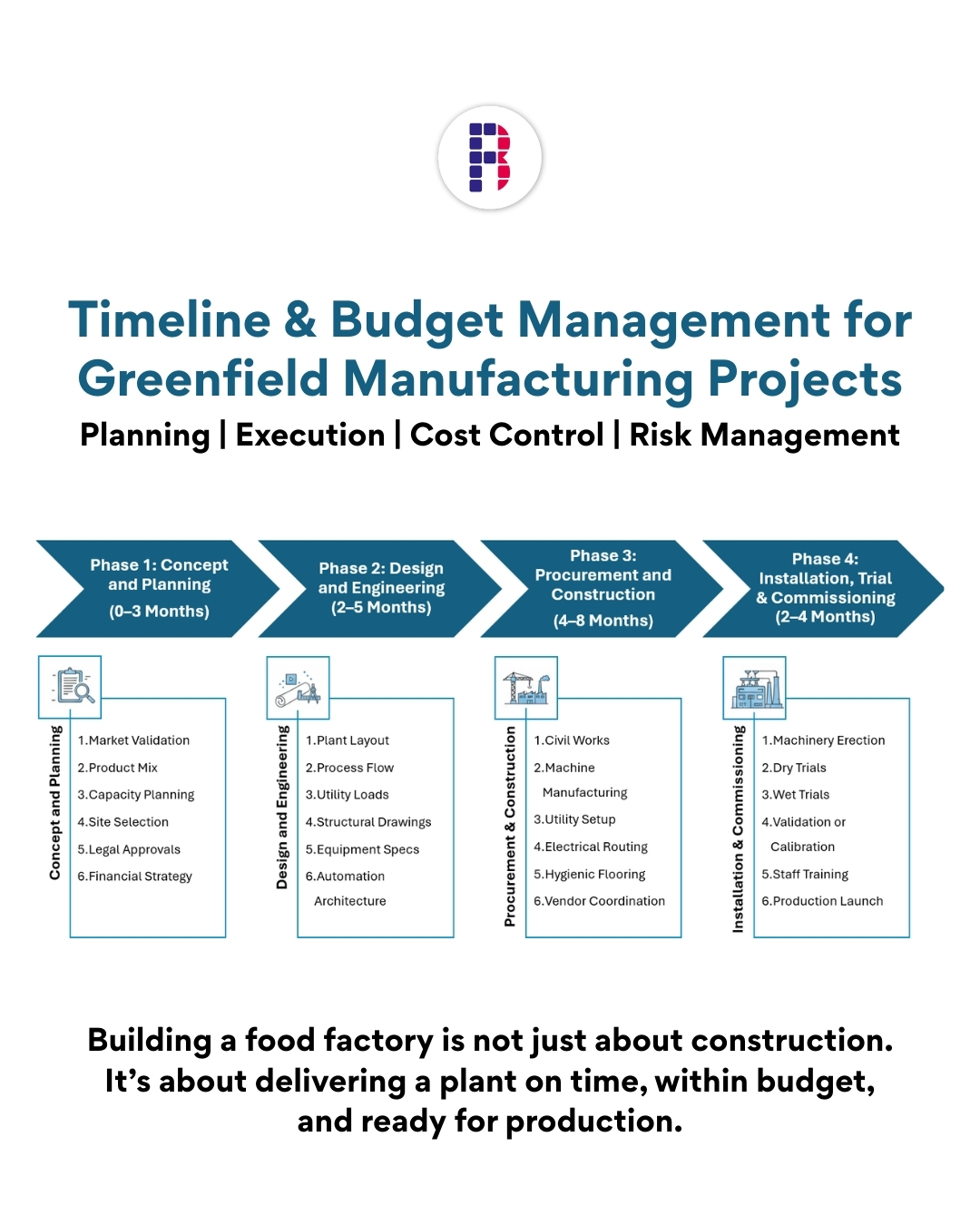
A well planned food manufacturing project generally progresses through four structured phases.
Phase 1: Concept and Planning (0–3 Months)
This is the foundation stage. Decisions taken here directly impact cost and execution speed.
Key activities include:
- Feasibility validation
- Product mix finalization
- Capacity planning
- Land selection and site evaluation
- Statutory approval identification
- Preliminary financial planning
Any delay in land finalization or unclear capacity planning can shift the entire schedule forward.
Phase 2: Design and Engineering (2–5 Months)
Once the project is approved, detailed engineering begins.
Activities include:
- Master plant layout freezing
- Process flow finalization
- Utility load calculation
- Civil structural drawings
- Equipment technical specifications
- Automation architecture planning
This stage must be tightly controlled. Frequent design changes during this phase lead to cost escalation and downstream delays.
Phase 3: Procurement and Construction (4–8 Months)
This is the capital heavy stage where real execution begins.
Major tasks include:
- Civil construction
- Machinery manufacturing and dispatch
- Utility installation such as boiler, refrigeration and ETP systems
- Electrical panels and cable routing
- Hygienic floor finishing
Coordination between civil contractors and equipment vendors is critical. Misalignment here often results in rework and timeline slippage.
Phase 4: Installation, Trial and Commissioning (2–4 Months)
This is the final stage before commercial production.
It includes:
- Machinery erection and alignment
- Dry trials
- Wet trials
- Calibration and validation
- Staff training
- Commercial production launch
Proper commissioning planning can significantly reduce ramp up time.
B. Why Greenfield Projects Get Delayed
Even well funded projects experience delays due to preventable mistakes.
In most Greenfield manufacturing projects, delays are not caused by lack of funds but by execution gaps. Poor coordination, unclear scope definition, delayed approvals, and weak monitoring systems often disrupt carefully planned schedules.
Since multiple stakeholders such as civil contractors, machinery suppliers, consultants, and regulatory authorities are involved, even minor misalignment can lead to significant timeline slippage. These delays increase interest burden, postpone revenue generation, and affect overall project profitability.
Common causes include:
- Scope changes during execution
- Slow decision making from management
- Vendor coordination issues
- Regulatory approval delays
- Imported equipment delivery uncertainties
Proper commissioning planning can significantly reduce ramp up time.
C. Understanding the Budget Structure of a Greenfield Project
Budgeting for a Greenfield manufacturing project must go beyond a rough capital expenditure estimate. A structured and detailed cost framework ensures financial clarity, prevents underestimation, and supports accurate return on investment projections.
A well planned budget is typically divided into three major components:
- Capital Expenditure
- Pre Operative Expenses
- Working Capital Buffer
Each component plays a critical role in overall project success.
1.Capital Expenditure
Capital Expenditure represents the core investment required to build and operationalize the manufacturing facility. This is the largest portion of the project budget and must be carefully planned with realistic cost assumptions.
Typical allocation may include:
- Land and site development – 10 to 20 %
- Civil construction – 20 to 30 %
- Plant and machinery – 30 to 40 %
- Utilities – 10 to 15 %
- Electrical and automation – 5 to 10 %
Machinery and civil construction together often account for 60 to 70 percent of the total project cost, making technical specification accuracy and vendor selection extremely important.
Underestimation in this category can significantly impact funding requirements and repayment planning.
2. Pre Operative Expenses
Pre Operative Expenses are frequently underestimated but have a direct impact on project viability. These costs are incurred before commercial production begins and must be factored into total project investment.
They typically include:
- Consultancy and design fees
- Approval charges and statutory compliance expenses
- Interest during construction
- Recruitment and training costs
- Trial production and stabilization expenses
Ignoring or under budgeting these elements can distort financial projections and lead to inaccurate ROI calculations.
Proper financial planning must incorporate these costs to avoid funding gaps during the execution phase.
3. Working Capital Buffer
While capital expenditure builds the facility, working capital sustains operations until the business reaches break even.
Before revenue stabilizes, the plant requires funding for:
- Raw material stock
- Packaging materials
- Initial salaries and operational manpower
- Utility deposits and recurring expenses
- Distribution and logistics costs
Many projects struggle not due to capital expenditure shortage but due to inadequate working capital planning.
A realistic working capital buffer ensures smooth operational ramp up and reduces financial stress during the early months of production.
D. Major Causes of Budget Overruns
Budget overruns are one of the most critical risks in industrial and greenfield projects. They usually arise from planning gaps, scope changes, technical miscalculations, market fluctuations, and regulatory adjustments during execution. Even small deviations from the approved budget can significantly affect overall project feasibility, cash flow planning, return on investment (ROI), and payback period. Therefore, identifying potential cost escalation factors at the planning stage and building financial contingencies is essential for sustainable project execution.
Cost overruns typically occur due to:
- Incomplete technical specifications during vendor selection
- Underestimated utility loads
- Civil rework due to layout changes
- Foreign exchange fluctuations
- Delay related overhead costs
- Unplanned compliance upgrades
Even a ten percent budget escalation can significantly alter profitability projections.
E. Practical Strategies for Timeline Management
Timely project completion is critical to controlling costs, preventing revenue loss, and maintaining stakeholder confidence. Delays not only increase overhead expenses but may also impact market launch plans and profitability. Effective timeline management requires proactive planning, coordination among all stakeholders, and continuous monitoring. A disciplined approach ensures that dependencies are managed, risks are anticipated, and corrective actions are implemented without waiting for major deviations.
1. Clear Milestone Definition
Clearly defined milestones break the project into measurable phases, making progress easier to track and control. Monthly or stage-wise targets improve visibility and assign responsibility to specific teams.
Break the project into monthly deliverables such as:
- Civil completion targets
- Equipment dispatch schedules
- Utility readiness checkpoints
Milestone tracking improves accountability.
2. Integrated Project Schedule
An integrated master schedule aligns all departments and vendors under a single execution roadmap. Without coordination, individual teams may work efficiently in isolation but still cause overall project delays due to misalignment.
Develop a master schedule integrating:
- Civil contractor
- Machinery supplier
- Utility vendor
- Electrical team
Avoid isolated planning by individual vendors.
3. Weekly Review Mechanism
Regular review meetings help detect delays at an early stage and ensure timely corrective action. Weekly monitoring prevents small slippages from becoming major bottlenecks.
Track:
- Planned versus actual progress
- Delay reasons
- Corrective action plans
Early detection prevents major schedule slippages.
4.Time Buffer Planning
Unforeseen delays are common in large projects. Including realistic buffer time reduces pressure and ensures smoother execution without compromising quality.
Include contingency time for:
- Imported equipment
- Approval dependent activities
- Weather sensitive construction
Parallel processing can significantly reduce execution time.
F. Practical Strategies for Budget Control
Budget control is essential to maintain financial discipline and protect project profitability. In capital-intensive projects, even minor deviations can accumulate into significant financial stress. Effective budget management requires structured planning, transparent procurement practices, phased financial commitments, and continuous monitoring. A proactive cost-control approach ensures that expenditures remain aligned with approved projections and prevents last-minute financial shocks.
1. Freeze Scope Before Execution
Frequent scope changes during execution are one of the primary causes of cost escalation. Clearly defining project requirements at the beginning reduces uncertainty and prevents rework expenses.
Finalize:
- Product mix
- Capacity
- Automation level
- Expansion provisions
Avoid costly mid project changes.
2. Transparent Bill of Quantities
A detailed and transparent Bill of Quantities (BOQ) ensures clarity in procurement and prevents disputes or hidden charges later in the project.
Ensure:
- Detailed technical specifications
- Clear vendor comparison
- No hidden cost elements
Avoid isolated planning by individual vendors.
3. Stage Wise Payment Control
Structured payment terms protect working capital and ensure vendor accountability. Payments should be linked to measurable project progress rather than advance-heavy structures.
Link vendor payments to:
- Dispatch
- Installation
- Trial completion
This protects cash flow and ensures accountability.
4. Cost Monitoring Dashboard
Continuous financial tracking enables early detection of deviations and timely corrective action. A centralized dashboard improves transparency for management and project teams.
Track:
- Planned versus actual expenditure
- Variance percentage
- Cash flow projections
Real time monitoring enables corrective action before escalation.
G. Risk Management Framework for Greenfield Projects
Greenfield projects involve technical, financial, regulatory, and execution risks due to their complexity. A practical risk framework focuses on early identification, impact assessment, financial preparedness, and structured decision-making to avoid major disruptions.
- Risk Identification
Identify risks across design, finance, compliance, vendor performance, and external factors. - Risk Prioritization
Assess risks based on probability and impact, and focus on high-risk areas first. - Mitigation Planning
Define preventive actions, backup options, and monitoring checkpoints. - Financial & Governance Control
Maintain a five to ten percent contingency fund and establish a clear escalation hierarchy for quick decisions.
H. Delivering Projects On Time and Within Budget
In today’s competitive food industry, speed to market determines long-term success. Timely and cost-efficient project execution not only protects capital investment but also strengthens market positioning. Effective coordination between planning, procurement, civil execution, utilities, and commissioning is essential to achieve this objective.
A project delivered:
- Within planned timelines
- Within approved budget
- With optimized utilities
Creates immediate financial advantage through faster revenue generation and reduced interest burden.
Delays increase:
- Overhead costs
- Market opportunity loss
- Operational pressure
Execution discipline is strategic, not optional.
How Beyzon Foodtek Can Help
Greenfield manufacturing projects require technical expertise, financial discipline, and coordinated execution.
Beyzon Foodtek Pvt. Ltd. supports food businesses through:
- Integrated project planning from feasibility to commissioning
- Detailed capital expenditure structuring with contingency modeling
- Vendor coordination and technical validation
- Structured timeline monitoring and reporting systems
- Transparent cost control mechanisms
- Risk mitigation planning and escalation management
With strong execution discipline and structured monitoring systems, Beyzon helps clients deliver Greenfield manufacturing projects on time, within budget, and ready for scalable growth.
If you are planning a Greenfield manufacturing facility, partner with Beyzon Foodtek to transform your vision into a fully operational and future ready production plant built with precision and profitability in mind.
If you want, I can now align the numbering style exactly with your previous two blogs so all three appear as one structured series.
Conclusion
Timeline and budget discipline are critical to the success of any greenfield manufacturing project. Realistic planning, structured budgeting, and continuous monitoring help businesses avoid delays, control costs, and achieve smoother commissioning.
Projects delivered within planned timelines and budgets are better positioned for operational stability and long-term growth. Investing in structured planning at the beginning reduces uncertainty and improves overall project outcomes.
FAQs
Why is timeline planning important in greenfield projects?
It ensures coordinated execution across design, construction, and commissioning stages
How can cost overruns be minimized?
Through accurate budgeting, contingency planning, and regular monitoring of expenses.
What commonly delays greenfield projects?
Approval delays, late design changes, and vendor coordination issues.
Should contingency funds always be included?
Yes, they help manage unforeseen costs and maintain financial stability.
How often should project progress be reviewed?
Regular milestone-based reviews help keep timelines and budgets on track.