Food manufacturing operations involve multiple interconnected processes, departments, and control points. Equipment failures, quality deviations, material shortages, process abnormalities, and food safety concerns can occur at any stage of production. The speed and effectiveness with which these issues are identified and addressed can significantly influence manufacturing performance.
An escalation system provides a structured method for reporting, communicating, prioritizing, and resolving operational issues. Instead of allowing problems to remain at the operator or departmental level, escalation ensures that issues reach the appropriate decision-makers before they develop into larger production losses.
For Beyzon Foodtek Pvt. Ltd., structured escalation systems form an important part of Operations Management & Excellence, helping food manufacturers strengthen response mechanisms, reduce operational risks, and improve manufacturing reliability.
What Is an Escalation System?
An escalation system is a defined process for moving an operational issue to the appropriate level of authority when it cannot be resolved within the normal scope of responsibility.
A structured escalation process typically defines:
- What constitutes an issue
- Who should be notified
- When escalation should occur
- What information must be communicated
- Who has decision-making authority
- How corrective action is tracked
- When the issue can be closed
The objective is not to escalate every problem. It is to ensure that significant issues receive timely attention at the appropriate level.
Why Escalation Matters
In manufacturing, small issues can quickly become expensive when they remain unresolved.
A minor equipment abnormality can develop into a breakdown. A small process deviation can result in an entire batch being rejected. A material shortage can stop a production line.
Delayed escalation can therefore lead to:
- Production downtime
- Product rejection
- Material wastage
- Quality deviations
- Food safety risks
- Missed production targets
- Increased maintenance costs
- Customer complaints
Early escalation allows manufacturers to intervene before the impact becomes larger.
What Issues Should Be Escalated?
Not every operational problem requires management intervention. Escalation criteria should be established based on risk, severity, impact, and time sensitivity.
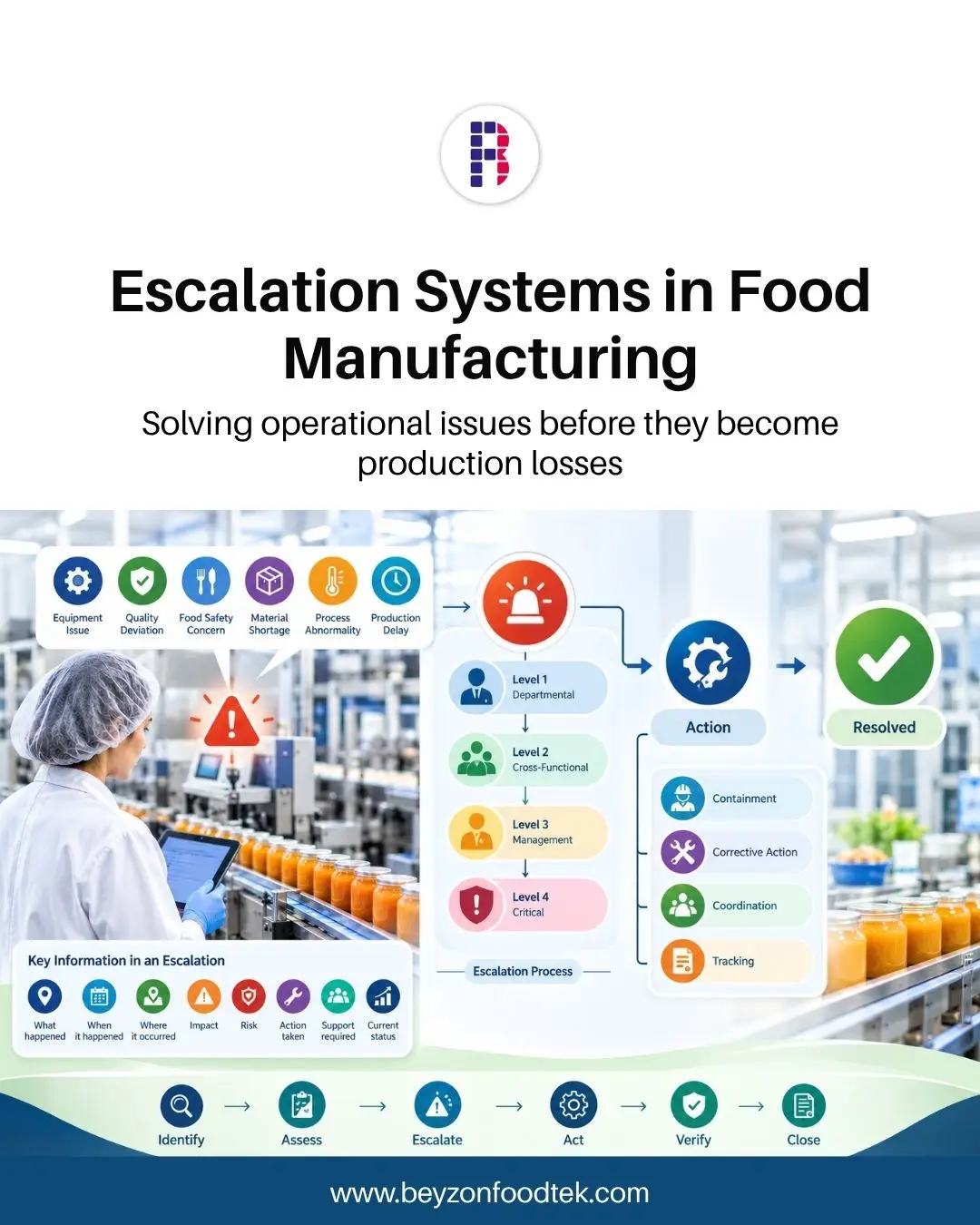
Common escalation triggers include:
Equipment Failures
Breakdowns, abnormal equipment conditions, or repeated failures that may affect production.
Quality Deviations
Process deviations, specification failures, or abnormal test results.
Food Safety Concerns
Potential contamination, hygiene failures, allergen risks, or critical control deviations.
Material Shortages
Raw material or packaging shortages that may affect production schedules.
Process Abnormalities
Unexpected changes in temperature, pressure, flow, yield, or other critical process parameters.
Production Delays
Issues that threaten planned production output or delivery commitments.
Clear escalation criteria help employees recognize when an issue requires additional support.
Designing an Effective Escalation Process
A practical escalation system should establish a clear sequence of actions.
Identify → Assess → Escalate → Act → Verify → Close
1. Identify
Recognize the abnormal condition and record relevant information.
2. Assess
Determine its severity, potential impact, and immediate risks.
3. Escalate
Notify the appropriate person or department according to predefined criteria.
4. Act
Implement containment, corrective action, or other required intervention.
5. Verify
Confirm that the issue has been effectively addressed.
6. Close
Document the outcome and identify further preventive actions where required.
This structure prevents issues from being reported without being properly resolved.
Defining Escalation Levels
Escalation levels should correspond to the potential impact of an issue.
For example:
Level 1 — Departmental:
Issue can be resolved by the responsible operating team.
Level 2 — Cross-Functional:
Issue requires support from another department such as Quality, Maintenance, Engineering, or Supply Chain.
Level 3 — Management:
Issue has significant impact on safety, quality, production, cost, or customer commitments.
Level 4 — Critical:
Immediate management intervention is required due to significant food safety, regulatory, operational, or business risk.
The exact levels should be adapted to the size and complexity of the manufacturing organisation.
Escalation and Communication
Effective escalation depends on timely and accurate communication.
An escalation notification should clearly communicate:
- What happened
- When it happened
- Where it occurred
- Immediate impact
- Potential risk
- Actions already taken
- Support required
- Current status
Standardized communication formats reduce ambiguity and help decision-makers respond quickly.
Digital systems can further support escalation by providing real-time notifications, issue tracking, dashboards, and escalation history.
Common Escalation Challenges
Manufacturers may struggle with escalation when:
- Escalation criteria are undefined
- Employees hesitate to report problems
- Issues are communicated informally
- Ownership is unclear
- Escalations are delayed
- Too many issues are unnecessarily escalated
- Corrective actions are not tracked
- Repeated issues are not analysed
An effective escalation system should create a culture of early reporting rather than blame.
Escalation and Operations Excellence
A structured escalation system strengthens Operations Management & Excellence by reducing the time between problem identification and corrective action.
It can help manufacturers achieve:
- Faster issue resolution
- Reduced production downtime
- Lower material losses
- Improved deviation management
- Stronger food safety response
- Better cross-functional coordination
- Improved accountability
- More reliable manufacturing performance
The objective is not simply to solve problems faster, but to prevent recurring problems from becoming systemic losses.
Performance Metrics That Matter
Manufacturers can evaluate escalation effectiveness through measurable indicators such as:
- Issue response time
- Escalation response time
- Issue resolution time
- Production downtime
- Deviation closure time
- Corrective action completion
- Repeat issue frequency
- Cost of operational losses
- Number of unresolved escalations
Monitoring these metrics helps identify weaknesses in both escalation processes and overall operational control.
The Role of Beyzon Foodtek Pvt. Ltd.
Beyzon Foodtek Pvt. Ltd. helps food manufacturers establish structured operational systems through its Operations Management & Excellence framework.
Its expertise includes:
- Escalation system development
- Process mapping
- SOP development
- Responsibility matrix development
- Deviation management systems
- KPI and performance tracking
- Cross-functional workflow improvement
- Food safety systems
- Manufacturing process optimization
- Manufacturing digitalization
By integrating escalation mechanisms into broader manufacturing systems, Beyzon helps organisations identify issues earlier, improve response times, reduce operational losses, and strengthen long-term manufacturing performance.
Conclusion
An effective escalation system enables food manufacturers to identify and address operational issues before they develop into significant losses. By defining clear escalation triggers, responsibilities, communication channels, and response timelines, manufacturers can improve the speed and consistency of problem resolution.
When supported by effective documentation, performance monitoring, and a culture of early reporting, escalation becomes more than a reactive mechanism. It becomes an important component of proactive operational control and continuous improvement.
For Beyzon Foodtek Pvt. Ltd., structured escalation systems are an essential part of building responsive, accountable, and reliable food manufacturing operations.
Partner with Beyzon Foodtek Pvt. Ltd. to strengthen issue escalation, improve response systems, and reduce operational losses.
FAQs
1. What is an escalation system in food manufacturing?
It is a structured process for reporting and transferring issues to the appropriate level of authority for timely resolution.
2. Which manufacturing issues should be escalated?
Equipment failures, quality deviations, food safety concerns, material shortages, process abnormalities, and issues that may affect production targets should have defined escalation criteria.
3. Why is early escalation important?
Early escalation allows manufacturers to contain problems before they result in greater downtime, wastage, quality losses, or food safety risks.
4. How can manufacturers improve escalation processes?
They can establish clear escalation criteria, responsibility levels, communication protocols, response timelines, and issue-tracking systems.
5. How does escalation support operational excellence?
It improves response times, accountability, cross-functional coordination, problem resolution, and overall manufacturing reliability.