Food manufacturing performance depends on the ability to consistently monitor production, quality, maintenance, people, costs, and resource utilization. Without a structured performance review system, operational problems can remain hidden within individual departments and may only become visible when they affect production targets, costs, or customer requirements.
A performance review system provides a structured approach to evaluating operational results, identifying deviations, assigning accountability, and initiating improvement actions. Rather than relying only on informal discussions or end-of-month reporting, manufacturers can use regular performance reviews to create greater visibility and faster decision-making across the organisation.
For Beyzon Foodtek Pvt. Ltd., performance review systems are an important component of Operations Management & Excellence, helping food manufacturers connect operational data with accountability, corrective action, and continuous improvement.
What Is a Performance Review System?
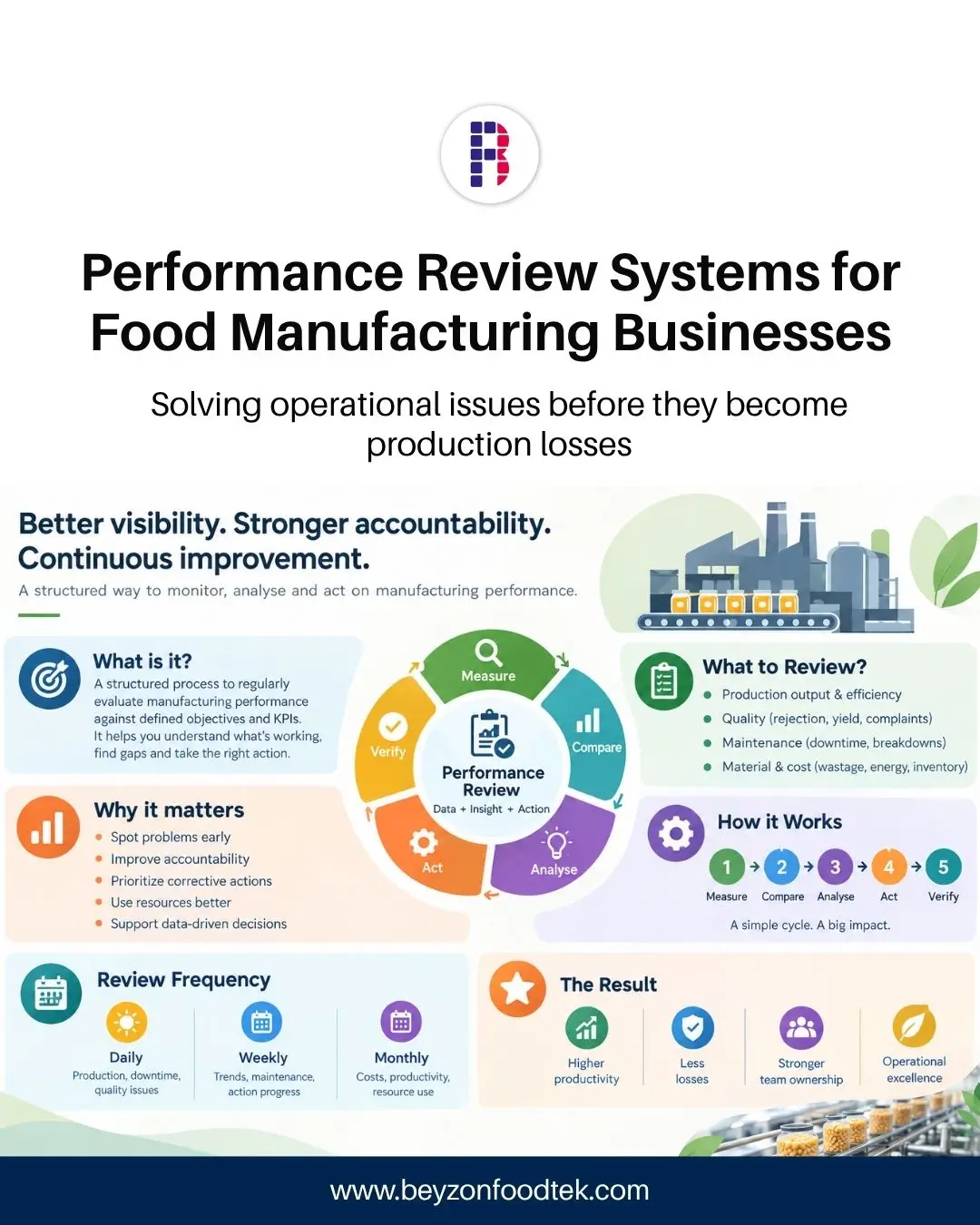
A performance review system is a structured process for regularly evaluating manufacturing performance against defined objectives, targets, and Key Performance Indicators (KPIs).
A manufacturing performance review may examine:
- Production output
- Overall Equipment Effectiveness (OEE)
- Product rejection
- Material yield
- Downtime
- Labour productivity
- Energy consumption
- Maintenance performance
- Quality deviations
- Customer complaints
The purpose is not simply to report numbers. It is to understand performance, identify gaps, and initiate appropriate action.
Why Performance Reviews Matter
Food manufacturing involves multiple variables that can influence operational performance. A decline in output, for example, may be caused by equipment downtime, material shortages, quality issues, inefficient processes, or workforce constraints.
Regular performance reviews help manufacturers:
- Identify performance gaps
- Detect recurring problems
- Improve accountability
- Prioritize corrective actions
- Align departmental objectives
- Improve resource utilization
- Support data-driven decisions
- Track improvement over time
Without regular review, organisations may identify problems only after significant losses have occurred.
What Should Be Reviewed?
An effective performance review should consider multiple dimensions of manufacturing performance rather than focusing only on production output.
Production Performance
Key indicators may include:
- Production volume
- Production plan achievement
- Line efficiency
- Throughput
- Changeover time
- Production downtime
Quality Performance
Manufacturers can monitor:
- Product rejection
- First-pass yield
- Process deviations
- Customer complaints
- Corrective action closure
- Quality-related downtime
Maintenance Performance
Important indicators include:
- Equipment availability
- Preventive maintenance compliance
- Breakdown frequency
- Mean Time Between Failures (MTBF)
- Mean Time To Repair (MTTR)
Material & Cost Performance
Reviews may also examine:
- Material yield
- Raw material wastage
- Packaging losses
- Energy consumption
- Production cost
- Inventory variance
A balanced review provides a more complete view of operational health.
Establishing a Manufacturing KPI Framework
Performance reviews are only effective when supported by relevant and clearly defined KPIs.
Each KPI should ideally have:
- A defined metric
- A target value
- A responsible owner
- A review frequency
- A defined data source
- An action threshold
For example, simply tracking downtime provides limited value. Establishing a downtime target, identifying the responsible function, and defining an escalation threshold makes the metric more actionable.
KPIs should also be aligned with broader business objectives so that departmental performance contributes to overall manufacturing goals.
How Should Performance Reviews Be Conducted?
A structured review cycle can follow a simple sequence:
Measure → Compare → Analyse → Act → Verify
Measure
Collect accurate and relevant operational data.
Compare
Evaluate actual performance against targets or historical benchmarks.
Analyse
Identify the reasons behind significant deviations.
Act
Assign corrective or improvement actions with clear ownership.
Verify
Review whether the action produced the intended improvement.
This approach turns performance reviews into an active management process rather than a reporting exercise.
Review Frequency and Management Levels
Different performance indicators require different review frequencies.
Daily Reviews
Focus on production output, downtime, quality deviations, and immediate operational issues.
Weekly Reviews
Examine trends, recurring problems, maintenance performance, and action-plan progress.
Monthly Reviews
Evaluate broader operational performance, costs, productivity, resource utilization, and strategic targets.
The frequency should be adapted to the organisation’s size, production complexity, and operational requirements.
Common Performance Review Challenges
Manufacturers may face several challenges when implementing performance review systems.
Common issues include:
- Too many KPIs
- Poor data quality
- Undefined KPI ownership
- Inconsistent reporting
- Reviews focused only on historical results
- Corrective actions without follow-up
- Departmental goals that conflict with overall objectives
- Lack of management accountability
A performance review system should remain focused, measurable, and action-oriented.
Performance Reviews and Operations Excellence
A structured performance review system strengthens Operations Management & Excellence by creating visibility across the manufacturing organisation.
Effective review systems can contribute to:
- Improved production efficiency
- Faster problem identification
- Better resource utilization
- Reduced operational losses
- Stronger accountability
- Improved cross-functional coordination
- Better decision-making
- Continuous improvement
Regular reviews create a feedback loop between performance measurement and operational action.
Performance Metrics That Matter
A food manufacturing performance dashboard may include:
- Production plan achievement
- OEE
- First-pass yield
- Product rejection rate
- Material yield
- Downtime
- MTBF
- MTTR
- Preventive maintenance compliance
- Labour productivity
- Energy consumption
- Customer complaints
- Corrective action closure
The exact KPI set should be customized according to the manufacturing process, product category, and business objectives.
The Role of Beyzon Foodtek Pvt. Ltd.
Beyzon Foodtek Pvt. Ltd. helps food manufacturers develop structured performance management systems through its Operations Management & Excellence framework.
Its expertise includes:
- KPI framework development
- Performance review systems
- Manufacturing dashboards
- Production performance monitoring
- Process optimization
- SOP development
- Corrective action systems
- Cross-functional performance management
- Manufacturing digitalization
- Continuous improvement initiatives
By connecting operational data with structured review mechanisms, Beyzon helps manufacturers improve accountability, identify performance gaps, optimize resources, and build more efficient manufacturing operations.
Conclusion
Performance review systems provide food manufacturers with a structured method for understanding operational performance and converting data into action. By monitoring relevant KPIs, reviewing deviations, assigning clear ownership, and tracking corrective actions, organisations can improve both short-term performance and long-term operational capability.
A well-designed performance review system does more than measure results. It creates a management feedback loop that supports accountability, continuous improvement, and operational excellence.
For Beyzon Foodtek Pvt. Ltd., structured performance management is an important part of building data-driven, accountable, and high-performing food manufacturing organisations.
FAQs
1. What is a performance review system in food manufacturing?
It is a structured process for reviewing manufacturing performance against defined KPIs, targets, and operational objectives.
2. Which KPIs should food manufacturers monitor?
Common KPIs include OEE, production output, downtime, product rejection, material yield, maintenance performance, labour productivity, and customer complaints.
3. How often should manufacturing performance be reviewed?
Daily, weekly, and monthly reviews can be used depending on the KPI, operational complexity, and management requirements.
4. Why is KPI ownership important?
Assigning ownership ensures that performance gaps have a responsible function or individual and that corrective actions are followed through.
5. How do performance reviews support operational excellence?
They improve visibility, accountability, decision-making, resource utilization, and continuous improvement across manufacturing operations.