Role of Packaging in Maintaining Quality in FG Warehouses goes beyond storage conditions and hygiene practices. Once products are packed and moved into the warehouse, they face risks such as moisture, temperature variations, physical handling, and environmental exposure. Packaging acts as the first and most important layer of protection against these risks.
Well designed packaging helps safeguard finished goods from damage, contamination, and quality deterioration during storage and movement. In food FG warehouses, where products may be stored for extended periods and handled multiple times, effective packaging plays a key role in preserving safety, shelf life, and compliance. Understanding its role is essential for ensuring consistent product quality and smooth warehouse operations.
Understanding Packaging in FG Warehouses
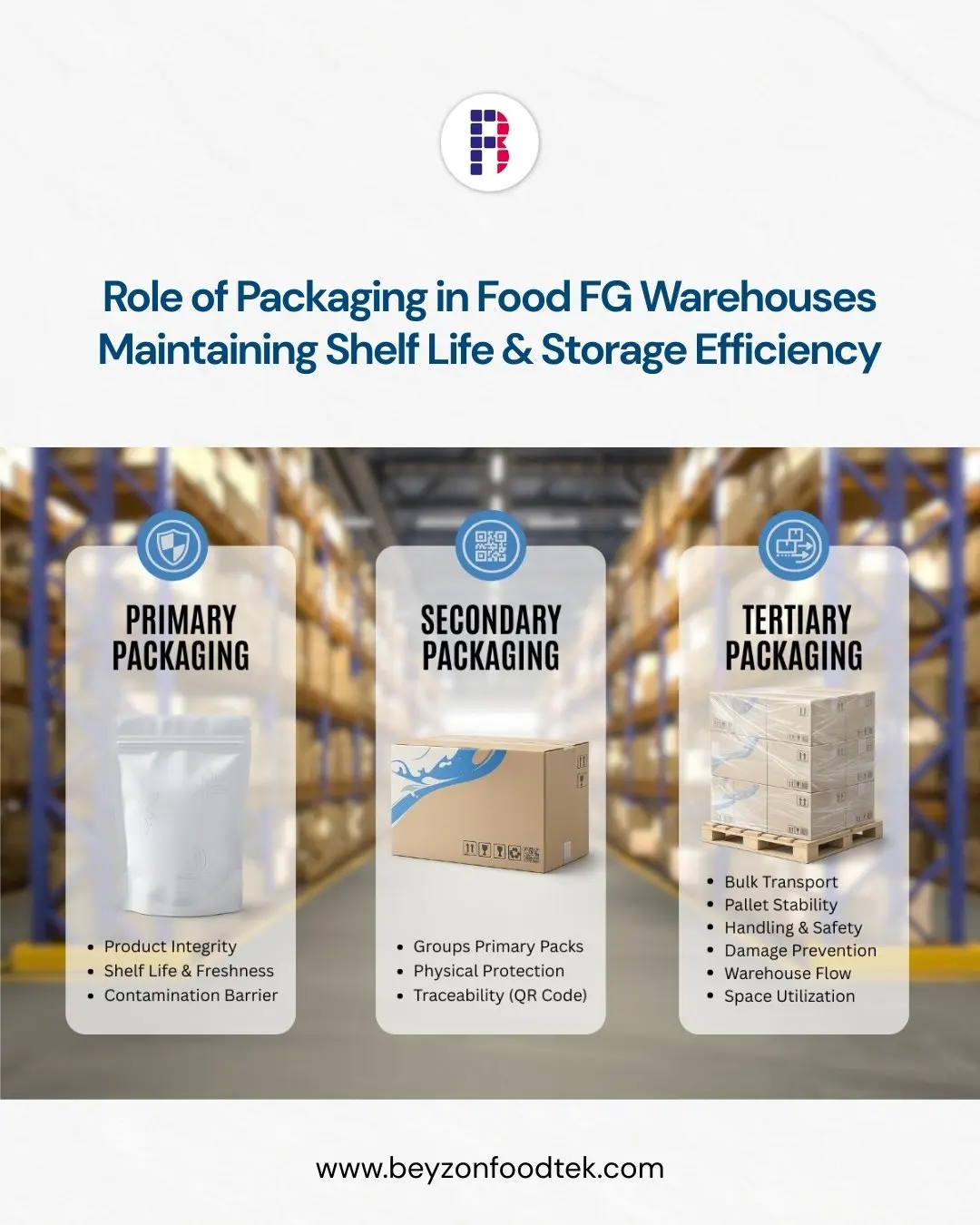
In FG warehouses, packaging is designed not only to contain the product but also to support safe storage and efficient warehouse operations. Different layers of packaging work together to protect the product throughout its warehouse lifecycle.
- Primary packaging
- Directly contacts the food product and protects it from contamination
- Maintains freshness, aroma, texture, and nutritional quality
- Acts as the main barrier against moisture, oxygen, and microbes
- Secondary packaging
- Groups individual packs for safer handling and storage
- Reduces the risk of physical damage during stacking and movement
- Improves identification and traceability at the carton level
- Tertiary packaging
- Includes cartons, pallets, stretch wrapping, and strapping
- Enables safe bulk storage and transportation
- Supports warehouse layout efficiency and material flow
Key Quality Risks in FG Warehouses
FG warehouses are exposed to environmental and operational factors that can negatively affect finished goods if not properly controlled. Packaging helps mitigate many of these risks when appropriately selected and managed.
- Fluctuating humidity causing moisture absorption, clumping, or microbial growth
- Temperature variations leading to texture changes or product degradation
- Mechanical stress during stacking, pallet movement, and loading operations
- Pest activity and dust ingress due to damaged or open packaging
- Exposure to light and oxygen resulting in oxidation and reduced shelf life
How Packaging Helps Maintain Product Quality
Packaging functions as a preventive control measure that shields products from quality deterioration during storage. It plays a direct role in maintaining product integrity and stability in FG warehouses.
- Provides effective environmental protection against moisture, oxygen, light, and odors
- Offers structural strength to withstand stacking pressure and handling stress
- Ensures product integrity through strong seals and tamper evident features
- Minimizes cross contamination from surrounding products or surfaces
- Helps retain sensory attributes and declared shelf life
Packaging Material Selection and Its Impact on Quality
The selection of packaging material has a long term impact on food safety and quality. Materials must be carefully chosen to suit both the product characteristics and warehouse storage conditions.
- Material selection should consider product sensitivity and storage duration
- Food grade compliance and regulatory approval are mandatory
- Material must be compatible with:
- Product composition
- Warehouse temperature and humidity
- Expected handling and stacking stress
- Incorrect material choice may result in:
- Migration issues
- Moisture or oxygen ingress
- Increased spoilage and customer complaints
Packaging Design Considerations for Warehouse Efficiency
Packaging design influences how effectively products can be stored, moved, and managed within FG warehouses. Poor design can lead to frequent damage and inefficiencies.
- Strong and stable designs prevent deformation during stacking
- Standardized pack sizes support optimal space utilization
- Compatibility with pallets, racks, and handling equipment reduces damage
- Clear labeling enables:
- FIFO and FEFO implementation
- Batch traceability
- Faster picking and dispatch accuracy
Role of Packaging in Hygiene and Food Safety Compliance
Packaging acts as a critical hygiene barrier between the product and the warehouse environment. It supports compliance with food safety standards and audit requirements.
- Prevents direct exposure of food products to dust, pests, and contaminants
- Limits human contact and handling related contamination
- Supports compliance with:
- Good Manufacturing Practices
- Good Hygiene Practices
- FSSAI and customer audit requirements
- Maintains consistent product protection during extended storage
Common Packaging Related Issues in FG Warehouses
Many quality deviations in FG warehouses originate from packaging related gaps. Identifying and addressing these issues is essential for quality consistency.
- Use of low strength or non compliant packaging materials
- Weak sealing leading to leakage or contamination
- Over packaging increasing costs and handling difficulty
- Under packaging causing frequent damage
- Designs not suitable for stacking or mechanized handling
Best Practices for Packaging Management in FG Warehouses
A structured packaging management approach ensures that packaging continues to perform effectively under real warehouse conditions.
- Defined and standardized packaging specifications
- Regular inspection of incoming and in-use packaging materials
- Proper storage of packaging materials to avoid damage or contamination
- Training warehouse staff on correct stacking and handling practices
- Periodic performance review under actual storage conditions
How Beyzon Foodtek Pvt. Ltd. Supports Packaging Optimization
Beyzon Foodtek Pvt. Ltd. typically approaches packaging and FG warehouse quality as a connected system, integrating food safety requirements, operational flow, and digital monitoring where needed. The goal is not to redesign packaging for appearance but to strengthen its ability to protect product quality during storage and dispatch.:
- Evaluating packaging systems during FG warehouse audits
- Aligning packaging selection with product characteristics and shelf life
- Integrating packaging requirements into warehouse layout and operations
- Implementing improvements through structured, on ground projects
- Validating effectiveness through post implementation reviews
These interventions ensure practical and sustainable packaging solutions.
Conclusion
Packaging plays a decisive role in maintaining food quality in FG warehouses because it is the final protective barrier between the product and real-world storage conditions. When packaging design, material selection, coding durability, secondary packaging strength, and warehouse handling practices are aligned, manufacturers preserve shelf life more reliably and reduce damage-related waste.
Treating packaging as an active quality control element, rather than a passive container, allows FG warehouses to function as stable extensions of manufacturing. This alignment is where quality consistency becomes scalable.
FAQs
Why does product quality drop in the warehouse even when manufacturing is strong?
Because packaging can fail under storage stress such as humidity, temperature cycling, stacking loads, and rough handling, leading to gradual quality drift.
Which packaging layer matters most in FG warehouses?
All layers matter. Primary packaging protects the product directly, while secondary and tertiary packaging protect against mechanical damage and contamination during storage and movement.
What is the most common packaging-related issue in FG warehouses?
Loss of seal integrity and physical damage from handling and stacking are frequent causes, followed closely by label and coding durability problems.
How can manufacturers improve traceability through packaging?
By using durable coding, selecting warehouse-suitable label materials, and implementing barcode or QR-based scanning systems tied to batch and expiry data.
How does Beyzon Foodtek help with warehouse-linked packaging issues?
By assessing packaging performance in real storage conditions, strengthening SOPs and handling discipline, improving traceability workflows, and executing practical improvements.