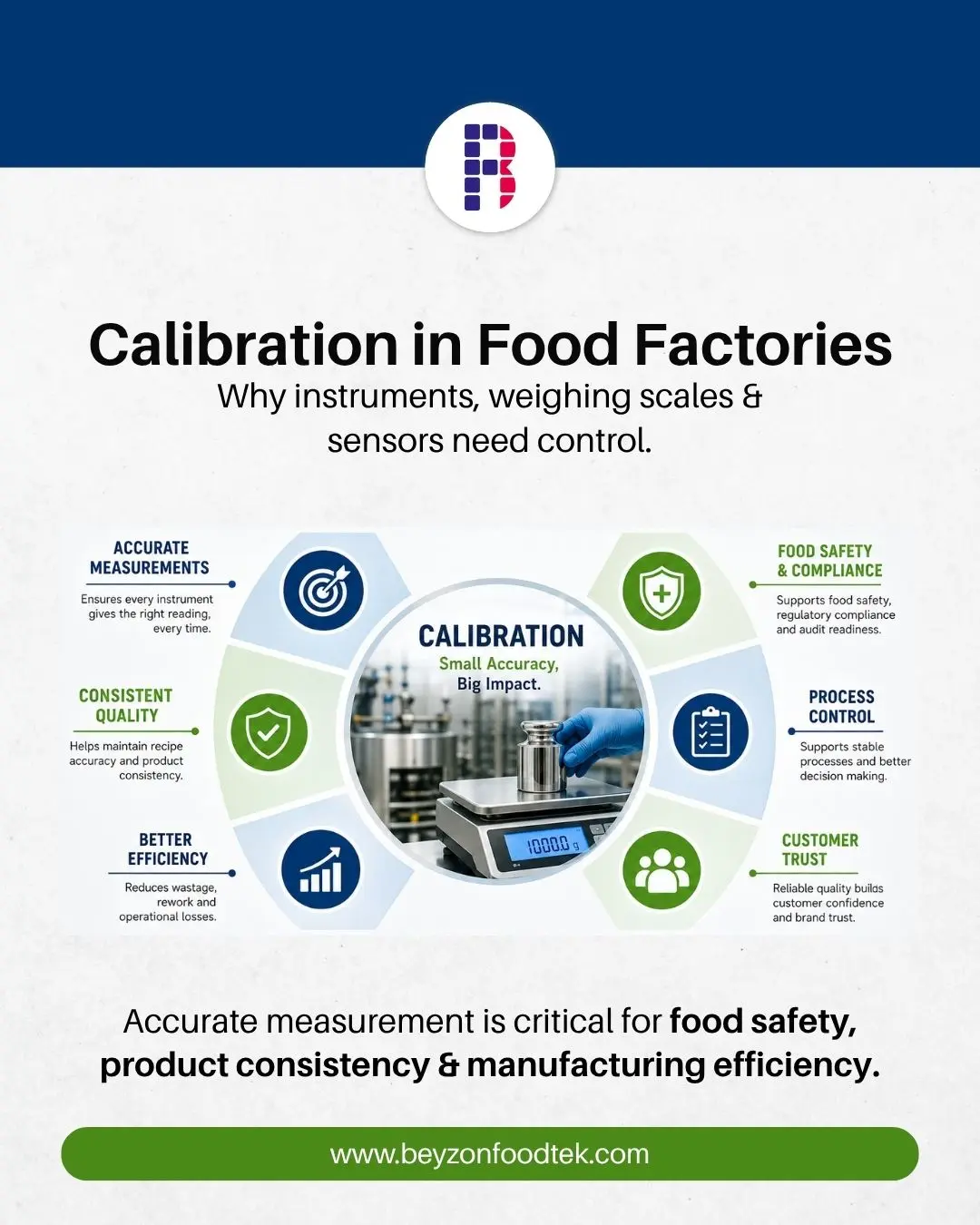
Modern food manufacturing depends on accurate measurements at every stage of production. From weighing raw materials and monitoring processing temperatures to controlling filling volumes and verifying product quality, every manufacturing decision relies on precise measurement. Even minor inaccuracies can affect product consistency, food safety, regulatory compliance, and operational efficiency.
Calibration is the process of verifying and adjusting measuring instruments to ensure they provide accurate and reliable readings. Whether it is a weighing scale, temperature sensor, pressure gauge, pH meter, or flow meter, regular calibration helps manufacturers maintain process control and produce products that consistently meet quality standards.
For Beyzon Foodtek Pvt. Ltd., calibration is a critical component of Operations Management & Excellence, enabling food manufacturers to build reliable manufacturing systems, improve product quality, and strengthen process control.
What Is Calibration?
Calibration is the documented process of comparing a measuring instrument against a known reference standard and making adjustments where necessary to maintain measurement accuracy.
Food factories routinely calibrate:
- Weighing scales
- Temperature sensors
- Pressure gauges
- Flow meters
- pH meters
- Moisture analyzers
- Metal detectors
- Checkweighers
- Filling machines
The objective is to ensure every instrument delivers accurate and repeatable measurements throughout production.
Why Calibration Matters
Every manufacturing process depends on reliable measurement. Incorrect instrument readings can lead to process deviations, product defects and unnecessary production losses.
Poor calibration may result in:
- Incorrect ingredient quantities
- Product quality variation
- Food safety risks
- Filling inaccuracies
- Increased product rejection
- Higher raw material wastage
- Regulatory non-compliance
- Customer complaints
For example, a weighing scale reading even slightly higher than the actual weight can increase ingredient consumption across thousands of production batches, significantly affecting manufacturing costs.
Regular calibration minimizes these risks and supports consistent manufacturing performance.
Instruments That Require Calibration
Different manufacturing processes require different measuring instruments.
Common examples include:
Production Equipment
- Weighing scales
- Flow meters
- Temperature sensors
- Pressure gauges
- Load cells
Quality Control Equipment
- pH meters
- Moisture analyzers
- Refractometers (Brix meters)
- Laboratory balances
- Thermometers
Packaging Equipment
- Checkweighers
- Filling machines
- Metal detectors
- Seal integrity testing equipment
Every instrument that influences product quality or food safety should be included in the factory’s calibration program.
How Calibration Supports Process Control
Calibration is not simply a maintenance activity—it is an important process control tool.
Accurate instruments help manufacturers:
- Maintain recipe accuracy
- Control processing conditions
- Improve product consistency
- Verify Critical Process Parameters (CPPs)
- Improve Critical Quality Attributes (CQAs)
- Reduce process variation
- Support process validation
Reliable measurements create stable and repeatable manufacturing processes.
Calibration Frequency and Documentation
Calibration should be carried out according to a planned schedule that considers factors such as equipment criticality, frequency of use, manufacturer recommendations, regulatory requirements, environmental conditions, and historical performance. International standards such as ISO 9001 and ISO/IEC 17025 do not prescribe fixed calibration intervals; instead, they require organizations to establish documented, risk-based calibration programmes that ensure measurement traceability and confidence in measurement results. Each calibration activity should be supported by comprehensive documentation, including calibration certificates, instrument identification, calibration schedules, reference standards used, measurement results, adjustments made, corrective actions, and the next scheduled calibration date. Well-maintained records improve traceability, simplify internal and external audits, support regulatory compliance, and provide objective evidence that measuring equipment remains fit for its intended purpose.
Common Calibration Challenges
Many manufacturers struggle to maintain an effective calibration program.
Common issues include:
- Missed calibration schedules
- Damaged measuring instruments
- Poor documentation
- Use of uncalibrated equipment
- Lack of operator awareness
- Inconsistent reference standards
Addressing these challenges helps maintain manufacturing accuracy and reduce operational risks.
Performance Metrics That Matter
An effective calibration program supports measurable operational improvements.
Important indicators include:
- First-pass quality
- Manufacturing throughput
- Product rejection rates
- Material utilization
- Batch consistency
- Process deviations
- Customer complaints
- Equipment reliability
Monitoring these metrics helps manufacturers evaluate the effectiveness of process control systems.
Calibration and Operations Excellence
Calibration strengthens Operations Management & Excellence by ensuring manufacturing decisions are based on accurate and reliable data.
Effective calibration helps manufacturers:
- Improve product consistency
- Strengthen food safety systems
- Reduce wastage
- Improve manufacturing efficiency
- Support regulatory compliance
- Reduce process variability
- Improve operational reliability
- Enable continuous improvement
Accurate measurements create predictable manufacturing outcomes.
The Role of Beyzon Foodtek Pvt. Ltd.
Beyzon Foodtek Pvt. Ltd. helps food manufacturers establish robust calibration systems as part of its Operations Management & Excellence framework.
Its expertise includes:
- Calibration program development
- Process validation support
- Manufacturing process optimization
- Standard Operating Procedures (SOPs)
- Performance tracking systems
- Food safety systems
- Manufacturing digitalization
- Operational excellence initiatives
By integrating calibration with standardized manufacturing systems, Beyzon helps manufacturers improve manufacturing throughput, reduce wastage, optimize process control, strengthen product quality, and achieve sustainable operational excellence.
Conclusion
Calibration is an essential element of food manufacturing that ensures instruments, sensors, and measuring devices deliver accurate and reliable results. From ingredient weighing to process monitoring and final packaging, calibrated equipment supports product consistency, food safety, and efficient manufacturing operations.
Manufacturers that implement structured calibration programs are better equipped to reduce operational risks, improve process control, and build reliable manufacturing systems. For Beyzon Foodtek Pvt. Ltd., calibration is a key pillar in developing accurate, efficient, and future-ready food manufacturing operations.
Partner with Beyzon Foodtek Pvt. Ltd. to strengthen calibration systems and improve manufacturing accuracy.
FAQs
1. What is calibration in food manufacturing?
Calibration verifies that measuring instruments provide accurate and reliable readings.
2. Which instruments should be calibrated?
Weighing scales, sensors, meters, laboratory equipment, checkweighers, and filling systems.
3. Why is calibration important?
It improves product quality, food safety, process consistency, and regulatory compliance.
4. How often should instruments be calibrated?
The frequency depends on equipment criticality, usage, manufacturer recommendations, and regulatory requirements.
5. What are the benefits of a calibration program?
Reduced process variation, lower wastage, improved accuracy, and stronger operational performance.