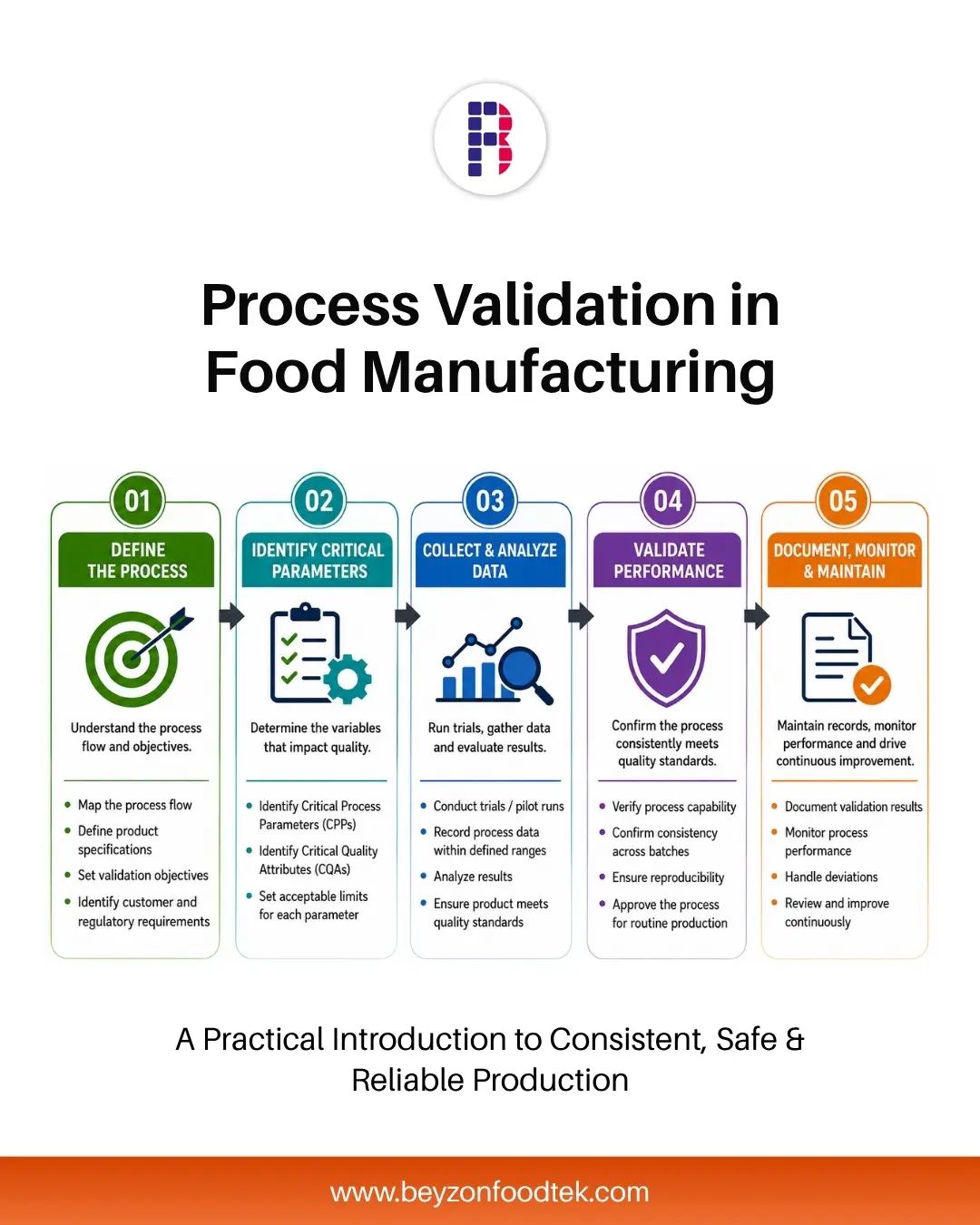
Process Validation in Food Manufacturing is a critical step in ensuring that manufacturing processes consistently produce safe, high-quality products that meet regulatory and customer requirements. While recipe development focuses on creating the right product, process validation confirms that the manufacturing process itself is capable of producing that product repeatedly, regardless of batch size, production shift, or operator.
In food manufacturing, even small variations in processing conditions can affect product quality, shelf life, food safety, and production efficiency. Validating a process helps manufacturers establish confidence that equipment, process parameters, and operating procedures work together to deliver consistent results.
For Beyzon Foodtek Pvt. Ltd., process validation is an essential part of building Operations Management & Excellence by creating structured manufacturing systems that improve process reliability, product consistency, and operational performance.
What Is Process Validation?
Process validation is the documented process of demonstrating that a manufacturing process consistently performs as intended under defined operating conditions.
Rather than relying solely on final product inspection, manufacturers validate the entire production process by confirming that critical process parameters remain within acceptable limits and consistently produce products that meet predefined quality specifications.
Process validation is commonly carried out:
- Before commercial production
- After installation of new equipment
- Following major process modifications
- When introducing new product formulations
- After significant changes in raw materials or packaging
The objective is to reduce process variability and ensure reliable manufacturing performance.
Why Process Validation Is Important
Every food manufacturing process contains variables that influence the final product. If these variables are not understood and controlled, manufacturers may experience inconsistent quality, higher rejection rates, production losses, or customer complaints.
Without proper validation, businesses may face:
- Batch-to-batch variation
- Product quality deviations
- Reduced shelf life
- Product recalls
- Increased wastage
- Customer complaints
- Regulatory non-compliance
For example, in a dairy processing plant, a slight variation in pasteurization temperature or holding time may affect both product safety and shelf life. Similarly, in a bakery, changes in oven temperature profiles can result in uneven baking, inconsistent moisture content, or colour variation across batches.
Process validation establishes scientifically verified operating conditions that reduce these risks.
Key Stages of Process Validation
Process validation is typically performed in structured stages before routine commercial production begins.
Process Development
The manufacturing process is developed through laboratory work, trial batches, and pilot production to establish suitable processing parameters.
Activities include:
- Product formulation
- Equipment selection
- Process flow development
- Initial quality evaluation
- Process parameter identification
Process Qualification
The process is evaluated under actual manufacturing conditions to verify that it consistently produces products meeting quality requirements.
This stage may include:
- Trial production batches
- Equipment performance verification
- Utility system checks
- Operator training
- Packaging validation
- Yield assessment
For example, a beverage manufacturer may validate filling equipment to ensure that every bottle consistently meets the declared fill volume across different production speeds.
Continued Process Verification
Manufacturers regularly monitor:
- Product quality
- Process deviations
- Equipment performance
- Batch yields
- Customer complaints
- Process improvements
This ongoing review helps maintain process stability and supports continuous improvement.
Critical Process Parameters
During validation, manufacturers identify the process conditions that have the greatest influence on product quality.
Common Critical Process Parameters (CPPs) include:
- Processing temperature
- Mixing speed
- Cooking time
- Filling pressure
- Homogenization pressure
- Drying conditions
- Cooling time
- Conveyor speed
For instance, in sauce manufacturing, mixing speed and cooking temperature directly influence viscosity, ingredient dispersion, and overall product consistency. Establishing acceptable operating ranges helps ensure uniform quality across production batches.
Critical Quality Attributes
Along with process parameters, manufacturers also monitor product characteristics known as Critical Quality Attributes (CQAs).
Examples include:
- Moisture content
- pH
- Water activity
- Brix value
- Viscosity
- Net weight
- Product texture
- Microbiological quality
These attributes are measured throughout validation to confirm that the manufacturing process consistently delivers products within specification.
Practical Examples of Process Validation
Different food categories require different validation activities depending on the manufacturing process.
Examples include:
- Dairy Processing: Validating pasteurization temperatures and holding times to ensure effective microbial control while maintaining product quality.
- Ready-to-Eat Foods: Confirming that cooking processes consistently achieve safe internal product temperatures without affecting texture or flavour.
- Snack Food Manufacturing: Validating fryer temperature, oil filtration systems, and seasoning application to achieve consistent product colour and taste.
- Bakery Operations: Establishing baking profiles that produce uniform moisture content and product texture across multiple oven zones.
- Packaging Operations: Verifying metal detector sensitivity, checkweigher accuracy, and sealing integrity before routine production.
These activities reduce production risks while improving consistency and operational confidence.
Documentation and Operational Control
Process validation relies on proper documentation and controlled manufacturing systems.
Typical records include:
- Validation protocols
- Validation reports
- Batch Manufacturing Records (BMR)
- Standard Operating Procedures (SOPs)
- Equipment calibration records
- Cleaning verification records
- Quality inspection reports
- Corrective and Preventive Action (CAPA) records
Strong documentation improves traceability, simplifies audits, and supports operational discipline throughout the manufacturing process.
Common Challenges During Process Validation
Many food manufacturers encounter challenges while validating new or existing production processes.
Common issues include:
- Insufficient production data
- Inconsistent raw material quality
- Equipment variability
- Poor documentation
- Operator-related process variation
- Inadequate process monitoring
- Weak change management practices
For example, changing a supplier for a key ingredient may alter particle size, moisture content, or functional properties, requiring parts of the manufacturing process to be revalidated before routine production continues.
Addressing these challenges early helps reduce operational risks and improve long-term manufacturing stability.
Process Validation and Operations Excellence
Process validation contributes directly to Operations Management & Excellence by creating stable, measurable, and repeatable manufacturing systems.
Validated processes help manufacturers:
- Increase manufacturing throughput
- Improve first-pass quality
- Reduce startup losses
- Reduce product rework
- Minimize production variability
- Improve process consistency
- Strengthen food safety systems
- Support continuous improvement initiatives
Rather than relying on individual experience or trial-and-error decision-making, manufacturers operate using verified processes supported by data and standardized procedures.
The Role of Beyzon Foodtek Pvt. Ltd.
Beyzon Foodtek Pvt. Ltd. helps food manufacturers strengthen Operations Management & Excellence by developing robust manufacturing systems, standardized operating procedures, and performance-driven operational frameworks.
This includes support in areas such as:
- Process validation
- Operations management
- Food safety systems
- Process optimization
- Manufacturing digitalization
- Mechanization and automation
- Production efficiency improvement
By helping manufacturers validate and standardize production processes, Beyzon supports improved manufacturing throughput, reduced wastage, optimized inventory levels, improved quality performance, and sustained operational excellence..
Conclusion
Process Validation in Food Manufacturing is much more than a quality requirement—it is a structured approach to building reliable and efficient manufacturing systems. By validating critical process parameters, monitoring product quality, and maintaining standardized operating procedures, manufacturers can consistently produce safe, high-quality products while reducing operational risks.
As food manufacturing continues to become more technology-driven and quality-focused, process validation plays an increasingly important role in supporting productivity, compliance, and business growth. For Beyzon Foodtek Pvt. Ltd., helping manufacturers build validated and repeatable manufacturing systems is an important part of creating future-ready food production environments.
FAQs
1. What is process validation in food manufacturing?
Process validation is the documented process of confirming that a manufacturing process consistently produces products meeting predefined quality, safety, and performance requirements.
2. When should process validation be performed?
It is commonly performed before commercial production, after installing new equipment, introducing new products, modifying manufacturing processes, or making significant formulation changes.
3. What is the difference between process validation and product testing?
Process validation confirms that the manufacturing process consistently performs as intended, while product testing evaluates whether finished products meet established quality specifications.
4. Which food manufacturing processes commonly require validation?
Processes such as pasteurization, thermal processing, frying, baking, filling, packaging, metal detection, and cleaning procedures are commonly validated to ensure consistent performance.
5. How does process validation improve manufacturing performance?
It reduces process variability, improves product consistency, minimizes wastage, strengthens food safety, supports regulatory compliance, and helps manufacturers achieve higher operational efficiency.