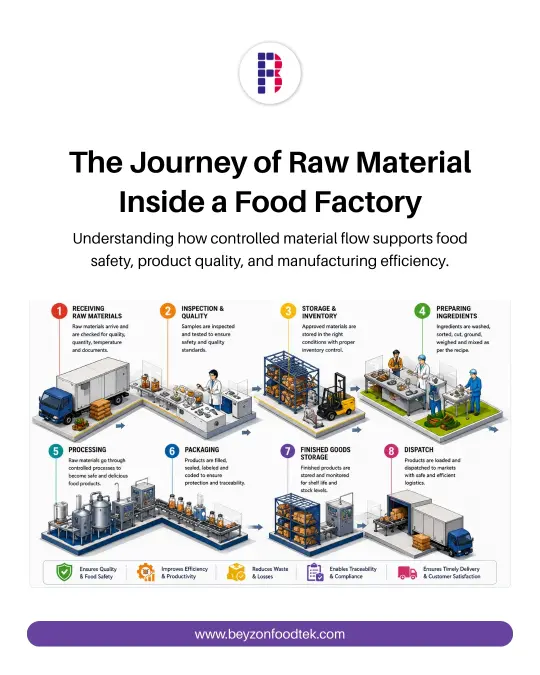
The Journey of Raw Material Inside a Food Factory is one of the most important processes in food manufacturing. Every packaged food product begins with raw ingredients that move through multiple stages before becoming a finished product ready for the market. From the moment ingredients arrive at the factory to the time the final product is dispatched, every movement is carefully controlled to maintain quality, hygiene, and efficiency.
In modern food manufacturing, raw material handling is not simply about transportation. It is a structured process that affects food safety, production speed, inventory management, operational cost, and product consistency. Even small delays or handling errors can impact the entire production cycle.
For Beyzon Foodtek Pvt. Ltd., improving operational systems inside food factories is an important part of helping manufacturers build more efficient and reliable production environments.
The Beginning: Receiving Raw Materials
The journey starts when raw materials arrive at the factory. These may include grains, spices, dairy ingredients, oils, fruits, vegetables, additives, or packaging materials. At this stage, the factory checks whether the materials meet required quality and safety standards before they enter the production area.
Receiving teams inspect:
- Packaging condition
- Quantity and weight
- Product temperature
- Supplier documents
- Visible damage or contamination
This first checkpoint is important because the quality of the final product depends heavily on the quality of the incoming ingredients. Proper receiving systems also help factories maintain traceability and inventory accuracy from the very beginning.
Inspection and Quality Verification
After receiving, raw materials move through quality inspection procedures. Food factories cannot risk using materials that may affect taste, shelf life, hygiene, or product safety.
Quality teams may conduct visual inspections, temperature checks, moisture analysis, or batch verification depending on the product category. In many factories, samples are also tested in laboratories before approval for production.
This stage helps manufacturers:
- Maintain product consistency
- Reduce contamination risks
- Avoid batch rejection
- Improve food safety compliance
Strong quality systems reduce operational problems later in the manufacturing process.
Storage and Inventory Management
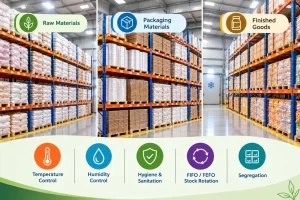
Once approved, raw materials are stored in dedicated areas based on their requirements. Some ingredients require dry storage, while others need refrigerated or frozen environments to maintain freshness and quality.
Storage management plays a major role in food manufacturing efficiency. Poor storage conditions can lead to spoilage, contamination, expiry losses, and production delays. To avoid this, factories use organized inventory systems such as FIFO (First In First Out) or FEFO (First Expiry First Out).
Modern food factories increasingly use digital inventory tracking systems that provide better visibility into stock movement and material usage.
Preparing Ingredients for Production
Before production begins, ingredients are prepared according to the manufacturing process. This preparation stage may involve washing, sorting, cutting, grinding, weighing, blending, or mixing.
Accuracy becomes extremely important here because even small variations in ingredient quantity can affect the taste, texture, appearance, and consistency of the final product.
Many food factories now use automated weighing and batching systems to improve:
- Precision
- Production speed
- Material handling
- Wastage control
These systems also reduce manual errors and improve operational efficiency.
The Processing Stage
The processing stage is where raw materials are transformed into finished food products. Depending on the type of food being manufactured, this process may involve cooking, baking, frying, mixing, fermentation, drying, cooling, or pasteurization.
Factories closely monitor:
- Temperature
- Timing
- Hygiene conditions
- Equipment performance
- Production consistency
Proper process control helps maintain product quality and operational efficiency while reducing the risk of downtime or product rejection.
In high-capacity manufacturing environments, even short production interruptions can create significant losses. This is why efficient production systems and reliable equipment are critical for smooth factory operations.
Packaging and Product Protection
Once processing is complete, products move to the packaging section. Packaging is not only important for branding but also for product safety, hygiene, shelf life, and transportation.
Packaging operations may include filling, sealing, labeling, coding, and cartoning. Modern food factories often use automated packaging systems to improve consistency, reduce handling errors, and increase production speed.
Proper packaging also helps manufacturers maintain product traceability throughout the supply chain.
Finished Goods Storage and Dispatch
After packaging, finished products are stored before dispatch to distributors, retailers, or customers. During this stage, factories manage stock levels, storage conditions, dispatch schedules, and shelf-life monitoring.
Efficient warehouse management helps:
- Prevent delivery delays
- Reduce product damage
- Improve stock visibility
- Maintain dispatch efficiency
Once orders are ready, products are loaded and transported according to distribution requirements. For temperature-sensitive products, cold-chain management becomes an important part of the dispatch process.
The Growing Role of Automation
As food manufacturing becomes more advanced, automation is playing a bigger role in managing raw material movement inside factories. Automated conveyors, digital inventory systems, smart sensors, and real-time monitoring systems are helping manufacturers improve efficiency and operational control.
Automation helps improve:
- Production speed
- Accuracy
- Hygiene management
- Traceability
- Operational reliability
For growing food manufacturers, these improvements are becoming increasingly important in maintaining competitiveness and production consistency.
How Beyzon Foodtek Pvt. Ltd. Supports Food Manufacturers
Beyzon Foodtek Pvt. Ltd. works with food manufacturers to improve operational systems, manufacturing efficiency, and production performance.
This includes support in areas such as:
- Operations management
- Process optimization
- Factory efficiency improvement
- Mechanization and automation
- Manufacturing digitalization
- Food safety systems
- Capacity enhancement
By improving how materials move through the factory environment, manufacturers can achieve better productivity, lower losses, and more consistent product quality.
Conclusion
The Journey of Raw Material Inside a Food Factory is a carefully managed process that connects every stage of food manufacturing, from receiving ingredients to dispatching finished products. Each stage plays a direct role in maintaining quality, food safety, operational efficiency, and production consistency.
As the food industry continues to grow, manufacturers are focusing more on better systems, automation, and operational planning to build smarter and more reliable factories.
For Beyzon Foodtek Pvt. Ltd., supporting these improvements is part of helping food businesses create stronger and future-ready manufacturing operations.
FAQs
1. Why is raw material handling important in food factories?
Raw material handling is important because it directly affects food safety, product quality, operational efficiency, and wastage control inside the factory.
2. What are the main stages of raw material movement in a food factory?
The main stages include receiving, inspection, storage, preparation, processing, packaging, finished goods storage, and dispatch.
3. How do food factories maintain raw material quality?
Factories use quality inspections, laboratory testing, proper storage systems, temperature monitoring, and traceability processes to maintain ingredient quality.
4. How does automation improve food manufacturing operations?
Automation improves production speed, accuracy, hygiene, inventory management, and operational consistency while reducing manual handling errors.
5. How can Beyzon Foodtek Pvt. Ltd. help food manufacturers?
Beyzon Foodtek Pvt. Ltd. supports manufacturers through process optimization, factory efficiency improvement, automation support, manufacturing digitalization, and food safety-focused operational systems.