Vendor Qualification in Food Manufacturing is one of the most important processes for ensuring product quality, food safety, and uninterrupted manufacturing operations. Every finished food product depends on the quality of its ingredients, packaging materials, processing aids, and service providers. Even a highly efficient production facility cannot consistently manufacture quality products if incoming materials vary from batch to batch.
Modern food manufacturers are expected to establish robust supplier approval and monitoring systems as part of their Food Safety Management System (FSMS). International food safety standards and globally recognized certification schemes require manufacturers to evaluate supplier capability before procurement and continuously monitor supplier performance throughout the business relationship.[1][2]
For Beyzon Foodtek Pvt. Ltd., vendor qualification is considered an integral part of Operations Management & Excellence. It strengthens supply chain reliability, improves operational visibility, and creates stable manufacturing systems that consistently deliver value to both customers and the business.
What Is Vendor Qualification?
Vendor qualification is the systematic process of evaluating, approving, and periodically reviewing suppliers to ensure they consistently meet predefined requirements for quality, food safety, regulatory compliance, delivery performance, and technical capability.
Rather than selecting suppliers solely on the basis of price, manufacturers assess whether suppliers can reliably provide materials that meet technical specifications while supporting efficient production operations.
Vendor qualification typically evaluates:
- Product quality
- Manufacturing capability
- Food safety systems
- Regulatory compliance
- Traceability systems
- Production capacity
- Delivery performance
- Technical documentation
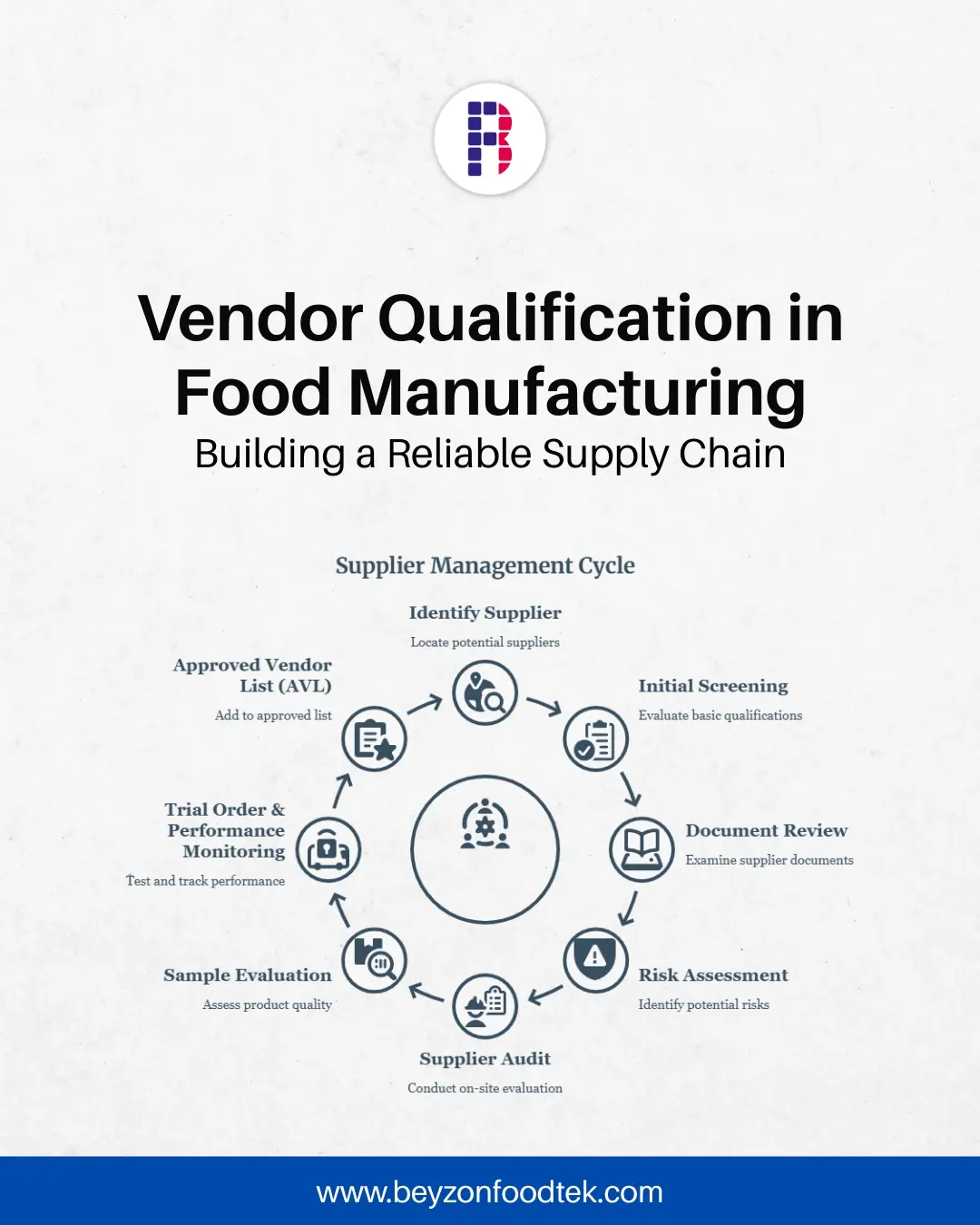
Approved suppliers are generally maintained in an Approved Vendor List (AVL), which serves as the organization’s authorized source for procurement.
Why Vendor Qualification Is Important
Raw materials account for a significant portion of product quality variation in food manufacturing. Differences in ingredient composition, moisture content, particle size, microbiological quality, or packaging specifications can directly influence production efficiency and finished product quality.
For example, flour with varying protein content can change dough absorption, mixing characteristics, and final loaf volume in commercial bakeries. Similarly, inconsistent pectin quality may affect gel formation in jams, while variations in milk solids can influence the texture of dairy products.
Packaging materials can also create operational challenges. Corrugated cartons with poor dimensional accuracy may reduce the efficiency of automatic cartoning machines, resulting in frequent stoppages and reduced Overall Equipment Effectiveness (OEE). Likewise, flexible pouches with inconsistent sealing layers can lead to seal failures, product leakage, and customer complaints.
A structured vendor qualification process helps manufacturers reduce these risks before materials enter commercial production.
Supplier Assessment
Supplier assessment evaluates whether a vendor possesses the infrastructure, systems, and operational capability required to consistently supply quality materials.
Typical assessment areas include:
- Manufacturing infrastructure
- Process capability
- Laboratory facilities
- Hygiene and sanitation practices
- Quality Management Systems
- Food Safety Management Systems
- Production capacity
- Business continuity
Many leading food manufacturers also conduct supplier audits to evaluate Good Manufacturing Practices (GMP), warehouse conditions, allergen controls, pest management programs, calibration systems, and traceability procedures before approving suppliers.[2]
Documentation Review
Technical documentation provides evidence that supplier processes comply with customer and regulatory requirements.
Common documents reviewed include:
- Product specifications
- Certificate of Analysis (COA)
- Allergen declarations
- Food safety certifications
- Regulatory compliance declarations
- Packaging specifications
- Shelf-life information
- Material Safety Data Sheets (where applicable)
Reviewing these documents helps manufacturers verify material suitability before commercial procurement begins.
Sample Evaluation Under Production Conditions
Documentation alone cannot confirm manufacturing performance.
Many food manufacturers conduct trial production using supplier samples before approving commercial purchases.
For example:
- A starch may satisfy laboratory specifications but behave differently during high-temperature cooking.
- A seasoning blend may produce acceptable flavour yet disperse unevenly during large-scale ribbon blending.
- Plastic containers may pass dimensional inspection but fail on high-speed filling and capping equipment due to tolerance variations.
Trial batches allow Production, Quality, and R&D teams to evaluate process compatibility, product consistency, yield, and packaging performance before supplier approval.
Monitoring Supplier Performance
Vendor qualification continues long after initial approval.
High-performing food manufacturers continuously monitor supplier performance using measurable Key Performance Indicators (KPIs).
Typical KPIs include:
- On-time delivery
- Incoming material acceptance rate
- Number of rejected lots
- Complaint frequency
- Corrective action closure time
- Documentation accuracy
- Supply continuity
- Response time for quality issues
Regular supplier performance reviews help identify trends before they affect production efficiency or customer satisfaction.
Managing High-Risk Suppliers
Not all suppliers present the same level of operational risk.
Manufacturers often classify suppliers based on the potential impact of their materials on food safety and product quality.
High-risk supplier categories typically include:
- Dairy ingredients
- Meat and poultry products
- Spices and herbs
- Fresh produce
- Functional food ingredients
- Food-contact packaging materials
For example, spices have historically required greater microbiological control because they are agricultural products that may carry higher microbial loads if not properly processed. Consequently, many manufacturers implement stricter sampling plans, supplier audits, and incoming inspection procedures for spice suppliers than for lower-risk materials.
Risk-based qualification enables manufacturers to focus resources where supplier performance has the greatest impact.
Vendor Qualification and Operations Excellence
Vendor qualification is not only a procurement activity—it directly influences manufacturing performance.
Reliable suppliers help manufacturers:
- Improve manufacturing throughput
- Reduce raw material variability
- Minimize production interruptions
- Improve first-pass quality
- Optimize inventory planning
- Reduce material wastage
- Lower procurement risks
- Improve customer service levels
When Procurement, Quality, Production, and Stores work together using structured supplier management systems, organizations gain greater operational visibility and improve decision-making across the entire supply chain.
These principles align closely with Operations Management & Excellence, where effective systems, standardized processes, and performance tracking methods support business growth and operational sustainability.
The Role of Beyzon Foodtek Pvt. Ltd.
Beyzon Foodtek Pvt. Ltd. helps food manufacturers build reliable supplier management systems that support operational excellence throughout the manufacturing value chain.
This includes support in areas such as:
- Vendor qualification systems
- Operations Management & Excellence
- Food Safety Management Systems
- Process optimization
- Manufacturing digitalization
- Supply chain improvement
- Production efficiency enhancement
By integrating supplier qualification with manufacturing operations, Beyzon helps organizations improve manufacturing throughput, reduce wastage, optimize inventory levels, improve product quality, reduce process time, and strengthen overall business performance.
Conclusion
Vendor Qualification in Food Manufacturing forms the foundation of a reliable supply chain. By systematically evaluating supplier capability, validating material performance, and continuously monitoring supplier performance, manufacturers can reduce operational risks while improving product quality, food safety, and production efficiency.
As supply chains become more complex and customer expectations continue to rise, strong vendor qualification systems are becoming an essential component of successful food manufacturing operations. For Beyzon Foodtek Pvt. Ltd., building structured supplier management systems is an important step toward creating sustainable Operations Management & Excellence.
FAQs
1. What is vendor qualification?
It is the process of evaluating and approving suppliers before commercial procurement.
2. Why is vendor qualification important?
It helps ensure consistent raw material quality, food safety, and reliable manufacturing operations.
3. What documents are reviewed during supplier qualification?
Manufacturers commonly review product specifications, Certificates of Analysis (COAs), certifications, compliance declarations, and quality documents.
4. How often should suppliers be re-evaluated?
Suppliers should be reviewed periodically based on their risk category, performance, and business requirements.
5. How does vendor qualification improve manufacturing performance?
Reliable suppliers reduce process variability, improve production efficiency, minimize downtime, and support consistent product quality.
Sources
- Food Safety and Standards Authority of India. (2023). Food Safety Management System (FSMS) Guidance Documents. https://www.fssai.gov.in
- Global Food Safety Initiative. (2024). GFSI Benchmarking Requirements. https://mygfsi.com
- Codex Alimentarius Commission. (2022). General Principles of Food Hygiene (CXC 1-1969). Food and Agriculture Organization & World Health Organization. https://www.fao.org/fao-who-codexalimentarius
- Nestlé. (2023). Nestlé Responsible Sourcing Standard. https://www.nestle.com