Introduction
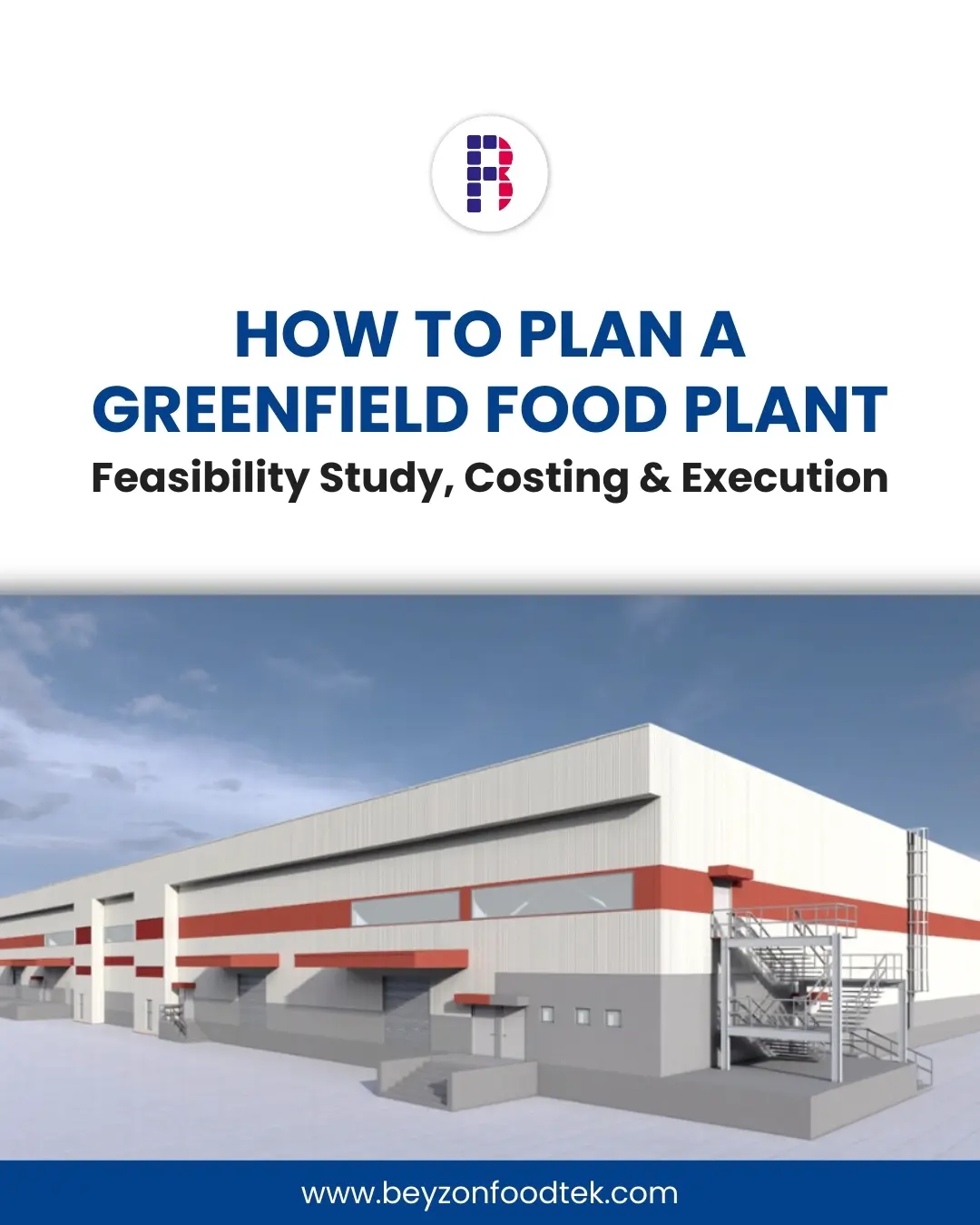
How to plan a greenfield food plant is a critical question for food manufacturers looking to expand capacity, enter new product categories, or build future-ready operations. A greenfield project involves setting up a food processing facility from the ground up, including land selection, plant design, utilities, manpower, compliance, and supply chain integration.
In the Indian food industry, greenfield projects are shaped by factors such as FSSAI regulations, state-specific incentives, infrastructure availability, raw material proximity, and evolving consumer demand. Without structured planning, such projects often face cost overruns, delayed commissioning, or underutilised capacity. A disciplined approach across feasibility, costing, and execution ensures that the plant is viable, scalable, and compliant from day one.
- Understanding Greenfield Food Plant Planning
A greenfield food plant refers to setting up a completely new food manufacturing facility from scratch on a new site. Unlike expansion or modification of an existing unit, greenfield projects require comprehensive planning of infrastructure, utilities, compliance, manpower, and operations.
These projects are capital-intensive and involve multiple stakeholders such as consultants, equipment suppliers, civil contractors, and regulatory authorities. Therefore, proper planning from day one is essential to avoid delays, cost overruns, and operational inefficiencies.
Key decisions before starting:
- Selection of product category and variants
- Production capacity planning based on market demand
- Target market (retail, institutional, export, private label)
- Level of automation and investment range
- Business model and growth vision
Clarity at this stage forms the foundation for all future planning.
- Feasibility Study for a Greenfield Food Plant
A feasibility study helps determine whether the proposed food plant is technically viable, financially feasible, and operationally sustainable. This step should always be completed before finalizing land or starting construction.
- Market Feasibility
Understanding the market is critical before setting up production.
This includes:
- Demand analysis for selected product category
- Competitor landscape and pricing trends
- Identification of target customers and sales channels
- Expected sales volume and margins
- Future growth potential
A strong market feasibility ensures that the plant will operate at optimal capacity and generate sustainable revenue.
- Location & Site Feasibility
The location of a food plant directly impacts logistics cost, operational efficiency, and compliance ease.
Key considerations:
- Availability of industrial land or MIDC plots
- Proximity to raw materials and suppliers
- Transportation and connectivity to markets
- Availability of skilled and unskilled labour
- Power, water, and fuel availability
- State government incentives and subsidies
Selecting the right location can significantly reduce long-term operational costs.
- Regulatory & Compliance Feasibility
Food processing units must comply with various statutory requirements. Early understanding of these approvals prevents costly delays during execution.
Important approvals include:
- FSSAI licensing requirements
- Pollution control board approvals
- Factory license applicability
- Fire and safety compliance
- Local authority permissions
Planning compliance in advance ensures smoother project execution.
- Operational Feasibility
Operational feasibility evaluates whether the plant can run efficiently after commissioning.
It includes:
- Raw material sourcing stability
- Storage and warehouse requirements
- Utility needs (electricity, water, steam, compressed air)
- Manpower availability and skill requirements
- Distribution and logistics planning
- Financial Feasibility
Financial feasibility determines the economic viability of the project.
It covers:
- Estimated capital investment
- Monthly operating cost
- Revenue projections and margins
- Break-even point and ROI
- Working capital requirement
A clear financial feasibility helps investors make informed decisions and secure funding if required.
C. Costing and Financial Planning
Accurate project costing is essential to avoid budget overruns and financial stress during execution.
- Capital Investment Cost
Land & Site Development
This includes land purchase or lease, land development, leveling, compound wall, internal roads, and drainage systems.
Building & Civil Construction
Civil cost depends on plant size and product category. It generally includes:
- Production area
- Raw material and finished goods warehouse
- Utility and service areas
- Office and staff facilities
Proper civil planning ensures smooth material and manpower movement.
Machinery & Equipment
Major investment goes into processing and packaging machinery. Costing should include:
- Core processing equipment
- Packaging lines
- Material handling systems
- Freight and installation
Utilities & Infrastructure
Utilities are the backbone of any food plant:
- Electrical systems and panels
- Water storage and plumbing
- Drainage and waste management
- Fire safety systems
- Ventilation and HVAC
- Pre-Operative & Approval Cost
Before commercial production begins, several pre-operative expenses are incurred:
- Licenses and statutory approvals
- Consultancy and design fees
- Trial production expenses
- Certification and documentation
These costs should be included in the project budget.
- Working Capital Requirement
Even after plant setup, funds are required to run operations smoothly.
Working capital includes:
- Raw material inventory
- Packaging materials
- Salaries and wages
- Electricity and fuel
- Distribution and logistics
- Maintenance expenses
Planning at least 3–6 months of working capital is advisable.
- Hidden Costs Often Ignored
Many projects face financial stress due to unplanned expenses:
- Project delays and interest cost
- Design changes and rework
- Initial production losses
- Slow market penetration
- Compliance modifications
Including a contingency provision helps manage uncertainties.
D. Execution Framework for Greenfield Food Plant
Execution of a food plant project requires coordination between multiple agencies and technical teams. A structured execution framework ensures timely completion and cost control.
Pre-Project Planning
- Understanding client requirements and production goals
- Process planning and layout development
- Utility and infrastructure planning
- Approval planning and documentation
Engineering & Finalization
- Equipment planning and vendor discussions
- Civil and building requirement planning
- Utility design and integration
- Compliance alignment
Project Implementation
- Civil construction and infrastructure setup
- Equipment manufacturing and delivery
- Installation and utility connections
- Coordination between vendors and teams
Commissioning & Commercial Production
- Trial production and testing
- Process validation and stabilization
- Quality checks and documentation
- Commercial production start
E. Common Challenges in Greenfield Food Projects
- Lack of proper feasibility study
- Underestimation of project cost
- Poor layout and infrastructure planning
- Approval delays
- Vendor coordination issues
- Insufficient working capital
Addressing these risks through proper planning ensures smoother execution.
F. Business Benefits of Structured Greenfield Planning
A disciplined greenfield planning approach delivers long-term advantages:
- Controlled capital and operating costs
- Faster stabilisation and ramp-up
- Improved food safety and audit readiness
- Higher asset utilisation and scalability
- Reduced operational risk and downtime
G. Role of Beyzon Foodtek Pvt. Ltd. in Greenfield Food Plant Projects
Planning and executing a greenfield food plant requires coordination across strategy, engineering, compliance, and operations. Beyzon Foodtek Pvt. Ltd. supports food manufacturers through:
- Feasibility studies covering market, technical, and financial viability
- Capex and opex modelling with phased expansion planning
- Process flow, layout, and utility design for food safety and efficiency
- Vendor evaluation, URS preparation, and project coordination
- Support during commissioning, stabilisation, and SOP implementation
Conclusion
How to plan a greenfield food plant is not just a technical exercise but a strategic decision that shapes long-term competitiveness. A well-structured approach covering feasibility, costing, layout, execution, and compliance transforms a greenfield site into a resilient and efficient food manufacturing operation.
The success of such projects depends on aligning data, processes, people, and infrastructure from the start. With disciplined planning and expert execution support, greenfield food plants can achieve faster returns, stronger compliance, and sustainable growth in a competitive food industry landscape.
FAQs
Why is a feasibility study critical for a greenfield food plant?
It validates demand, costs, technical capability, and compliance feasibility before major capital is committed.
What are the biggest cost drivers in greenfield food plants?
Civil construction, processing equipment, utilities, automation, and energy consumption are major cost components.
How long does it take to commission a greenfield food plant?
Depending on scale and complexity, commissioning typically takes 12 to 24 months.
Can greenfield plants be planned for future expansion?
Yes. Modular layouts, scalable utilities, and phased capacity planning support future growth.
Should digital systems be implemented at the start?
Yes. Early implementation improves traceability, control, and operational discipline from day one.