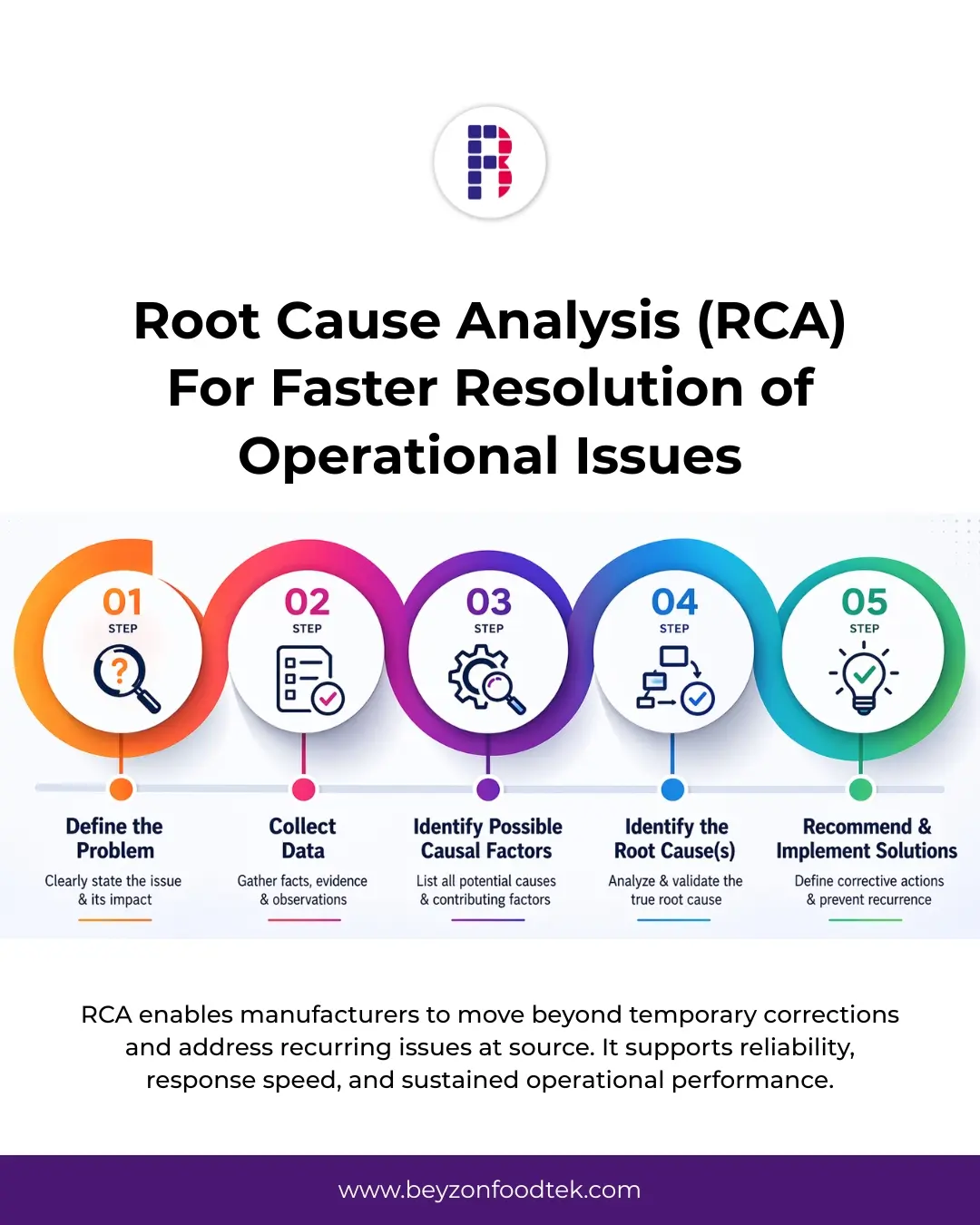
Root Cause Analysis, commonly referred to as RCA, is one of the most important disciplines in operational management because it helps organisations move beyond symptom-based response and toward permanent problem resolution. In manufacturing environments, operational issues rarely remain isolated. A recurring downtime event, a repeated quality failure, a dispatch delay, or an unexpected spike in wastage can continue consuming time and resources if the organisation only treats the immediate effect rather than the underlying cause. RCA IS a collective term for approaches, tools, and techniques used to uncover the causes of problems, while also noting that RCA must form part of a larger problem-solving effort if it is to create real improvement.
This is why RCA matters not only for problem accuracy, but also for problem speed. Many operational delays are prolonged because teams keep revisiting the same issue through troubleshooting, temporary workarounds, or repeated escalation. Lean thinking distinguishes this from structured problem-solving, which is used for gap-from-standard problems and focuses on problem definition, root cause analysis, countermeasures, checks, standards, and follow-up to prevent recurrence. In that sense, RCA helps plants solve operational issues faster not by rushing analysis, but by reducing repeat failure.
For Beyzon Foodtek Pvt. Ltd., Pune, this subject fits naturally within its broader focus on management and technology services for the food industry, with stated strengths in operations management & excellence, manufacturing capacity improvement, mechanization & automation, digitalization in manufacturing, food safety, and technology support. Within that operating philosophy, RCA is not an isolated quality tool. It is part of the management discipline required to improve plant reliability, consistency, and future readiness.
Understanding Root Cause Analysis in Operations
RCA is a structured method used to investigate why a problem happened, why it was not prevented, and what must change so that it does not happen again. It is especially useful in manufacturing because many operational problems are interconnected. A downtime incident may involve maintenance practice, operator method, material condition, line settings, or planning discipline at the same time. ASQ notes that RCA draws on multiple methods and tools rather than one single formula, and that better outcomes are generally achieved when the analysis is done by a small team rather than by one person alone.
In plant environments, RCA is commonly applied to issues such as:
- Recurring Downtime
- Repeated Quality Defects
- High Rework Or Scrap
- Changeover Delays
- Yield Losses
- Packaging Failures
- Material Variance
- Food Safety Or Hygiene Deviations
The real objective is not simply to explain what happened. The objective is to identify the cause that, if removed or controlled, will materially reduce recurrence.
Why RCA Helps Solve Issues Faster
At first glance, RCA may appear slower than immediate troubleshooting. In practice, the opposite is often true for recurring operational issues. Quick fixes restore production for the moment, but they frequently leave the underlying mechanism untouched. Lean’s 5 Whys guidance makes this point clearly: if a team only replaces the visible failed part or reacts to the immediate symptom, the same failure can recur because the true cause was never eliminated.
RCA improves operational speed by helping teams:
- Separate Symptoms From Causes
- Focus Effort On The Highest-Leverage Issue
- Reduce Repeat Breakdowns And Rework
- Improve Corrective Action Quality
- Strengthen Cross-Functional Learning
- Standardize Preventive Countermeasures
In other words, RCA reduces wasted motion in problem-solving itself. Instead of solving the same issue five times, the plant works toward solving it once with greater discipline.
A Practical RCA Flow for Manufacturing Operations
A strong RCA process should be structured enough to produce reliable conclusions, but practical enough to be used in daily manufacturing environments. ASQ’s RCA training framework highlights key elements such as cause-and-effect analysis, 5 Whys, FMEA, data collection, control charts, and problem-solving models including PDCA, 8D, and DMAIC.
A practical operational RCA flow often includes:
- Define The Problem Clearly
- Confirm The Gap From Standard Or Expected Performance
- Collect Facts From The Actual Process
- Form A Cross-Functional Team
- Identify Possible Causes
- Test The Cause-And-Effect Relationship
- Confirm The Most Likely Root Cause
- Define Corrective And Preventive Actions
- Verify Effectiveness
- Update Standards, Checks, And Follow-Up
The last step is especially important. ASQ notes that RCA alone does not create results unless it is integrated into broader corrective action and improvement activity. Likewise, ASQ’s PDCA guidance emphasizes that improvement depends on carrying change through a repeatable cycle of planning, testing, checking, and acting.
Core RCA Tools That Matter
Not every problem requires the same tool. The sophistication of RCA lies in choosing the right method for the nature of the issue.
Common RCA tools include:
- 5 Whys
- Cause-And-Effect Or Fishbone Analysis
- Data Charts And Control Charts
- Failure Mode And Effects Analysis
- Fault Tree Analysis
- Logic Trees
- PDCA-Based Corrective Action Loops
The 5 Whys remains one of the most practical tools in operations because it forces teams to move below obvious symptoms. Lean Enterprise Institute defines it as the practice of asking why repeatedly to discover the root cause, and also notes that the number five is not literal; the purpose is to keep asking until the underlying cause is reached. Lean further stresses that RCA should be grounded in actual cause-and-effect at the gemba, not in conference-room opinion.
Fishbone or cause-and-effect diagrams are also useful when problems have multiple possible sources. ASQ’s quality tools resources list cause-and-effect diagrams among the core cause analysis tools used to support structured investigation.
Best Practices for Faster and Better RCA
RCA becomes far more effective when organisations treat it as a disciplined operational habit rather than an occasional exercise.
Best practices include:
- Go To The Actual Place Where The Problem Occurred
- Use Facts, Data, And Observation Before Opinion
- Involve The People Closest To The Process
- Define The Problem Narrowly And Specifically
- Distinguish Immediate Containment From Root Cause Removal
- Test Whether The Proposed Cause Truly Explains The Effect
- Verify That Corrective Action Worked
- Update SOPs, Checks, And Training Where Needed
These principles are strongly supported by both ASQ and Lean sources, which emphasize team-based analysis, factual investigation, cause-and-effect validation, and follow-up as core parts of effective RCA.
Common Reasons RCA Fails
RCA often fails not because the method is weak, but because the discipline is weak.
Common failure points include:
- Treating The Symptom As The Cause
- Closing Actions Without Verification
- Conducting Analysis Away From The Actual Process
- Using Opinion Instead Of Evidence
- Stopping At The First Plausible Answer
- Failing To Involve Operations, Maintenance, Quality, And Planning Together
- Not Translating Findings Into Standard Changes
When this happens, RCA turns into paperwork instead of plant improvement. Lean’s distinction between troubleshooting and structured problem-solving is useful here. Immediate fixes may restore output, but they often do not prevent recurrence unless the deeper cause is identified and controlled.
How Beyzon Foodtek Can Support RCA-Led Operational Improvement
For food and process manufacturers, RCA should sit inside a larger system of operational control. Beyzon Foodtek Pvt. Ltd., Pune presents itself as a management and technology services company for the food industry, led by professionals with decades of experience across small to large food manufacturing businesses and MNC environments. Its service positioning around operations management & excellence, manufacturing process mechanization & automation, digitalization, food safety, and technology support makes RCA a natural component of its consulting approach.
In practical terms, Beyzon Foodtek can support manufacturers by helping them:
- Identify Recurring Operational Losses
- Structure RCA Around Plant Priorities
- Connect RCA With Daily Review And KPI Systems
- Improve Cross-Functional Problem-Solving Discipline
- Link Corrective Action To SOPs And Controls
- Strengthen Operational Excellence Through Better Tracking And Follow-Up
Beyzon’s own manufacturing-efficiency content stresses that operational excellence begins with clarity, meaningful tracking, and systems that help every machine, person, and minute add value. RCA supports exactly that objective by helping plants remove the causes that repeatedly drain performance.
Conclusion
Root Cause Analysis is one of the most effective ways to solve operational issues faster because it reduces recurrence, improves corrective action quality, and strengthens managerial discipline. It shifts the plant away from repeated firefighting and toward more reliable problem-solving. When used properly, RCA does not slow operations down. It prevents operations from being slowed down again and again by the same unresolved causes.
For Beyzon Foodtek Pvt. Ltd., Pune, the relevance of RCA fits directly within a broader commitment to manufacturing capacity, food safety, operational excellence, digitalization, and future-ready plant systems. In that context, RCA is not simply an investigation technique. It is a practical foundation for stronger operational performance.
FAQs
1. What is Root Cause Analysis in manufacturing?
RCA is a structured method used to identify the underlying cause of recurring operational problems so they can be solved more permanently.
2. How is RCA different from troubleshooting?
Troubleshooting usually addresses the immediate symptom. RCA goes deeper to identify and eliminate the underlying cause.
3. What tools are commonly used in RCA?
Common tools include 5 Whys, Fishbone analysis, FMEA, data charts, control charts, and PDCA-based corrective action.
4. Why does RCA help solve issues faster?
It helps plants avoid repeated breakdowns, repeated rework, and repeated firefighting by targeting the cause that drives recurrence.
5. How can Beyzon Foodtek Pvt. Ltd., Pune support RCA implementation?
Beyzon Foodtek can help manufacturers structure RCA around plant priorities, connect it with daily reviews and KPI systems, and strengthen operational follow-through across functions.