Cleaning validation is one of the most important control systems within food manufacturing because it helps verify that cleaning procedures are consistently capable of removing product residues, allergens, microorganisms, cleaning chemicals, and other contaminants from equipment and production environments. Although cleaning activities are often associated with audit readiness and regulatory compliance, the actual importance of cleaning validation extends far beyond inspection requirements. It is fundamentally linked to product safety, process reliability, operational consistency, contamination prevention, and consumer protection.
In modern food processing environments, cleaning cannot be treated as a routine housekeeping activity alone. Manufacturing systems today are increasingly complex, involving multi-product lines, allergen-sensitive formulations, automated equipment, high-throughput processing, and strict hygiene expectations. Under such conditions, ineffective or poorly controlled cleaning systems can create significant operational and food safety risks.
This is why cleaning validation plays a critical role in establishing scientific evidence that a cleaning process is effective, repeatable, and suitable for the intended manufacturing operation.
For Beyzon Foodtek Pvt. Ltd., Pune, the subject aligns naturally with its broader focus on food safety systems, operational excellence, manufacturing process optimization, hygiene management, and future-ready food manufacturing practices.
Understanding Cleaning Validation in Food Manufacturing
Cleaning validation refers to the documented process of demonstrating that a cleaning procedure consistently reduces contamination risks to an acceptable and predefined level.
The objective is not simply to confirm that equipment appears visually clean. Instead, cleaning validation seeks to verify through structured assessment and evidence that residues capable of affecting food safety, quality, allergen control, or product integrity have been effectively removed.
In food manufacturing environments, cleaning validation may address the removal of:
- Product residues
- Allergen traces
- Microbial contamination
- Cleaning chemical residues
- Lubricants and processing aids
- Environmental contaminants
- Cross-product carryover materials
Validation activities are particularly important in facilities where multiple products are processed using shared equipment or where allergen-containing and non-allergen products operate within the same manufacturing system.
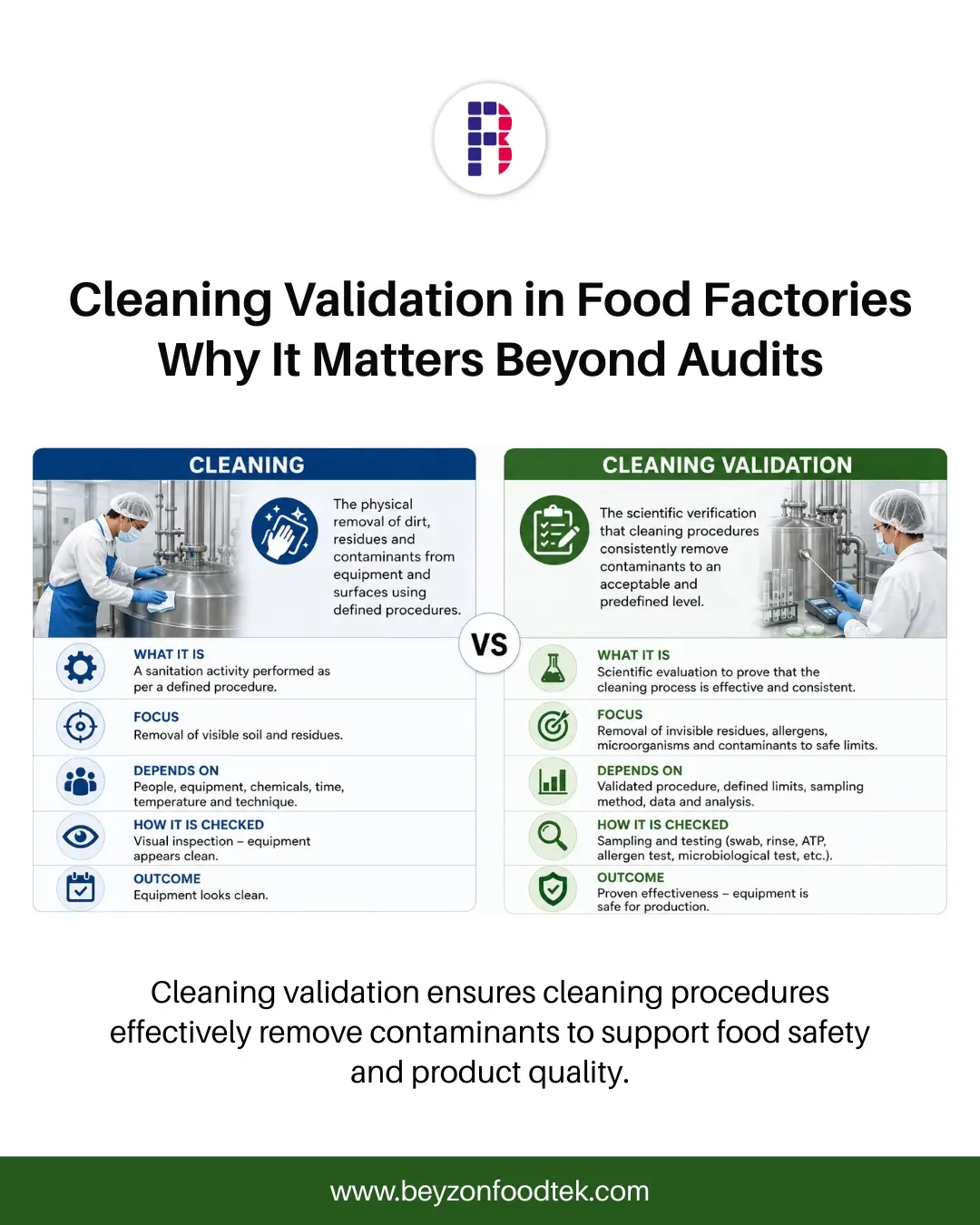
The Difference Between Cleaning and Cleaning Validation
A common misunderstanding in manufacturing operations is the assumption that performing cleaning activities automatically guarantees cleaning effectiveness.
In practice, cleaning and cleaning validation are two different concepts.
Cleaning
Cleaning refers to the actual removal of soil, residues, contaminants, and unwanted material from equipment and surfaces using defined procedures.
Cleaning Validation
Cleaning validation refers to the scientific verification that the cleaning procedure consistently achieves the required hygiene outcome under actual operating conditions.
This distinction is important because visually clean equipment may still contain:
- Allergen residues
- Microbial contamination
- Biofilm formation
- Cleaning chemical traces
- Microscopic product carryover
Validation provides evidence that cleaning performance is both measurable and reliable.
Why Cleaning Validation Matters Beyond Audits
In many manufacturing environments, cleaning validation is sometimes approached primarily as a documentation requirement for audits, certifications, or customer compliance reviews. However, its operational importance is far broader.
A scientifically validated cleaning system supports several critical manufacturing objectives simultaneously, including:
- Food safety protection
- Cross-contamination prevention
- Allergen management
- Product quality consistency
- Shelf-life reliability
- Equipment hygiene control
- Operational standardization
- Consumer protection
- Regulatory confidence
- Brand protection
Without proper validation, cleaning effectiveness may depend excessively on operator judgement, visual inspection, or inconsistent cleaning practices, all of which increase operational risk.
Cleaning Validation and Food Safety
One of the primary purposes of cleaning validation is the prevention of contamination events that may compromise food safety.
Food manufacturing environments frequently involve conditions that support contamination risk, including:
- Shared processing equipment
- Moisture-rich environments
- Protein and fat residues
- Complex piping systems
- Difficult-to-access equipment surfaces
- Frequent product changeovers
- High production throughput
If cleaning systems are not properly validated, residues may remain within equipment dead zones, transfer systems, seals, joints, conveyors, or processing surfaces.
These residues can contribute to:
- Microbial growth
- Allergen carryover
- Product spoilage
- Cross-contamination
- Chemical contamination
- Reduced product stability
Cleaning validation therefore functions as a preventive control mechanism within broader food safety management systems.
Key Components of Cleaning Validation
A structured cleaning validation program generally includes several interconnected elements.
Identification of Critical Equipment
Certain equipment presents higher contamination risk due to:
- Complex design geometry
- Difficult cleaning access
- Product retention zones
- Shared processing use
- Moisture accumulation potential
These areas require particular validation focus.
Definition of Cleaning Procedures
Validated cleaning systems require standardized procedures that define:
- Cleaning sequence
- Cleaning chemicals used
- Concentration levels
- Water quality requirements
- Cleaning duration
- Temperature parameters
- Mechanical action requirements
- Rinse procedures
- Verification methods
Standardization is essential for repeatability.
Residue and Contamination Limits
Acceptable residue levels must be scientifically defined based on:
- Food safety risk
- Allergen thresholds
- Product sensitivity
- Regulatory guidance
- Process capability
These limits establish measurable cleaning acceptance criteria.
Sampling and Verification Methods
Cleaning validation often involves structured testing methods such as:
- Swab testing
- Rinse sampling
- ATP testing
- Allergen testing
- Microbiological analysis
- Visual inspection verification
Different methods may be required depending on the nature of the manufacturing process and contamination risk.
Documentation and Record Control
Cleaning validation must be properly documented to ensure traceability, consistency, and verification capability.
Documentation typically includes:
- Validation protocols
- Test methods
- Acceptance criteria
- Sampling records
- Corrective actions
- Verification reports
- Review and approval records
Cleaning Validation and Allergen Control
Allergen management has become one of the most significant reasons for robust cleaning validation in food manufacturing.
Even extremely small quantities of allergen carryover may present serious consumer health risks. Consequently, manufacturers processing products containing allergens such as milk, nuts, soy, gluten, or egg ingredients must ensure that cleaning systems effectively prevent cross-contact.
Cleaning validation supports allergen management by helping manufacturers:
- Verify allergen removal effectiveness
- Reduce cross-contact risk
- Improve changeover reliability
- Support allergen labeling accuracy
- Strengthen consumer safety protection
In facilities with shared equipment usage, cleaning validation is often one of the most important allergen control measures available.
Operational Benefits of Effective Cleaning Validation
Beyond compliance and food safety, validated cleaning systems also contribute to broader operational improvement.
Well-structured cleaning validation programs can help organizations:
- Reduce unplanned contamination events
- Improve process consistency
- Reduce product rejection risk
- Improve production scheduling confidence
- Standardize sanitation performance
- Reduce variability between cleaning shifts
- Improve audit preparedness
- Strengthen customer confidence
- Support operational discipline
In this sense, cleaning validation contributes not only to hygiene control but also to manufacturing reliability and operational stability.
Common Challenges in Cleaning Validation
Food manufacturers frequently encounter challenges while implementing or maintaining cleaning validation systems.
Common issues include:
- Inconsistent cleaning execution
- Poorly designed equipment
- Difficult-to-access cleaning areas
- Inadequate sanitation training
- Lack of defined residue limits
- Insufficient sampling plans
- Incomplete documentation systems
- Infrequent revalidation practices
- Excessive dependence on visual inspection
These challenges become more significant as manufacturing complexity and product diversity increase.
Cleaning Validation and Continuous Improvement
Cleaning validation should not be treated as a one-time exercise conducted only during commissioning or certification audits.
Manufacturing conditions frequently change due to:
- New product introductions
- Equipment modifications
- Process parameter changes
- Cleaning chemical changes
- Increased production volumes
- Allergen profile changes
As a result, cleaning validation systems require ongoing review, verification, and periodic revalidation.
Continuous improvement approaches may involve:
- Monitoring recurring contamination trends
- Reviewing sanitation deviations
- Improving cleaning efficiency
- Optimizing cleaning cycle duration
- Reducing water and chemical consumption
- Enhancing sanitation standardization
This allows cleaning systems to evolve alongside manufacturing operations.
How Beyzon Foodtek Supports Food Safety and Cleaning Systems
Beyzon Foodtek Pvt. Ltd., Pune positions itself as a management and technology services company for the food industry with expertise in food safety systems, operational excellence, process optimization, manufacturing efficiency, and technology-driven industrial improvement.
Within food manufacturing environments, cleaning validation forms an important component of broader hygiene and food safety management systems.
Beyzon Foodtek can support manufacturers through:
- Food safety system strengthening
- Cleaning process evaluation
- Hygiene management improvement
- Operational standardization support
- Manufacturing process optimization
- Sanitation system review
- Cross-functional operational alignment
- Process control improvement initiatives
Strong cleaning systems contribute directly to safer, more reliable, and more scalable food manufacturing operations.
Conclusion
Cleaning validation is a critical operational and food safety discipline within modern food manufacturing because it provides scientific assurance that cleaning procedures are capable of consistently controlling contamination risks. Its importance extends significantly beyond audit compliance and documentation requirements.
Effective cleaning validation supports contamination prevention, allergen management, product consistency, process reliability, operational standardization, and consumer protection. In increasingly complex manufacturing environments, validated cleaning systems are essential for maintaining both food safety integrity and operational confidence.
For Beyzon Foodtek Pvt. Ltd., Pune, cleaning validation aligns directly with broader commitments toward food safety, operational excellence, manufacturing optimization, and future-ready processing systems within the food industry.
FAQs
1. What is cleaning validation in food manufacturing?
Cleaning validation is the documented process of verifying that cleaning procedures consistently remove residues, contaminants, allergens, and microorganisms to acceptable levels.
2. Why is cleaning validation important beyond audits?
Cleaning validation supports food safety, allergen control, contamination prevention, operational consistency, consumer protection, and manufacturing reliability beyond regulatory compliance.
3. What is the difference between cleaning and cleaning validation?
Cleaning refers to performing sanitation activities, while cleaning validation scientifically verifies that the cleaning process is consistently effective.
4. Why is cleaning validation important for allergen control?
It helps verify that allergen residues are effectively removed from shared equipment, reducing the risk of allergen cross-contact between products.
5. How can Beyzon Foodtek Pvt. Ltd., Pune support cleaning validation systems?
Beyzon Foodtek can assist manufacturers with food safety system improvement, sanitation process evaluation, operational standardization, hygiene management, and manufacturing process optimization.