Factory layout design is one of the foundational elements of food manufacturing because it directly influences operational efficiency, food safety, manpower utilization, material handling, production continuity, hygiene management, and long-term scalability. In industrial food processing environments, layout planning is not merely an architectural exercise. It is a strategic operational decision that determines how effectively materials, personnel, equipment, utilities, and products interact within the manufacturing system.
An inadequately designed factory layout can create persistent operational inefficiencies such as excessive material movement, process bottlenecks, cross-contamination risks, congested work zones, delayed production cycles, poor supervision visibility, and increased labour dependency. Over time, these inefficiencies can negatively affect manufacturing cost, production reliability, product quality consistency, and regulatory compliance.
Conversely, a scientifically planned factory layout enables smoother production flow, improved hygiene segregation, safer operational movement, better equipment accessibility and stronger manufacturing control. In modern food manufacturing, where operational excellence increasingly depends upon mechanization, automation, traceability, and process standardization, layout design plays an even more critical role.
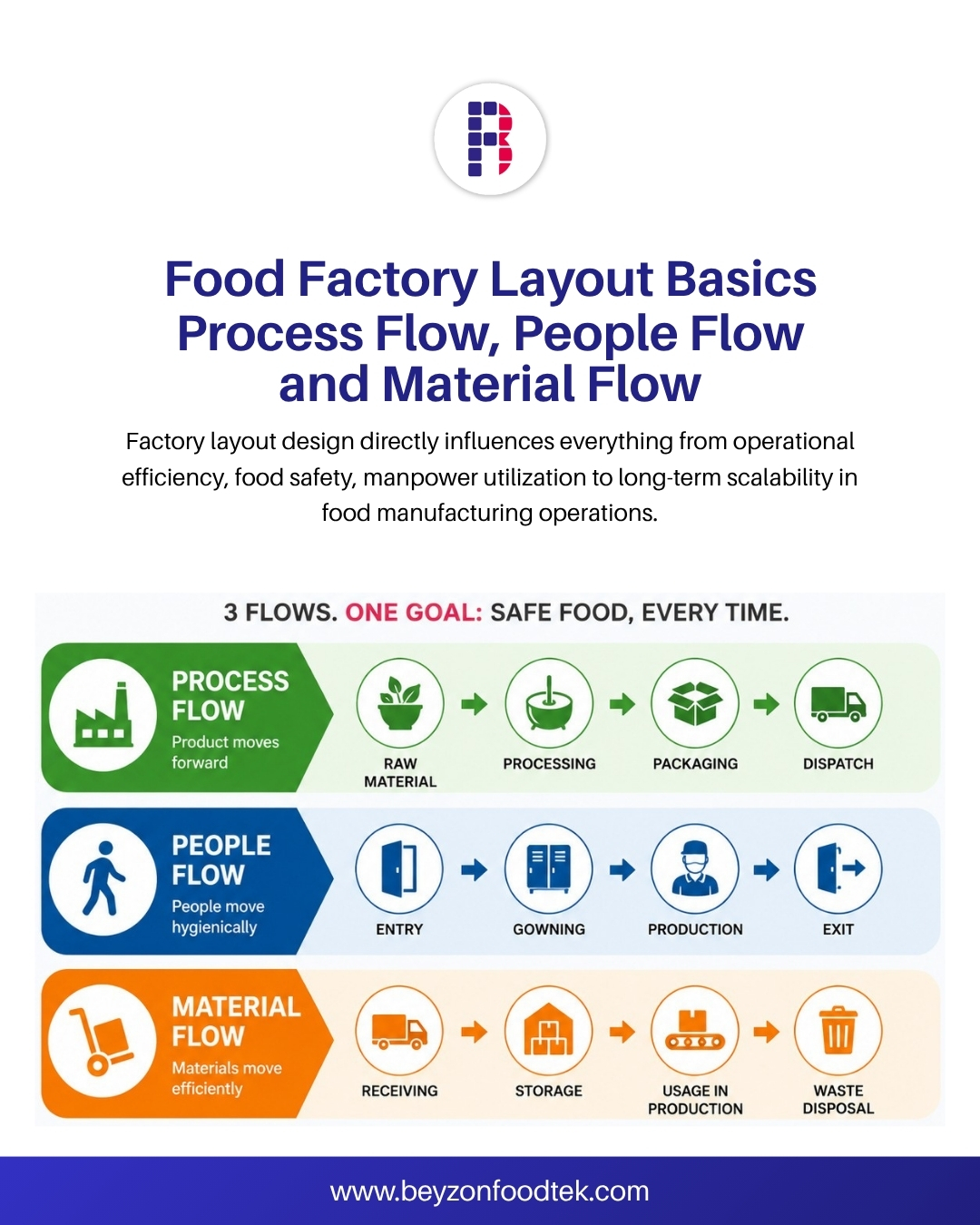
Three interrelated components form the core of effective food factory layout planning:
- Process Flow
- People Flow
- Material Flow
Together, these flows determine how efficiently and safely the manufacturing system functions on a daily basis.
For Beyzon Foodtek Pvt. Ltd., Pune, this subject aligns directly with its broader focus on operations management, manufacturing process optimization, mechanization, automation, digitalization, food safety systems, and operational excellence within the food industry.
The Importance of Factory Layout in Food Manufacturing
Food manufacturing facilities function as integrated operational systems in which raw materials, packaging components, processing equipment, utilities, personnel, and finished products continuously interact across multiple stages of production.
A properly structured layout is essential because it helps ensure:
- Efficient production movement
- Reduced handling time
- Controlled hygiene segregation
- Improved manpower productivity
- Safer workplace movement
- Better equipment accessibility
- Simplified operational supervision
- Faster cleaning and maintenance activities
- Improved process continuity
- Enhanced future scalability
In contrast, poorly designed layouts often generate recurring operational constraints such as:
- Unnecessary transportation and handling
- Repeated cross-traffic between departments
- Congestion near critical process areas
- Delayed material availability
- Increased contamination risk
- Difficult maintenance access
- Reduced production visibility
- Higher labour requirements
- Lower operational efficiency
In food manufacturing environments, these inefficiencies can have direct implications for both operational cost and food safety compliance.
Understanding Process Flow
Process flow refers to the sequential movement of products and production activities from raw material receipt through processing, packaging, storage, and final dispatch.
An effective process flow should be designed to support logical and uninterrupted production movement with minimal backtracking, crossing, waiting, or unnecessary handling.
A typical food manufacturing process flow may include:
- Raw Material Receiving
- Raw Material Inspection And Storage
- Preparation Or Pre-Processing
- Primary Processing Operations
- Secondary Processing Or Finishing
- Filling And Packaging
- Finished Goods Storage
- Dispatch And Distribution
The objective of process flow design is to ensure that each stage transitions efficiently into the next while maintaining production continuity, hygiene control, and operational clarity.
Operational Significance of Process Flow
Well-designed process flow contributes significantly to manufacturing performance by helping organizations:
- Reduce production delays
- Improve line balancing
- Minimize idle time
- Lower handling losses
- Improve process visibility
- Simplify supervision and coordination
- Support process standardization
- Improve production scheduling reliability
- Strengthen food safety controls
- Facilitate mechanization and automation
In food manufacturing facilities, process flow must additionally support hygienic zoning principles. Raw, semi-processed and finished product areas should be appropriately segregated to minimize contamination risks and maintain product integrity.
Understanding People Flow
People flow refers to the movement patterns of employees, supervisors, quality personnel, maintenance staff, sanitation teams, visitors, and contractors within the manufacturing facility.
In food factories, personnel movement is particularly significant because human activity directly influences both operational efficiency and hygiene management.
People flow planning typically includes:
- Entry and exit pathways
- Change room placement
- Handwashing and hygiene station access
- Controlled production access points
- Internal departmental movement routes
- Maintenance access pathways
- Visitor movement segregation
- Emergency evacuation pathways
An effectively planned people flow system minimizes unnecessary movement while reducing interference with production activities and material handling operations.
Importance of People Flow in Food Processing Facilities
Improperly designed personnel movement systems can contribute to several operational and hygiene-related risks, including:
- Cross-contamination between process zones
- Congestion near critical production areas
- Increased workplace safety hazards
- Hygiene protocol violations
- Delays in supervision and maintenance response
- Reduced operational discipline
For example, unrestricted movement between raw material zones and finished product zones may increase contamination risk if hygiene barriers are not properly maintained.
Accordingly, modern food manufacturing layouts increasingly emphasize controlled personnel pathways, hygiene zoning, and restricted movement protocols as part of broader food safety systems.
Understanding Material Flow
Material flow refers to the movement of raw materials, ingredients, packaging materials, work-in-progress inventory, finished products, waste streams, and auxiliary production inputs throughout the facility.
Material handling is one of the most resource-intensive aspects of manufacturing operations. Consequently, inefficient material flow can significantly increase operational cost, handling time, manpower requirements, and process delays.
An efficient material flow system seeks to:
- Reduce transportation distance
- Minimize repeated handling
- Eliminate unnecessary movement
- Improve storage accessibility
- Reduce congestion points
- Improve inventory visibility
- Enhance dispatch efficiency
- Support production continuity
Key Material Flow Areas in Food Manufacturing
Material movement generally includes:
- Raw material unloading and staging
- Ingredient transfer systems
- Packaging material supply
- Work-in-progress movement
- Finished goods transfer
- Waste and reject handling
- Dispatch and warehouse movement
Each movement path should be designed carefully to reduce operational conflict and support smooth manufacturing continuity.
Integration of Process Flow, People Flow and Material Flow
One of the most common limitations in factory design is the tendency to focus primarily on equipment placement without adequately considering the interaction between personnel movement, material handling, and production flow.
A manufacturing facility may possess advanced machinery and processing capabilities yet continue to experience inefficiencies if:
- Material routes repeatedly intersect with personnel movement
- Operators travel excessive distances
- Maintenance access is obstructed
- Storage placement disrupts workflow
- Hygiene segregation is inadequate
- Work-in-progress movement lacks structure
Effective factory layouts therefore require integrated planning in which process flow, people flow, and material flow function cohesively rather than independently.
Fundamental Principles of Food Factory Layout Design
Several operational principles are widely recognized as essential within food factory layout planning.
Linear and Unidirectional Movement
Whenever operationally feasible, production movement should progress in a forward direction without unnecessary reversal or crossing. Linear movement reduces confusion, simplifies control, and improves process clarity.
Hygienic Segregation
Different operational zones should be physically or functionally segregated according to process risk.
These may include:
- Raw material areas
- High-care processing zones
- Packaging areas
- Finished goods zones
- Utility and maintenance areas
- Waste handling zones
Proper segregation supports both food safety compliance and operational discipline.
Accessibility for Cleaning and Maintenance
Equipment spacing should allow adequate access for sanitation, inspection, maintenance, and repair activities. Restricted access areas often become sources of hygiene and operational challenges.
Operational Visibility and Supervision
Production layouts should support effective supervisory oversight and rapid operational response. Clear visibility improves process monitoring and coordination across departments.
Scalability and Expansion Capability
Factory layouts should account for future production growth, equipment additions, and process modifications. Failure to consider scalability may create major expansion constraints later.
Safety-Oriented Movement Planning
Pedestrian pathways, forklift routes, and material handling systems should be planned carefully to minimize accident risk and improve workplace safety.
Factory Layout and Operational Efficiency
In contemporary food manufacturing, layout design strongly influences operational efficiency initiatives such as:
- Lean manufacturing implementation
- Line balancing
- Mechanization and automation
- Digital production monitoring
- Inventory optimization
- Labour productivity improvement
- Waste reduction programs
Poorly planned layouts frequently undermine these initiatives by introducing unnecessary operational complexity.
Conversely, an optimized layout creates a stronger foundation for:
- Conveyor integration
- Automated handling systems
- Production data tracking
- Reduced manual handling
- Improved production scheduling
- Faster changeovers
- Better process standardization
As manufacturing facilities increasingly pursue higher throughput and greater consistency, layout efficiency becomes a strategic operational advantage.
Common Factory Layout Mistakes
Several recurring errors are commonly observed in food manufacturing layout planning:
- Designing around available building space instead of process requirements
- Inadequate hygiene zoning separation
- Poor integration between departments
- Insufficient storage planning
- Ignoring maintenance accessibility
- Mixing pedestrian and material movement routes
- Creating bottlenecks near packaging operations
- Neglecting future expansion requirements
- Poor waste handling flow design
Such limitations often become increasingly expensive to correct once production operations are fully established.
How Beyzon Foodtek Supports Food Factory Layout Optimization
Beyzon Foodtek Pvt. Ltd., Pune positions itself as a management and technology services organization for the food industry with expertise in operations management, process optimization, mechanization, automation, digitalization, manufacturing efficiency, and food safety systems.
Within food manufacturing environments, factory layout optimization directly supports these operational objectives.
Beyzon Foodtek can support manufacturers through:
- Process flow evaluation and optimization
- Material handling improvement
- Operational bottleneck identification
- Hygiene zoning assessment
- Manufacturing scalability planning
- Mechanization and automation readiness evaluation
- Production efficiency improvement
- Operational systems integration
Effective layout planning establishes a stronger operational foundation for long-term manufacturing performance and future industrial growth.
Conclusion
Factory layout planning is a critical operational discipline within food manufacturing because it influences efficiency, hygiene, safety, manpower utilization, process reliability, and scalability simultaneously. Process flow, people flow, and material flow must be systematically integrated to create a manufacturing environment capable of supporting both operational excellence and food safety compliance.
A well-designed layout reduces unnecessary movement, improves manufacturing continuity, strengthens hygiene control, enhances supervision, and supports future mechanization and automation initiatives.
For Beyzon Foodtek Pvt. Ltd., Pune, factory layout planning aligns naturally with a broader commitment to operational excellence, manufacturing optimization, food safety, and future-ready industrial systems for the food processing sector.
FAQs
1. What is process flow in a food factory?
Process flow refers to the sequential movement of products and manufacturing activities from raw material receipt through processing, packaging, storage, and dispatch.
2. Why is people flow important in food manufacturing?
People flow affects hygiene management, operational safety, supervision efficiency, and contamination control within the manufacturing environment.
3. What does material flow mean in factory layout planning?
Material flow refers to the movement of raw materials, packaging materials, work-in-progress inventory, finished goods, and waste streams throughout the factory.
4. Why is factory layout important in food processing plants?
Factory layout directly affects operational efficiency, food safety, labour productivity, material handling efficiency, process continuity, and scalability.
5. How can Beyzon Foodtek Pvt. Ltd., Pune support factory layout improvement?
Beyzon Foodtek can assist manufacturers with process optimization, operational flow improvement, hygiene zoning, manufacturing scalability planning, and mechanization readiness through structured layout evaluation and operational consulting.