Bringing a new food product to market involves much more than developing a successful recipe. Before a product reaches commercial production, manufacturers typically validate it through a series of structured production stages that evaluate process capability, equipment performance, product quality, food safety, and commercial viability.
Three of the most important stages in this journey are the Trial Batch, Pilot Batch, and Commercial Batch. Although these terms are often used interchangeably, each serves a distinct purpose within the product development and manufacturing lifecycle.
Understanding the differences between these batch types helps manufacturers reduce technical risks, optimize production processes, improve product consistency, and achieve a smoother transition to commercial manufacturing.
For Beyzon Foodtek Pvt. Ltd., establishing structured scale-up processes is an important part of helping food manufacturers build efficient, reliable, and scalable production systems.
Why Structured Batch Progression Matters
Scaling directly from laboratory formulation to commercial production is rarely successful.
As production volumes increase, several manufacturing variables change, including:
- Mixing efficiency
- Heat transfer characteristics
- Processing time
- Equipment loading
- Product flow behaviour
- Packaging performance
- Cleaning requirements
- Material handling
A formulation that performs well in a small mixer or pilot kettle may behave differently in a 1,000-litre processing vessel or on a high-speed packaging line.
A structured batch progression allows manufacturers to validate these variables before full-scale production.
What Is a Trial Batch?
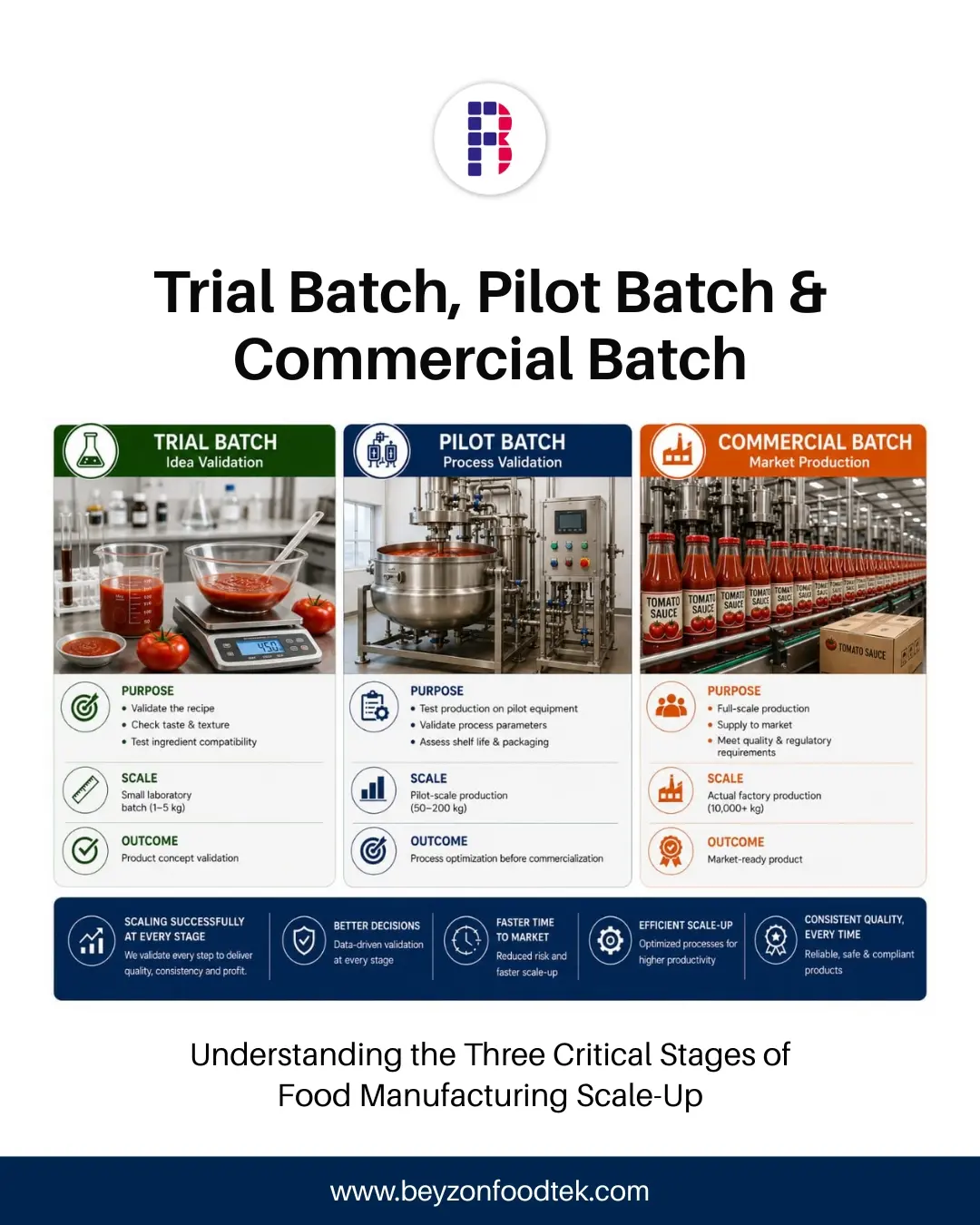
A Trial Batch is the first controlled production run used to evaluate whether a product formulation can be manufactured successfully under actual processing conditions.
Trial batches are generally conducted during product development or immediately after transferring a formulation from the R&D laboratory to the production floor.
The objectives include:
- Verifying product formulation
- Evaluating processing parameters
- Identifying manufacturing challenges
- Assessing ingredient functionality
- Checking product appearance, texture and flavour
- Confirming basic process feasibility
For example, a sauce manufacturer may prepare a 100 kg trial batch to determine whether starch hydration, emulsification, and cooking temperatures deliver the desired product consistency before proceeding further.
Trial batches often require multiple adjustments before acceptable results are achieved.
What Is a Pilot Batch?
A Pilot Batch is a larger-scale production run carried out under conditions that closely resemble commercial manufacturing. Its purpose is to validate whether the product and process can be consistently reproduced before full-scale production begins.
Unlike trial batches, pilot batches focus on process capability rather than formulation development.
Pilot batch activities commonly include:
- Process validation
- Equipment performance evaluation
- Yield verification
- Packaging compatibility testing
- Shelf-life sample generation
- Food safety verification
- Standard Operating Procedure (SOP) validation
- Production time studies
For example, a beverage manufacturer introducing a new fruit drink may conduct a 1,500-litre pilot batch to evaluate filling accuracy, pasteurization performance, bottle integrity, and production line efficiency before commercial launch.
Pilot batches provide valuable production data that supports investment decisions and operational planning.
What Is a Commercial Batch?
A Commercial Batch is the routine production batch manufactured for market distribution after the product, process, and manufacturing systems have been successfully validated.
Commercial production focuses on delivering consistent product quality while meeting operational and business objectives such as throughput, cost efficiency, inventory management, and customer service levels.
Commercial batches are expected to comply with established:
- Product specifications
- Standard operating procedures
- HACCP plans
- Quality standards
- Regulatory requirements
- Batch documentation systems
Unlike trial or pilot batches, commercial production operates under planned production schedules with defined performance targets.
Comparing Trial, Pilot and Commercial Batches
| Parameter | Trial Batch | Pilot Batch | Commercial Batch |
| Primary objective | Product feasibility | Process validation | Routine production |
| Typical scale | Small | Intermediate | Full production capacity |
| Focus | Formulation and process | Process consistency | Productivity and business performance |
| Frequency | During development | Before commercialization | Regular production |
| Outcome | Technical learning | Manufacturing readiness | Market supply |
Each stage reduces uncertainty before advancing to the next level of production.
Common Challenges During Scale-Up
One of the biggest challenges in food manufacturing is maintaining product consistency as production volume increases.
Manufacturers commonly experience:
- Different mixing behaviour
- Longer heating or cooling times
- Reduced ingredient dispersion
- Increased startup losses
- Packaging line adjustments
- Higher process variability
- Unexpected yield reductions
For example, a spice blend that mixes uniformly in a laboratory ribbon blender may require different blending times or loading patterns in a commercial-scale mixer to achieve the same level of homogeneity.
Identifying these differences during trial and pilot batches helps avoid costly problems after commercial launch.
Documentation Throughout Batch Development
Each stage of manufacturing should be supported by structured documentation.
Typical records include:
- Batch Manufacturing Records (BMR)
- Process parameter logs
- Equipment settings
- Yield reports
- Quality inspection reports
- Cleaning verification records
- Deviation reports
- Corrective and Preventive Action (CAPA) documentation
Well-maintained records improve traceability, simplify technology transfer, and support regulatory compliance.
Performance Metrics That Matter
As manufacturers move from trial to commercial production, technical validation is gradually complemented by operational performance measurement.
Important manufacturing indicators include:
- Manufacturing throughput
- Yield percentage
- Overall Equipment Effectiveness (OEE)
- First-pass quality
- Batch cycle time
- Changeover time
- Rejection and rework rates
- Material utilization
- Utility consumption per batch
Monitoring these metrics enables manufacturers to identify improvement opportunities while maintaining consistent product quality.
From Product Development to Operational Excellence
A successful product launch is not only about creating a good formulation—it also depends on developing a robust manufacturing process.
A structured progression from trial batch to pilot batch and finally commercial production allows manufacturers to:
- Minimize scale-up risks
- Improve process repeatability
- Optimize production parameters
- Strengthen food safety controls
- Improve manufacturing throughput
- Reduce startup losses
- Standardize operating procedures
- Build confidence before market launch
This systematic approach forms the foundation of reliable and scalable food manufacturing operations.
The Role of Beyzon Foodtek Pvt. Ltd.
Beyzon Foodtek Pvt. Ltd. supports food manufacturers in developing scalable manufacturing systems by integrating product development with Operations Management & Excellence principles.
From process validation and production scale-up to operational readiness and manufacturing optimization, Beyzon helps manufacturers establish structured systems, standardized processes, and performance tracking frameworks that improve manufacturing throughput, reduce wastage, optimize inventory levels, improve quality performance, reduce process time, and support sustainable business growth.
Conclusion
Understanding the differences between Trial Batches, Pilot Batches, and Commercial Batches is essential for successful product commercialization in the food industry. Each stage plays a unique role in validating product quality, process capability, equipment performance, and manufacturing readiness.
Manufacturers that adopt a structured scale-up approach are better positioned to reduce operational risks, improve production efficiency, and achieve consistent product quality from development through commercial manufacturing.
For Beyzon Foodtek Pvt. Ltd., supporting manufacturers through every stage of this transition is part of building robust, efficient, and future-ready food manufacturing operations.
FAQs
1. What is the difference between a trial batch and a pilot batch?
A trial batch primarily evaluates whether a formulation can be manufactured successfully, while a pilot batch validates the manufacturing process, equipment performance, and production consistency under conditions similar to commercial production.
2. Why are pilot batches important before commercial production?
Pilot batches help identify scale-up issues, validate processing parameters, generate shelf-life samples, verify packaging compatibility, and establish standard operating procedures before market launch.
3. Can a product move directly from development to commercial production?
While possible for simple products, most food manufacturers conduct trial and pilot batches to minimize technical risks, improve consistency, and validate production processes before commercial manufacturing.
4. What documents are generated during batch development?
Typical documents include Batch Manufacturing Records (BMRs), process logs, quality inspection reports, yield reports, cleaning verification records, deviation reports and CAPA documentation.
5. Which performance indicators should manufacturers monitor during scale-up?
Key indicators include manufacturing throughput, yield percentage, Overall Equipment Effectiveness (OEE), first-pass quality, batch cycle time, rejection rates, changeover time, and material utilization.