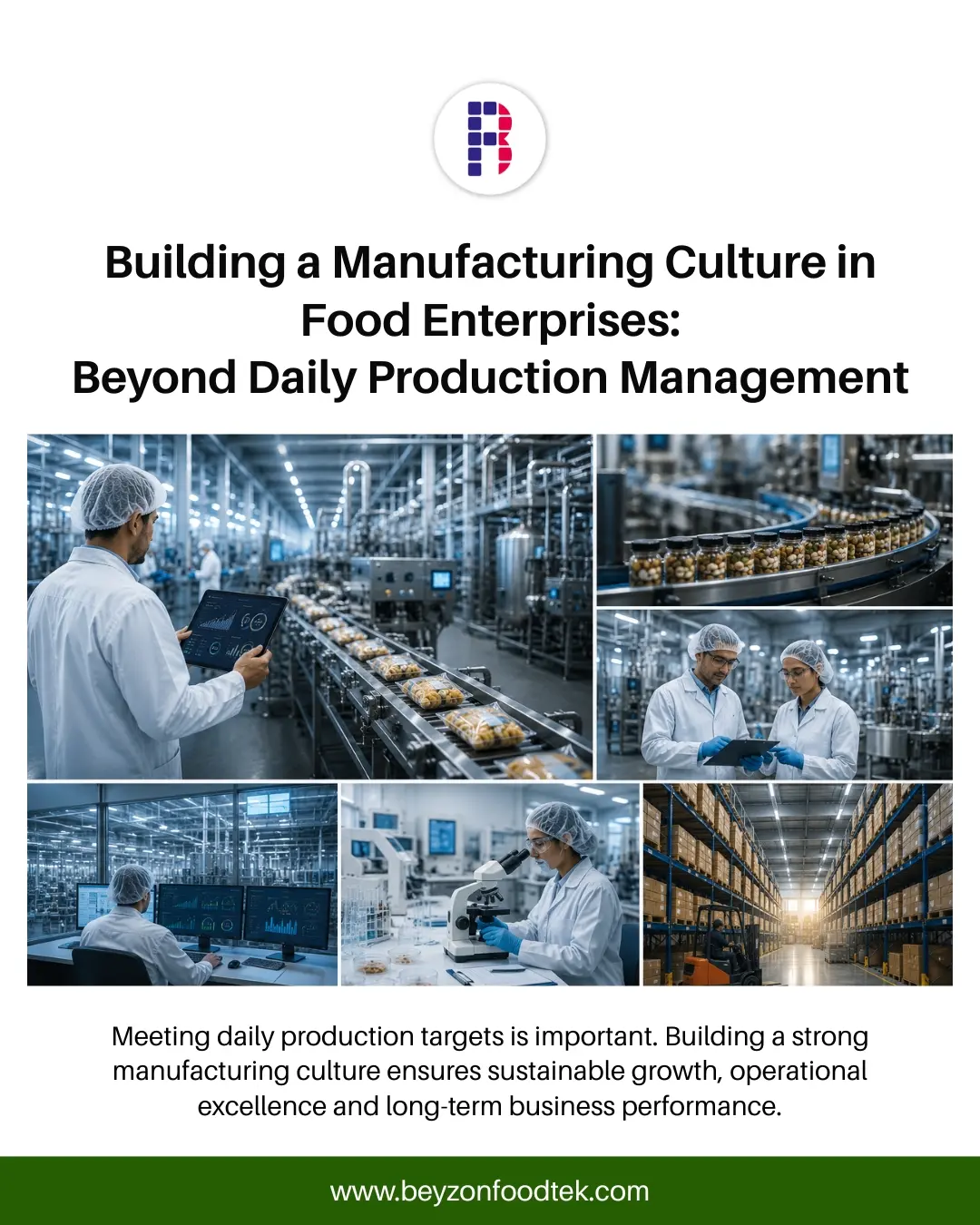
Building a Manufacturing Culture in Food Enterprises is essential for achieving long-term operational excellence, sustainable growth, and consistent business performance. While many food businesses focus heavily on meeting daily production targets, successful manufacturers understand that lasting performance depends on the culture that drives behaviors, decision-making, accountability, and continuous improvement across the organization.
In many growing food enterprises, management attention is often consumed by production schedules, raw material availability, customer orders, quality issues, and equipment breakdowns. While these activities are important, organizations that focus only on day-to-day operations often struggle to improve productivity, reduce costs, and scale effectively.
A strong manufacturing culture creates an environment where employees understand operational goals, follow standardized processes, take ownership of performance, and actively contribute to improving business results.
For Beyzon Foodtek Pvt. Ltd., developing manufacturing cultures that support operational excellence is an important part of helping food businesses achieve sustainable performance improvements.
What Is Manufacturing Culture?
Manufacturing culture refers to the shared values, behaviors, systems, and practices that influence how people perform their work within a manufacturing organization.
It shapes how employees:
- Approach quality and food safety
- Follow operational procedures
- Respond to production challenges
- Communicate across departments
- Solve problems
- Manage resources
- Contribute to continuous improvement
Unlike equipment, infrastructure, or technology, culture cannot be purchased or installed. It is built over time through leadership, systems, training, and consistent operational practices.
Why Manufacturing Culture Matters
Many food manufacturers invest in modern equipment, automation, and facility upgrades but fail to achieve expected performance improvements because cultural foundations are weak.
For example, a factory may install a high-speed packaging line capable of producing 250 packs per minute. However, if operators do not follow standard operating procedures, supervisors do not track performance losses, and departments fail to communicate effectively, actual productivity may remain significantly below installed capacity.
Manufacturing culture influences critical business outcomes such as:
- Manufacturing throughput
- Product quality
- Food safety compliance
- Employee engagement
- Process consistency
- Equipment utilization
- Waste reduction
- Customer satisfaction
Strong cultures help organizations convert operational capability into measurable business results.
Moving Beyond Daily Production Management
Many food enterprises operate in a reactive environment where managers spend most of their time responding to immediate issues.
Common daily challenges include:
- Equipment breakdowns
- Material shortages
- Production delays
- Quality deviations
- Customer complaints
- Staffing shortages
While these issues require attention, organizations that focus exclusively on firefighting often struggle to address the root causes behind recurring problems.
Manufacturing culture encourages a shift from reactive management to proactive operational control.
Instead of asking:
“How do we solve today’s problem?”
Organizations begin asking:
“How do we prevent this problem from happening again?”
This mindset is a fundamental characteristic of operational excellence.
Leadership’s Role in Building Manufacturing Culture
Manufacturing culture is strongly influenced by leadership behavior.
Employees often follow what leaders consistently measure, communicate, and reinforce.
Leaders help shape culture by:
- Establishing clear expectations
- Defining operational standards
- Promoting accountability
- Encouraging problem-solving
- Supporting employee development
- Recognizing performance improvements
- Reinforcing food safety and quality priorities
When leadership focuses only on production output, employees may overlook quality, maintenance, safety, or process discipline. Balanced leadership creates a more sustainable operational environment.
Standardization as a Cultural Foundation
Strong manufacturing cultures are built on standardized processes rather than individual habits or personal preferences.
Standardization includes:
- Standard operating procedures (SOPs)
- Work instructions
- Cleaning procedures
- Quality control methods
- Maintenance routines
- Reporting systems
For example, if shift operators follow different startup procedures for the same processing line, product consistency and equipment performance can vary significantly. Standardization reduces variability and creates predictable outcomes.
It also helps organizations preserve knowledge as teams grow and employee turnover occurs.
Creating Ownership at Every Level
One characteristic of high-performing manufacturing organizations is employee ownership.
Ownership means employees understand how their actions affect operational performance and take responsibility for results within their area of control.
Examples include:
- Operators monitoring process performance
- Supervisors tracking production losses
- Quality teams driving corrective actions
- Maintenance teams improving equipment reliability
- Warehouse teams improving inventory accuracy
When ownership becomes part of the culture, organizations often experience faster problem resolution and stronger operational performance.
Building a Continuous Improvement Mindset
Continuous improvement is a key element of manufacturing culture.
Rather than accepting inefficiencies as normal, employees actively look for opportunities to improve operations.
Improvement initiatives may focus on:
- Reducing changeover times
- Improving line efficiency
- Lowering rejection rates
- Reducing material wastage
- Improving equipment uptime
- Optimizing inventory levels
- Streamlining workflows
Even small improvements can generate significant business benefits when applied consistently across manufacturing operations.
Performance Visibility and Data-Driven Decisions
Manufacturing culture becomes stronger when employees can see and understand operational performance.
Many leading food manufacturers use performance indicators such as:
- Manufacturing throughput
- Overall Equipment Effectiveness (OEE)
- Yield performance
- Downtime trends
- Rejection rates
- Schedule adherence
- Customer service levels
- Inventory turnover
Visible performance metrics create transparency and help teams make decisions based on facts rather than assumptions.
This visibility also encourages accountability throughout the organization.
Cross-Functional Collaboration
Manufacturing culture extends beyond individual departments.
Production, Quality, Maintenance, Procurement, Warehousing, and Planning functions must work together to achieve business objectives.
For example, reducing changeover time on a production line may require collaboration between:
- Production teams
- Maintenance personnel
- Quality departments
- Planning functions
Organizations with strong collaborative cultures are often more effective at solving complex operational challenges and sustaining improvements over time.
Manufacturing Culture and Business Growth
As food businesses expand, manufacturing culture becomes increasingly important.
Growth often introduces:
- More employees
- Additional production lines
- Greater product complexity
- Larger customer requirements
- Higher compliance expectations
Without a strong culture, operational complexity can lead to inefficiencies, inconsistent performance, and reduced customer satisfaction.
A well-developed manufacturing culture helps organizations scale while maintaining operational control, product quality, and customer confidence.
The Role of Beyzon Foodtek Pvt. Ltd.
Beyzon Foodtek Pvt. Ltd. helps food manufacturers build Operations Management & Excellence systems that strengthen organizational culture, improve process visibility, and create sustainable operational performance.
Through structured operational frameworks, performance tracking systems, standardized processes, and continuous improvement methodologies, manufacturers can improve manufacturing throughput, reduce wastages, optimize inventory levels, improve quality performance, reduce process time, and strengthen customer service outcomes.
By helping organizations create systems-driven operations, Beyzon supports the development of manufacturing cultures that contribute directly to business growth and competitive advantage.
Conclusion
Building a Manufacturing Culture in Food Enterprises requires much more than managing daily production activities. It involves creating an environment where people, processes, systems, and performance expectations work together to drive operational excellence.
Organizations that invest in standardization, accountability, continuous improvement, performance visibility, and cross-functional collaboration are better positioned to improve productivity, reduce costs, maintain food safety standards, and support long-term growth.
For Beyzon Foodtek Pvt. Ltd., helping manufacturers build strong operational cultures is a key part of creating sustainable manufacturing performance and future-ready food businesses.
FAQs
1. What is manufacturing culture in a food enterprise?
Manufacturing culture refers to the values, behaviors, systems, and operational practices that influence how employees perform their work and contribute to business objectives.
2. Why is manufacturing culture important?
A strong manufacturing culture improves operational consistency, quality performance, food safety compliance, employee accountability, and overall manufacturing efficiency.
3. How does manufacturing culture differ from daily production management?
Daily production management focuses on achieving short-term production targets, while manufacturing culture focuses on long-term behaviors, systems, and continuous improvement that drive sustainable performance.
4. What role does leadership play in manufacturing culture?
Leadership establishes expectations, reinforces standards, promotes accountability, and influences how employees approach quality, safety, productivity, and continuous improvement.
5. How can food manufacturers strengthen their manufacturing culture?
Manufacturers can strengthen culture through standardization, employee ownership, performance visibility, continuous improvement programs, leadership engagement, and cross-functional collaboration.