Interdepartmental Coordination in Food Factories is a critical factor in achieving operational excellence, food safety, and consistent manufacturing performance. While food manufacturing facilities often organize Production, Quality, and Maintenance as separate departments, the reality is that factory performance depends on how effectively these functions work together.
Many operational challenges in food factories including production delays, quality deviations, excessive downtime, high wastage, and missed delivery schedules; can often be traced back to poor coordination between departments rather than technical failures alone.
Modern food manufacturing requires an integrated operating model where Production, Quality, and Maintenance function as interconnected systems with shared objectives and clear communication channels. This approach improves manufacturing throughput, strengthens food safety controls, and supports sustainable business growth.
For Beyzon Foodtek Pvt. Ltd., building integrated operational systems is an important part of helping manufacturers improve efficiency, visibility, and execution across their operations.
Why Interdepartmental Coordination Matters
A food manufacturing facility operates as a chain of interconnected activities. Production cannot achieve planned output without reliable equipment. Maintenance cannot perform effective preventive maintenance without production schedules. Quality teams cannot ensure compliance without collaboration from both departments.
For example, a packaging line producing ready-to-eat snacks may experience repeated downtime due to sealing machine failures. Production may view this as a maintenance issue, while Maintenance may identify improper machine operation as the root cause. At the same time, Quality may observe an increase in package integrity failures affecting shelf life.
Without coordinated problem-solving, each department addresses symptoms independently rather than resolving the underlying issue.
Strong coordination helps manufacturers:
- Improve manufacturing throughput
- Reduce downtime
- Improve product quality
- Strengthen food safety compliance
- Reduce wastage and rework
- Improve schedule adherence
- Optimize operating costs
- Improve customer service levels
Understanding the Relationship Between Production, Quality and Maintenance
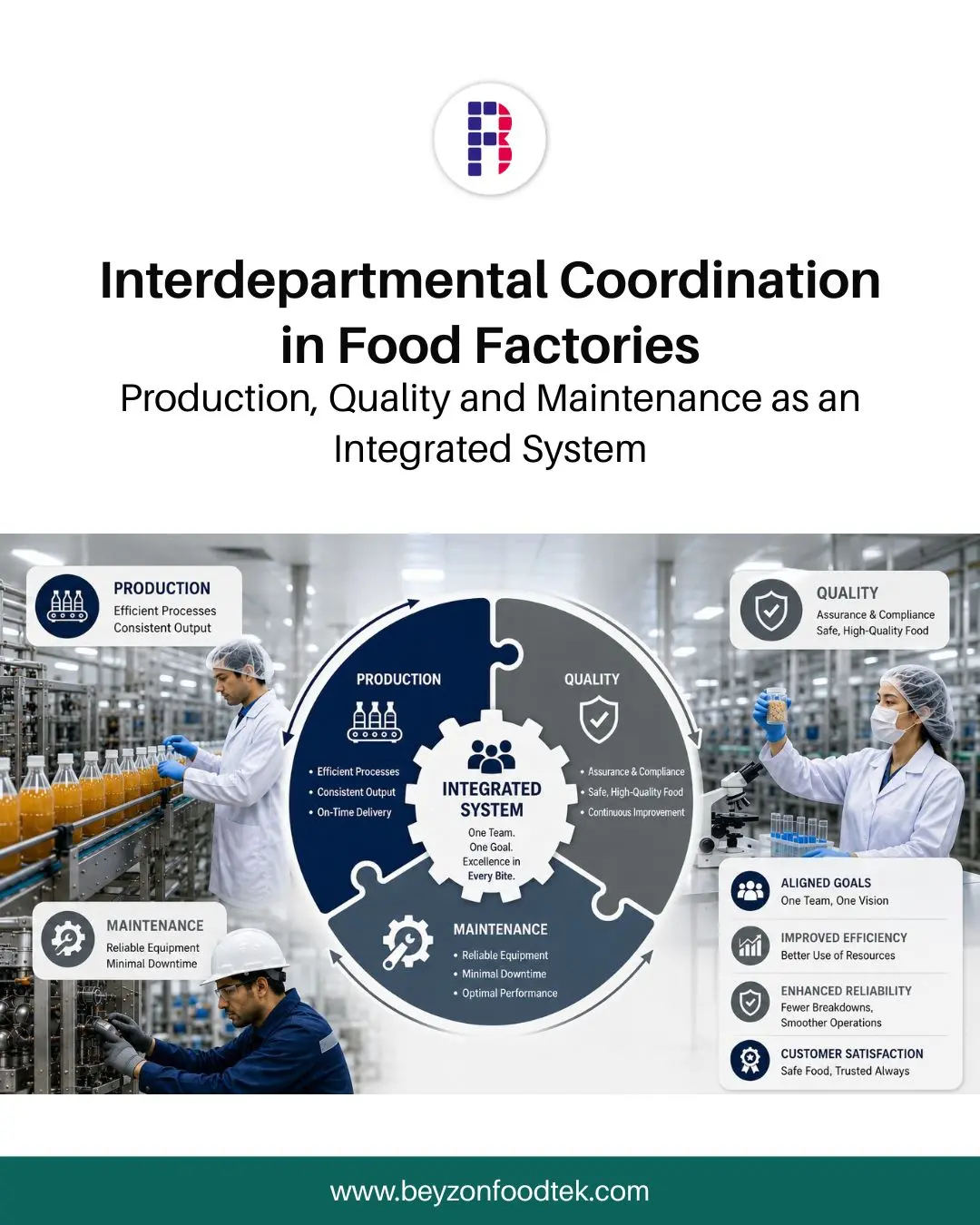
Although each department has distinct responsibilities, their objectives are closely linked.
Production Focuses On
- Meeting production targets
- Maximizing line efficiency
- Reducing process losses
- Managing changeovers
- Meeting delivery schedules
Quality Focuses On
- Product safety
- Regulatory compliance
- Process control
- Quality verification
- Traceability and documentation
Maintenance Focuses On
- Equipment reliability
- Preventive maintenance
- Asset performance
- Breakdown reduction
- Utility system reliability
When these functions operate independently, conflicting priorities often emerge. An integrated approach ensures decisions support overall factory performance rather than departmental objectives alone.
The Impact of Poor Coordination
Food factories frequently encounter operational inefficiencies when communication between departments is weak.
Common examples include:
Unplanned Production Downtime
Production schedules may be created without considering preventive maintenance requirements. As a result, critical maintenance activities are postponed until equipment failures occur.
Quality Holds and Delayed Releases
Production may complete batches on schedule, but insufficient coordination with Quality can delay inspections, testing, and batch release activities.
Repeated Equipment Failures
Maintenance teams may repair recurring breakdowns without involving Production and Quality in root cause analysis, leading to repeated failures and unnecessary costs.
Inefficient Changeovers
Product changeovers involving allergen management, cleaning verification, and equipment adjustments require coordination between all three departments. Poor planning often extends downtime and increases startup losses.
These issues directly affect manufacturing efficiency and customer delivery performance.
Production Planning as a Cross-Functional Activity
Effective production planning requires input from multiple departments.
Before finalizing schedules, manufacturers should consider:
- Equipment maintenance requirements
- Quality inspection schedules
- Cleaning and sanitation activities
- Raw material availability
- Packaging material readiness
- Utility capacity
For example, scheduling a major preventive maintenance activity during a high-demand production period can disrupt customer deliveries and increase operational pressure.
Cross-functional planning helps manufacturers balance production targets with quality and reliability requirements.
Quality as an Operational Partner
In many organizations, Quality is viewed primarily as an inspection function. However, modern food manufacturing increasingly recognizes Quality as an operational partner that contributes to process stability and continuous improvement.
Quality teams support operations through:
- Process validation
- Critical control point monitoring
- Root cause analysis
- Corrective action implementation
- Change management reviews
- Product release management
When Quality is involved early in operational decision-making, manufacturers often experience fewer deviations, reduced rework, and stronger compliance performance.
Maintenance and Equipment Reliability
Equipment reliability directly influences production efficiency and product quality.
For example, inconsistent temperatures in a dairy pasteurization process or fluctuating filling volumes on a beverage line can create both production and quality issues.
Maintenance teams contribute to operational excellence by focusing on:
- Preventive maintenance programs
- Predictive maintenance strategies
- Equipment condition monitoring
- Spare parts management
- Utility system reliability
- Asset lifecycle planning
Collaboration with Production and Quality helps prioritize maintenance activities based on operational risk and business impact.
Using Data to Improve Coordination
High-performing food manufacturers increasingly use data to improve decision-making across departments.
Common performance indicators include:
- Overall Equipment Effectiveness (OEE)
- Manufacturing throughput
- Downtime analysis
- First-pass quality rate
- Rejection and rework levels
- Schedule adherence
- Maintenance compliance
- Mean Time Between Failures (MTBF)
When all departments review common performance metrics, discussions become focused on improving overall factory performance rather than individual departmental results.
Daily Management Systems and Communication
Many successful food factories establish structured communication systems to improve coordination.
Examples include:
- Daily production review meetings
- Shift handover processes
- Maintenance planning meetings
- Quality review sessions
- Visual performance dashboards
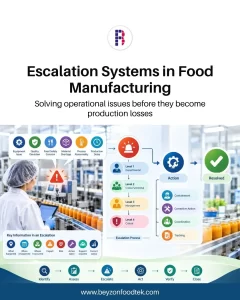
- Escalation and action tracking systems
These practices improve operational visibility and help departments respond quickly to emerging issues.
Interdepartmental Coordination and Operations Excellence
Operations Excellence requires more than efficient individual departments. It requires integrated systems that provide visibility, accountability, and alignment across the organization.
When Production, Quality, and Maintenance work as a coordinated system, manufacturers often achieve:
- Higher manufacturing throughput
- Reduced process wastage
- Improved product quality
- Lower operating costs
- Reduced process time
- Improved inventory performance
- Better equipment utilization
- Improved customer service levels
These outcomes provide a significant competitive advantage in today’s food manufacturing environment.
The Role of Beyzon Foodtek Pvt. Ltd.
Beyzon Foodtek Pvt. Ltd. helps food manufacturers strengthen Operations Management & Excellence by developing systems, processes, and performance tracking methods that improve visibility and coordination across manufacturing operations.
Through structured operational frameworks, manufacturers can align Production, Quality, and Maintenance functions around common business objectives while improving throughput, reducing wastages, optimizing inventory levels, improving quality performance, and lowering operational costs.
By creating integrated operational systems, Beyzon supports manufacturers in building sustainable performance improvements and long-term operational excellence.
Conclusion
Interdepartmental Coordination in Food Factories is essential for achieving reliable, efficient, and quality-focused manufacturing operations. Production, Quality, and Maintenance should not operate as independent functions but as interconnected components of a single operational system.
As food manufacturing becomes increasingly complex, organizations that establish strong coordination mechanisms, shared performance metrics, and integrated decision-making processes are better positioned to improve manufacturing performance, reduce costs, and meet customer expectations consistently.
For Beyzon Foodtek Pvt. Ltd., helping manufacturers build these integrated systems is a key part of creating operational excellence and supporting sustainable business growth.
FAQs
1. Why is interdepartmental coordination important in food manufacturing?
It helps improve communication, reduce downtime, improve product quality, strengthen food safety compliance, and support overall manufacturing performance.
2. Which departments are most critical for operational coordination?
Production, Quality, and Maintenance are the three most critical departments because their activities directly influence throughput, product quality, equipment reliability, and customer service performance.
3. How does poor coordination affect manufacturing operations?
Poor coordination can result in production delays, quality deviations, equipment failures, increased wastage, and missed delivery schedules.
4. What metrics can be used to improve coordination?
Manufacturers commonly use OEE, throughput, downtime, rejection rates, schedule adherence, MTBF, and maintenance compliance metrics to support cross-functional decision-making.
5. How can food factories improve interdepartmental coordination?
Factories can improve coordination through structured communication systems, shared performance metrics, cross-functional planning, daily management reviews, and integrated operational excellence frameworks.