Daily Manufacturing Management Systems, commonly referred to as DMS, are increasingly important in manufacturing environments where performance depends on timely visibility, disciplined review, and structured follow-through. A DMS is not simply a reporting board or a daily meeting. It is a management framework through which plant performance is reviewed against expected conditions, abnormalities are identified early, and corrective action is assigned with clarity. Lean Enterprise Institute describes daily management as the discipline that connects day-to-day work with performance control, problem-solving, and strategic targets.
In practical terms, DMS becomes relevant when small deviations in output, downtime, quality, labour deployment, or material flow begin to affect plant stability. Instead of waiting for weekly or monthly reviews, the organisation creates a daily rhythm of visibility, accountability, and response. For Beyzon Foodtek Pvt. Ltd., Pune, this subject sits naturally within its broader focus on management and technology services for the food industry, with emphasis on efficiency, manufacturing capacity, food safety, quality, profitability, mechanisation, automation, digitalization, and operations management & excellence.
Understanding Daily Manufacturing Management Systems
A Daily Manufacturing Management System is a structured method for managing plant performance every day. It creates a routine in which teams compare actual performance with expected performance, identify abnormalities, assign actions, and review closure. The purpose is not reporting for its own sake. The purpose is to ensure that operational issues are seen early and acted upon before they become larger losses. Lean Enterprise Institute notes that effective daily management gives teams visibility of problems, shows whether performance is ahead or behind, and allows issues to surface, be discussed, and be resolved on an everyday basis.
In manufacturing, DMS is typically built around areas such as:
- Safety
- Quality
- Delivery
- Cost
- Productivity
- Downtime
- Attendance And Staffing
- Training And Capability Development
For food and process manufacturing, this structure becomes especially valuable because operational inconsistency can influence not only throughput but also quality control, compliance readiness, and process discipline. This makes DMS a practical layer within a larger operational excellence framework.
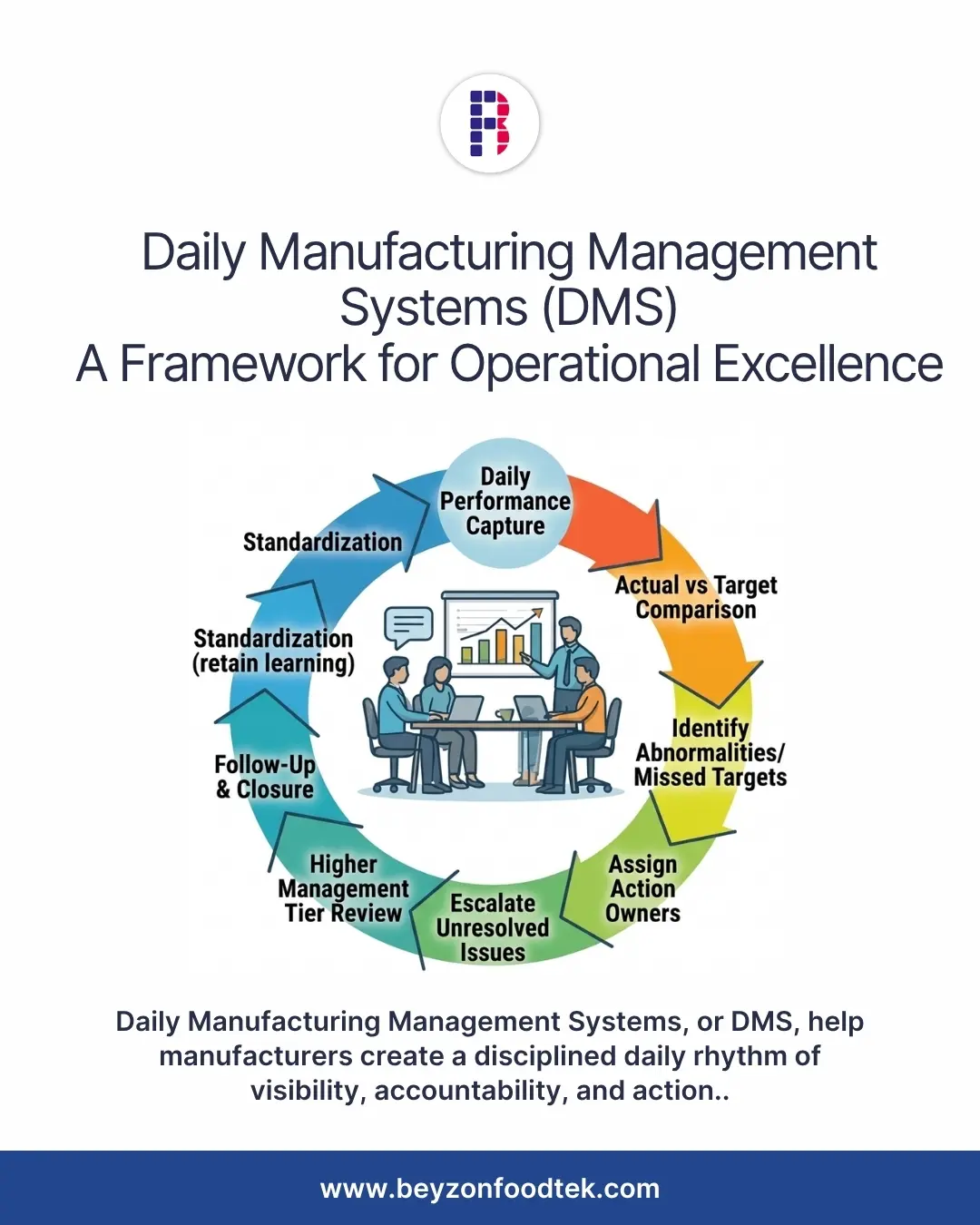
Typical Daily Management System Flow
A typical DMS follows a repeatable operating sequence rather than an informal review format. A common flow includes:
- Daily Performance Capture At Line, Cell, Or Department Level
- Comparison Of Actual Versus Target Conditions
- Identification Of Abnormalities Or Missed Targets
- Assignment Of Action Owners
- Escalation Of Unresolved Issues
- Review At Higher Management Tiers
- Follow-Up And Closure
- Standardisation Where Learning Must Be Retained
This matters because it turns information into action. Lean thinking on daily management emphasizes that the system works when teams review daily goals, compare planned versus actual results, prioritize problems, and escalate issues through a tiered structure when support is needed.
Performance Visibility and Visual Management
One of the strongest foundations of DMS is visibility. Plant performance cannot be managed effectively when information remains delayed, fragmented, or buried in retrospective reports. For this reason, DMS typically uses visual management tools that make operating conditions immediately understandable to the people responsible for action. Lean Enterprise Institute highlights daily huddles near the work, data trending, and visual discussion of issues as core elements of effective daily management.
Common visual elements include:
- Planned Versus Actual Output Charts
- Rejection And Defect Summaries
- Downtime Logs
- Changeover Tracking
- Maintenance Action Boards
- Material Shortage Indicators
- Staffing Updates
- Open Action Trackers
For manufacturers, this improves speed of response, strengthens cross-functional coordination, and reduces dependence on assumptions.
Tiered Accountability and Escalation
An effective DMS does not stop at first-level review. It establishes a tiered accountability structure so that issues move to the right level of response without delay. Lean Enterprise Institute specifically points to escalation in a tiered management system as one of the elements that makes daily management effective.
A well-structured system should clarify:
- What Qualifies As An Abnormality
- Who Owns First Response
- When Escalation Is Required
- Which Level Must Intervene
- How Closure Is Reviewed
This is particularly relevant for companies evaluating plant systems with Beyzon Foodtek Pvt. Ltd., Pune, where operations management, food safety, technology support, and process improvement often require coordination across production, maintenance, quality, and planning.
Leader Standard Work and Corrective Action
A DMS remains effective only when leaders follow it consistently. Leader standard work usually includes attending daily reviews, checking performance boards, verifying standards, following up on unresolved issues, and supporting escalation. Lean Enterprise Institute stresses that discipline and consistency are essential to the structure of daily management and that the daily cadence itself must be maintained.
Once a deviation is identified, the system should support:
- Immediate Containment Where Required
- Definition Of Action Owner
- Target Date For Correction
- Escalation If Closure Is Delayed
- Root Cause Review For Recurring Problems
- Standard Revision Where Learning Must Be Retained
This is what converts DMS from a status mechanism into a problem-solving discipline.
Digital DMS and Operational Best Practices
Many manufacturers are moving toward digital or hybrid DMS systems. Digital tools can improve traceability, visibility, and follow-up, but only when the underlying management logic is sound. A dashboard cannot compensate for weak review discipline or unclear escalation paths. In Beyzon Foodtek Pvt. Ltd.’s service context, this has direct relevance because the company positions digitalization in manufacturing, mechanisation & automation, and operations management & excellence as core capabilities.
Best practices for effective DMS typically include:
- Use A Limited Number Of Meaningful Daily Metrics
- Review Performance At A Fixed Daily Cadence
- Make Abnormalities Visually Obvious
- Define Ownership For Every Open Action
- Build Escalation Rules Into The System
- Link Recurring Issues To Structured Problem-Solving
- Audit The DMS Process For Consistency
- Keep The System Close To Actual Work And Actual Losses
How Beyzon Foodtek Can Support DMS Implementation
Establishing an effective Daily Manufacturing Management System requires more than KPI boards or meeting formats. It requires alignment between plant operations, performance measures, accountability structures, review discipline, and the broader systems that govern manufacturing performance. Beyzon Foodtek Pvt. Ltd. presents itself as a management and technology services company for the food industry, led by professionals with decades of experience across small to large food manufacturing companies and MNC environments.
In DMS-related work, this can translate into support such as:
- Mapping Plant-Level Review Requirements
- Designing Practical DMS Structures For Manufacturing Environments
- Aligning Daily Metrics With Plant Objectives
- Defining Escalation And Accountability Mechanisms
- Integrating DMS With SOPs, Quality Systems, And Operational Controls
- Strengthening Supervisory Review Routines
- Improving Visibility Across Production, Maintenance, Quality, And Planning Functions
Conclusion
Daily Manufacturing Management Systems are best understood as a practical framework for operational excellence. They help manufacturers create daily visibility, reinforce accountability, improve response discipline, and reduce the operational drift that weakens plant performance over time. For Beyzon Foodtek Pvt. Ltd., Pune, the topic fits naturally within a wider focus on manufacturing improvement, operations management & excellence, digitalization, automation, and future-ready plant systems. In that sense, DMS is not an isolated management concept. It is a foundational discipline that helps manufacturing organisations convert plant visibility into plant action.
FAQs
1. What is a Daily Manufacturing Management System?
A Daily Manufacturing Management System, or DMS, is a structured way of reviewing plant performance every day, identifying gaps early, and assigning actions to keep operations on track.
2. How is DMS different from a daily production meeting?
A daily production meeting is only one part of DMS. A full DMS also includes visual performance tracking, escalation rules, action follow-up, and leadership review.
3. What are the main elements of DMS?
The main elements of DMS usually include visual management, daily review routines, action ownership, escalation mechanisms, and consistent leader involvement.
4. Why is DMS important in food manufacturing?
In food manufacturing, daily issues in output, quality, downtime, hygiene, or material flow can quickly affect performance. DMS helps teams respond faster and maintain better control.
5. How can Beyzon Foodtek Pvt. Ltd., Pune support DMS implementation?
Beyzon Foodtek Pvt. Ltd., Pune can support manufacturers by helping structure daily review systems, improve accountability, and align DMS with overall plant operations and efficiency goals.