Scaling up food manufacturing operations is one of the most important transitions in the growth of a food business. It marks the shift from limited or developing production to a more stable, repeatable, and commercially viable manufacturing system. While growth in demand often creates the need for scale, successful scale-up depends on much more than increasing output. It requires coordinated planning across process design, equipment capacity, utilities, quality systems, manpower, food safety, and operational control.
In food manufacturing, scale-up must be approached carefully because growth can expose weaknesses that were manageable at a smaller level. Variations in raw material handling, process timing, line balance, hygiene discipline, or packaging efficiency can begin to affect consistency, waste, and delivery performance once volumes rise. This is why scaling up should be treated as a structured operational exercise rather than a simple expansion of production hours or machinery.
For Beyzon Foodtek Pvt. Ltd., Pune, the subject aligns closely with its broader focus on management and technology services for the food industry, including operations management & excellence, mechanisation & automation, digitalization in manufacturing, food safety, and capacity improvement. From that perspective, scaling up is not only about producing more. It is about building a stronger manufacturing system.
Understanding Scale-Up in Food Manufacturing
Scaling up in food manufacturing means increasing production capacity while maintaining product quality, process control, food safety, and operational efficiency. It may involve higher batch sizes, additional lines, faster throughput, new equipment, more manpower, or expanded infrastructure.
In practical terms, scale-up usually affects areas such as:
- Production Capacity
- Process Stability
- Equipment Utilisation
- Material Flow
- Packaging Throughput
- Utility Demand
- Quality Assurance
- Food Safety Control
A successful scale-up does not only increase output. It ensures that the plant remains manageable as complexity increases.
When Food Businesses Need to Scale Up
Food manufacturers usually begin considering scale-up when demand outgrows the reliability of the current setup. In some cases, this happens because the business enters modern trade, exports, contract manufacturing, or wider distribution networks. In other cases, the trigger may be internal, such as excessive bottlenecks, repeated overtime dependence, poor planning flexibility, or frequent capacity constraints.
Common indicators include:
- Demand Regularly Exceeds Current Capacity
- Production Depends Too Heavily On Manual Intervention
- Quality Variation Increases At Higher Volumes
- Packaging Or Dispatch Becomes A Repeated Bottleneck
- Existing Layout Restricts Material Movement
- Utility Systems Are No Longer Sufficient
- Waste, Rework, Or Downtime Begin To Rise
These signals suggest that the current manufacturing model may no longer support growth efficiently.
Capacity Planning and Process Review
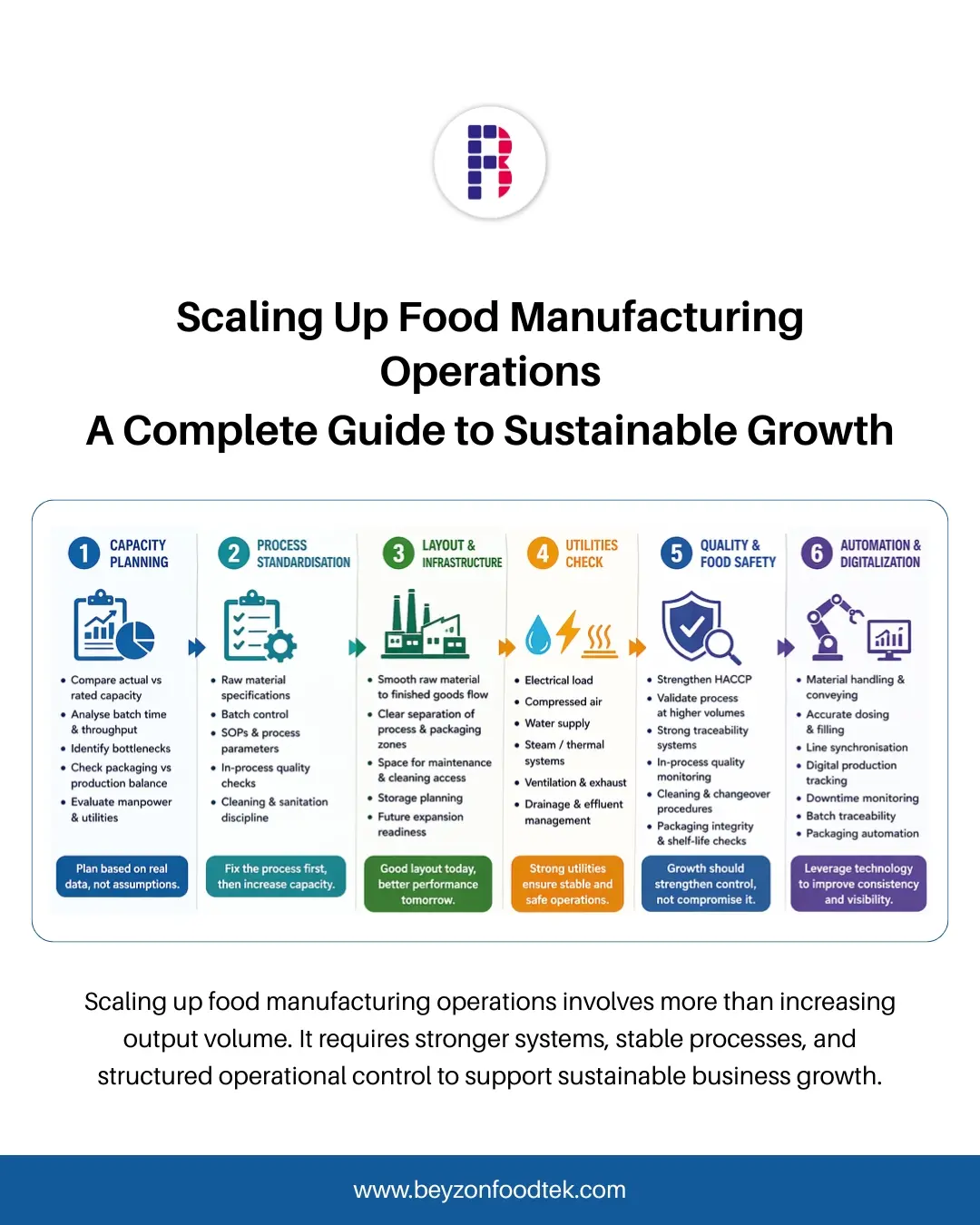
One of the first requirements in scale-up is a realistic assessment of current and future capacity. This means evaluating not only what the plant can theoretically produce, but what it can produce consistently under normal operating conditions.
A structured capacity review should examine:
- Actual Versus Rated Equipment Capacity
- Batch Times And Throughput Rates
- Line Balance Between Process Stages
- Changeover Time And Cleaning Time
- Packaging Capacity Relative To Production Output
- Packaging Failures
- Utility Availability For Expanded Operations
- Manpower Requirements Per Shift
Without this review, businesses may invest in isolated equipment upgrades that do not solve the real bottleneck. In many food plants, the limiting factor is not primary processing alone, but secondary operations such as transfer, cooling, packaging, or dispatch readiness.
Process Standardisation Before Expansion
Scaling up unstable processes often leads to larger and more expensive problems. Before increasing capacity, manufacturers need to ensure that the process itself is standardised and repeatable.
This usually requires attention to:
- Raw Material Specifications
- Batch Formulation Control
- Line Balance Between Process Stages
- Critical Process Parameters
- Standard Operating Procedures
- In-Process Quality Checks
- Cleaning And Sanitation Discipline
- Rework And Rejection Handling
When process variation is not controlled at a smaller scale, it tends to multiply as production increases. A scale-up plan should therefore begin with process discipline, not only with equipment addition.
Plant Layout, Utilities and Material Flow
As production grows, layout efficiency becomes more important. A facility that performs acceptably at a modest level can become congested and inefficient when volumes increase. Material movement, operator access, storage allocation, and equipment spacing all begin to affect daily performance.
Key layout considerations include:
- Smooth Raw Material To Finished Goods Flow
- Clear Separation Of Process And Packaging Zones
- Space For Maintenance And Cleaning Access
- Controlled Personnel And Material Movement
- Storage Planning For Raw, Packing, And Finished Goods
- Future Expansion Possibilities Within The Facility
Utilities must also be reviewed carefully. Scale-up often places additional demand on:
- Electrical Load
- Compressed Air
- Water Supply
- Steam Or Thermal Systems
- Ventilation And Exhaust
- Drainage And Effluent Management
Quality Systems and Food Safety During Scale-Up
One of the most common risks in scale-up is the assumption that food safety and quality systems will automatically remain effective at larger volumes. In reality, higher throughput can increase exposure to cross-contamination, process deviation, delayed checks, and documentation gaps if systems are not strengthened.
Scale-up planning should therefore include:
- Review Of HACCP Or Food Safety Controls
- Validation Of Process Conditions At Higher Volumes
- Stronger Traceability Systems
- More Disciplined In-Process Quality Monitoring
- Review Of Cleaning And Changeover Procedures
- Packaging Integrity And Shelf-Life Checks
Growth should not weaken compliance. It should strengthen the plant’s control systems.
Automation, Digitalization, and Operational Control
As volumes increase, manual systems often become harder to manage. This is where mechanisation, automation, and digitalization begin to play a larger role in scale-up projects. These tools can improve consistency, reduce handling losses, strengthen traceability, and support better decision-making.
Common areas for improvement include:
- Material Handling And Conveying
- Dosing And Filling Accuracy
- Line Synchronisation
- Digital Production Tracking
- Downtime Monitoring
- Batch Traceability
- Packaging Automation
Common Challenges in Food Manufacturing Scale-Up
Although scale-up creates growth opportunities, it also introduces operational pressure. Some of the most common challenges include:
- Increased Process Variation
- Poor Line Balance
- Inadequate Utility Support
- Weak Documentation And SOP Compliance
- Packaging Delays
- Higher Rejections Or Waste
- Manpower Coordination Issues
- Inconsistent Shift Discipline Integrity And Shelf-Life Checks
These issues usually appear when scale is attempted without sufficient process review, system discipline, or plant-level planning.
How Beyzon Foodtek Can Support Scale-Up Projects
Scaling up food manufacturing operations requires more than equipment expansion. It requires coordinated planning across process engineering, plant layout, operational control, quality systems, and execution discipline.
Beyzon Foodtek Pvt. Ltd., Pune supports food businesses through this transition by helping structure scale-up projects more systematically. This can include:
- Capacity Assessment And Bottleneck Analysis
- Process Flow Review And Improvement
- Layout And Infrastructure Planning
- Mechanisation And Automation Support
- Alignment Of Quality And Food Safety Systems
- Operational Excellence And Review Structures
- Support For Brownfield And Expansion Projects
This approach helps businesses move from volume pressure to structured growth.
Conclusion
Scaling up food manufacturing operations is a critical stage in the growth of a food business. It should not be treated as a simple increase in output, but as a broader transformation of the manufacturing system. Capacity, process stability, layout, utilities, food safety, quality control, manpower, and operational discipline must all be aligned if growth is to remain sustainable. In that sense, scale-up is not only about producing more food. It is about building a stronger and more reliable food manufacturing operation.
FAQs
1. What does scaling up food manufacturing mean?
It means increasing production capacity while maintaining product quality, food safety, and operational efficiency.
2. When should a food business consider scaling up?
A business should consider scale-up when demand regularly exceeds capacity, bottlenecks increase, or the current system can no longer support efficient growth.
3.What is the biggest risk in scale-up?
One of the biggest risks is increasing output without strengthening process control, food safety systems, and operational discipline.
4. Why is layout planning important during scale-up?
Layout planning improves material flow, reduces congestion, supports hygiene, and helps the plant operate more efficiently at higher volumes.
5. How can Beyzon Foodtek Pvt. Ltd., Pune support scale-up?
Beyzon Foodtek Pvt. Ltd., Pune can support scale-up through capacity assessment, process review, layout planning, automation support, and operational improvement.