Millet processing plants are becoming increasingly important as demand for nutritious grains continues to grow across the food industry. Millets are widely used in food products such as flours, ready-to-cook mixes, snacks and breakfast cereals, creating new opportunities for food manufacturers and agro-processing businesses.
A typical millet processing plant involves several stages including cleaning, grading, dehusking, milling, sieving and packaging. Because millets are small-grained cereals with outer husk layers and variable moisture levels, processing lines must be carefully designed to ensure effective impurity removal, controlled milling and minimal grain breakage.
This guide explains the key considerations for setting up a millet processing plant, including equipment selection, plant layout planning and operational best practices required to achieve efficient production and consistent product quality.
Understanding Millet Processing Requirements
Millet processing involves removing impurities, husk, and outer layers of the grain to obtain clean and edible millet grains suitable for consumption or further value-added processing.
Some of the commonly processed millets include:
- Finger Millet (Ragi)
- Pearl Millet (Bajra)
- Foxtail Millet
- Little Millet
- Kodo Millet
- Barnyard Millet
Each millet variety has different grain characteristics and processing requirements, making proper equipment selection extremely important.
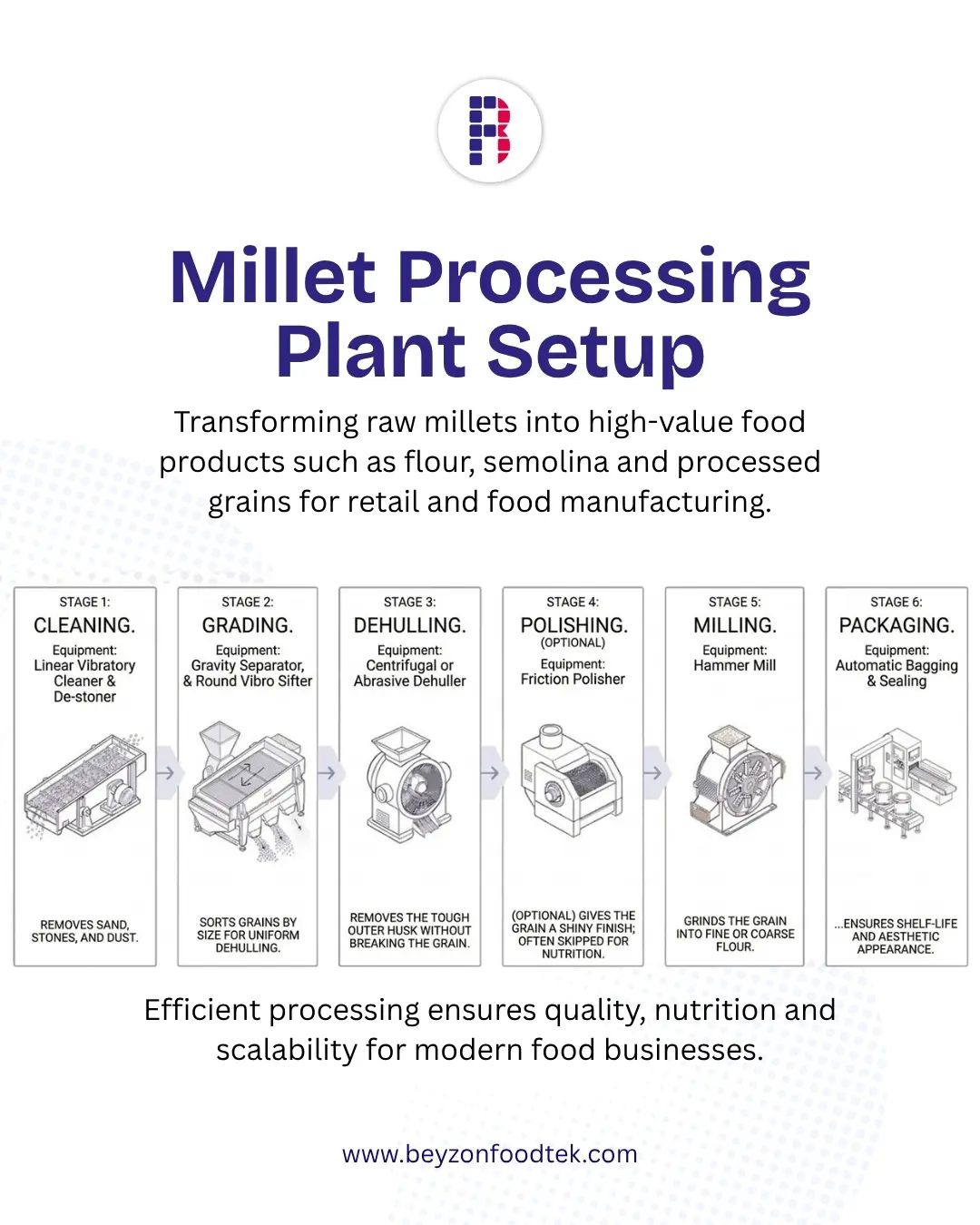
Typical Millet Processing Flow
Raw material reception → Cleaning and grading → Dehusking → Milling or grinding → Sieving → Packaging and storage
Each stage must be designed to remove impurities, protect grain quality and ensure that the finished product meets the required specifications for flour, semolina or processed millet ingredients.
A well-designed process line improves yield, reduces product loss and maintains the nutritional characteristics that make millets valuable in modern food products.
- Raw Material Handling and Storage
The processing of millets begins with the reception and storage of raw grains sourced from farms or aggregators. Raw millet typically contains foreign matter such as dust, stones, husk fragments and immature grains that must be removed before milling.
At the intake stage, processing plants generally establish procedures for:
- Sampling and quality inspection
- Moisture testing and grain grading
- Removal of damaged or infested grains
- Batch identification and traceability documentation
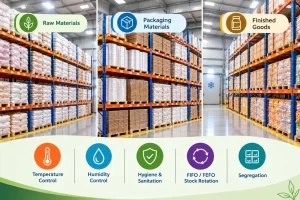
Storage conditions play an important role in maintaining grain quality. Millet grains should be stored in clean, well-ventilated warehouses with controlled humidity to prevent mould growth or pest infestation.
Proper segregation of raw materials, intermediate products and finished goods helps maintain hygiene and traceability throughout the facility.
- Cleaning and Grading Systems
Cleaning is one of the most important stages in millet processing. Raw grains typically contain a mixture of impurities that must be removed before further processing.
Cleaning lines often include multiple stages:
Pre-cleaning equipment such as vibratory screens or rotary cleaners remove large impurities including straw, stones and coarse debris.
Destoners separate heavy particles such as stones from millet grains based on density differences.
Air aspirators remove dust and light materials through controlled airflow.
Magnetic separators capture metal fragments that may be present in the raw material stream.
In addition to impurity removal, grading equipment helps classify grains according to size and quality. This improves milling efficiency and ensures consistent product characteristics.
- Dehusking and Milling Operations
Many millet varieties contain an outer husk that must be removed before consumption or milling. Dehusking is therefore a key step in the millet processing line.
Dehuskers or millet hullers are designed to remove the outer husk while minimising grain breakage. Proper adjustment of equipment parameters is necessary to achieve efficient husk separation without damaging the grain.
Following dehusking, the millet grains may be processed further depending on the desired product.
Common processing options include:
- Milling into millet flour
- Producing semolina or coarse meal
- Generating polished grains for cooking applications
Milling systems often use roller mills, hammer mills or stone mills depending on the required particle size and product characteristics.
Efficient milling operations help maximise product yield while preserving the nutritional properties of millets.
- Sieving and Product Standardisation
After milling, the product is passed through sieving systems to obtain uniform particle size distribution.
Vibratory sieves or rotary sifters are commonly used to separate fine flour from coarser particles that may require regrinding. This step ensures that the final product meets specification requirements for texture and consistency.
Particle size standardisation is particularly important when millet flour is used as an ingredient in bakery products, snacks or ready-to-cook formulations.
Automated sieving systems also reduce manual handling and improve process efficiency.
- Packaging and Storage of Finished Products
Once the desired product specifications are achieved, the processed millet products move to the packaging stage.
Packaging formats vary depending on the target market and product type. Common formats include:
- Retail pouches or bags for millet flour and grains
- Bulk bags for food manufacturers
- Rigid containers for value-added products
Packaging systems often incorporate form-fill-seal machines, weighers and check weighers to ensure pack accuracy and consistency.
Proper packaging protects millet products from moisture, contamination and environmental exposure during storage and transportation.
Plant Layout Considerations
A well-designed plant layout is essential for efficient millet processing operations. The layout must support smooth material flow from raw material reception to finished product dispatch while maintaining hygienic processing conditions.
Key layout principles include:
- Clear separation between raw grain areas and finished product zones
- Logical arrangement of cleaning, milling and packaging sections
- Adequate space for equipment maintenance and material handling
- Controlled personnel movement to maintain food safety
Efficient layout planning also reduces unnecessary material movement, improves workflow and enhances overall plant productivity.
Utilities and Dust Management
Millet processing operations generate dust during cleaning, milling and material handling stages. Without proper control systems, dust accumulation can affect hygiene and equipment performance.
Processing plants therefore integrate:
- Dust extraction and filtration systems
- Enclosed conveying systems
- Adequate ventilation in milling areas
Utilities such as compressed air, electrical power and process ventilation must be planned carefully to support continuous plant operations.
Good utility planning ensures stable equipment performance and safe working conditions for plant personnel.
Capacity Planning for Millet Processing Plants
Millet processing plants can be designed based on market demand and investment capacity.
Typical plant capacities include:
- Small-scale plants: 0.5 – 1 ton per hour
- Medium-scale plants: 1 – 3 tons per hour
- Large-scale plants: 3 – 10 tons per hour or more
Capacity planning depends on factors such as:
- Target market demand
- Product range
- Investment budget
- Automation level
- Available infrastructure
Best Practices for Efficient Millet Processing
- Ensure Good Raw Material Quality: High-quality raw millets improve processing efficiency and product yield.
- Maintain Optimal Moisture Levels: Proper moisture control reduces grain breakage during processing.
- Regular Equipment Maintenance: Routine maintenance ensures consistent performance and minimal downtime.
- Follow Food Safety Standards: Food processing plants should comply with FSSAI guidelines and food safety practices.
- Invest in Modern Technology: Using advanced technologies like color sorting and automated packaging improves product quality and efficiency.
Operational Best Practices
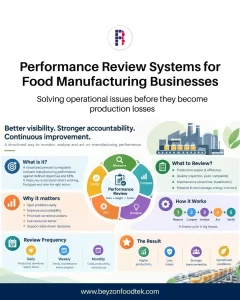
Beyond equipment and layout design, efficient plant operation requires well-defined procedures and monitoring systems.
Best practices in millet processing plants typically include:
- Regular equipment maintenance and cleaning schedules
- Monitoring of moisture and grain quality parameters
- Implementation of food safety systems such as HACCP or ISO-based frameworks
- Training of personnel in hygienic handling and operational procedures
These practices help maintain consistent product quality while ensuring compliance with food safety standards.
Common Challenges in Millet Processing
Millet processing can face several operational challenges, such as:
- High husk content in grains
- Grain breakage during dehusking
- Dust generation during processing
- Maintaining uniform grain quality
These challenges can be effectively managed through proper equipment selection, process optimization, and skilled plant operation.
How Beyzon Foodtek Can Support Your Millet Processing Project
Establishing a millet processing facility requires careful coordination between process engineering, plant design, equipment selection, and operational planning. Proper technical planning ensures that the facility operates efficiently, maintains product quality, and complies with food safety regulations.
Consulting partners such as Beyzon Foodtek Pvt. Ltd. support food businesses, startups, and agro-processing companies in developing efficient, scalable, and future-ready millet processing facilities.
Our expertise covers the complete project lifecycle, including:
- Process flow design and equipment selection
- Master planning and plant layout development
- Mechanisation and automation of food processing lines
- Capacity planning and operational efficiency improvement
- Food safety systems and regulatory compliance support
- Standard operating procedures (SOPs) and operational planning
With experience across greenfield and brownfield food manufacturing projects, Beyzon Foodtek works closely with food businesses to design processing plants that are efficient, scalable, and aligned with industry best practices.
Whether you are planning a small-scale millet processing unit or a large commercial processing plant, our team can help you develop a cost-effective, technically sound, and future-ready facility.
If you are exploring opportunities in millet processing or planning to establish a new processing unit, our team would be glad to support you with end-to-end technical consulting and project guidance.
Conclusion
Millet processing plants play an important role in transforming raw grains into value-added food ingredients used in a variety of applications. Establishing such facilities requires careful attention to cleaning systems, milling technology, product handling and hygienic plant design.
By selecting appropriate equipment, designing efficient layouts and implementing strong operational practices, food manufacturers can develop millet processing plants that deliver consistent product quality and reliable manufacturing performance.
With structured process engineering and expert guidance, millet processing facilities can be designed to meet growing global demand for nutritious and sustainable grain-based foods.
FAQs
1. What are the main stages in a millet processing plant?
Millet processing typically includes raw material cleaning, grading, dehusking, milling or grinding, sieving and final packaging.
2. What equipment is commonly used in millet processing plants?
Typical equipment includes pre-cleaners, destoners, aspirators, millet hullers or dehuskers, milling machines, vibratory sieves and packaging systems.
3. Why is cleaning important in millet processing?
Cleaning removes impurities such as dust, stones, husk and metal fragments, which helps protect milling equipment and ensures food safety and product quality.
4. What products can be produced in a millet processing plant?
Processing plants can produce millet flour, semolina, cleaned grains, and ingredients used in snacks, bakery products and ready-to-cook foods.
5. What factors should be considered when designing a millet processing plant?
Key factors include equipment selection, plant layout, material flow, dust management systems, and adherence to food safety and hygiene standards.