Predictive Maintenance for Food Processing Equipment is becoming one of the most important operational priorities for manufacturers seeking higher uptime, lower maintenance cost, and more reliable production systems. In many factories, maintenance still operates in a reactive mode where equipment is repaired only after failure occurs. This breakdown-driven culture creates avoidable downtime, product losses, delayed schedules, emergency labour cost, and increased operational stress. While reactive maintenance may appear simpler in the short term, it usually becomes more expensive and disruptive over time.
Food manufacturing environments are especially vulnerable to this problem because equipment performance directly affects throughput, hygiene, temperature control, packaging integrity and product consistency. A failed pump, worn conveyor bearing, unstable compressor, faulty filler, or damaged sealing unit can rapidly affect output and quality.
For Beyzon Foodtek Pvt. Ltd., this topic aligns naturally with its broader focus on management and technology services for the food industry, including operations management & excellence, mechanization & automation, digitalization in manufacturing, food safety systems, and capacity improvement. Predictive maintenance is not just a technical initiative. It is a strategic move toward future-ready manufacturing performance.
Understanding Breakdown Culture in Manufacturing
Breakdown culture refers to an environment where maintenance action begins only after equipment stops functioning or visibly fails. This often results in repeated emergency repairs, spare-part shortages, overtime maintenance activity, and unstable production planning.
Common signs of breakdown culture include:
- Frequent unplanned stoppages
- Repeated repairs on the same machine
- Maintenance teams constantly firefighting
- Poor spare-part readiness
- Last-minute production schedule changes
- Rising utility inefficiencies
- Reduced confidence in equipment reliability
- Stress between production and maintenance teams
In food plants, these issues can become more serious because equipment failure may also impact hygiene windows, cold-chain conditions, batch integrity, or packaging shelf life.
What Is Predictive Maintenance?
Predictive maintenance is a structured approach where equipment condition is monitored continuously or periodically so likely failures can be detected before breakdown occurs. Instead of servicing machines only by calendar intervals or waiting for failure, maintenance decisions are based on actual equipment health.
This is commonly achieved through:
- Vibration monitoring
- Temperature trend analysis
- Motor current analysis
- Oil condition monitoring
- Pressure and flow deviation tracking
- Noise and acoustic pattern checks
- Sensor alerts and machine diagnostics
- Data analytics from connected equipment
The objective is simple: repair at the right time, before failure becomes costly.
Why Predictive Maintenance Matters in Food Processing
Food processing plants depend on continuous, hygienic, and repeatable operations. Even short interruptions may create wider losses than expected.
Examples include:
- Filler downtime delaying packaging lines
- Chiller failure affecting product temperature
- Conveyor stoppage interrupting multiple upstream stations
- Seal failure causing leakage or rejected packs
- Mixer issues creating batch inconsistency
- Compressor faults reducing pneumatic system reliability
- Pump wear affecting flow rates and CIP systems
Predictive maintenance helps identify these risks early, allowing planned intervention rather than crisis response.
How Predictive Maintenance Improves Operational Speed
At first glance, monitoring systems may seem like additional complexity. In practice, they often simplify operations.
Predictive maintenance helps plants by:
- Reducing unplanned downtime
- Improving production schedule reliability
- Lowering emergency maintenance cost
- Increasing equipment life
- Improving spare-part planning
- Reducing overtime labour pressure
- Improving energy efficiency
- Supporting consistent output quality
Instead of losing hours to sudden failures, plants can plan short maintenance windows with far less disruption.
A Practical Predictive Maintenance Flow for Food Plants
A strong program should be practical and scalable rather than overly theoretical.
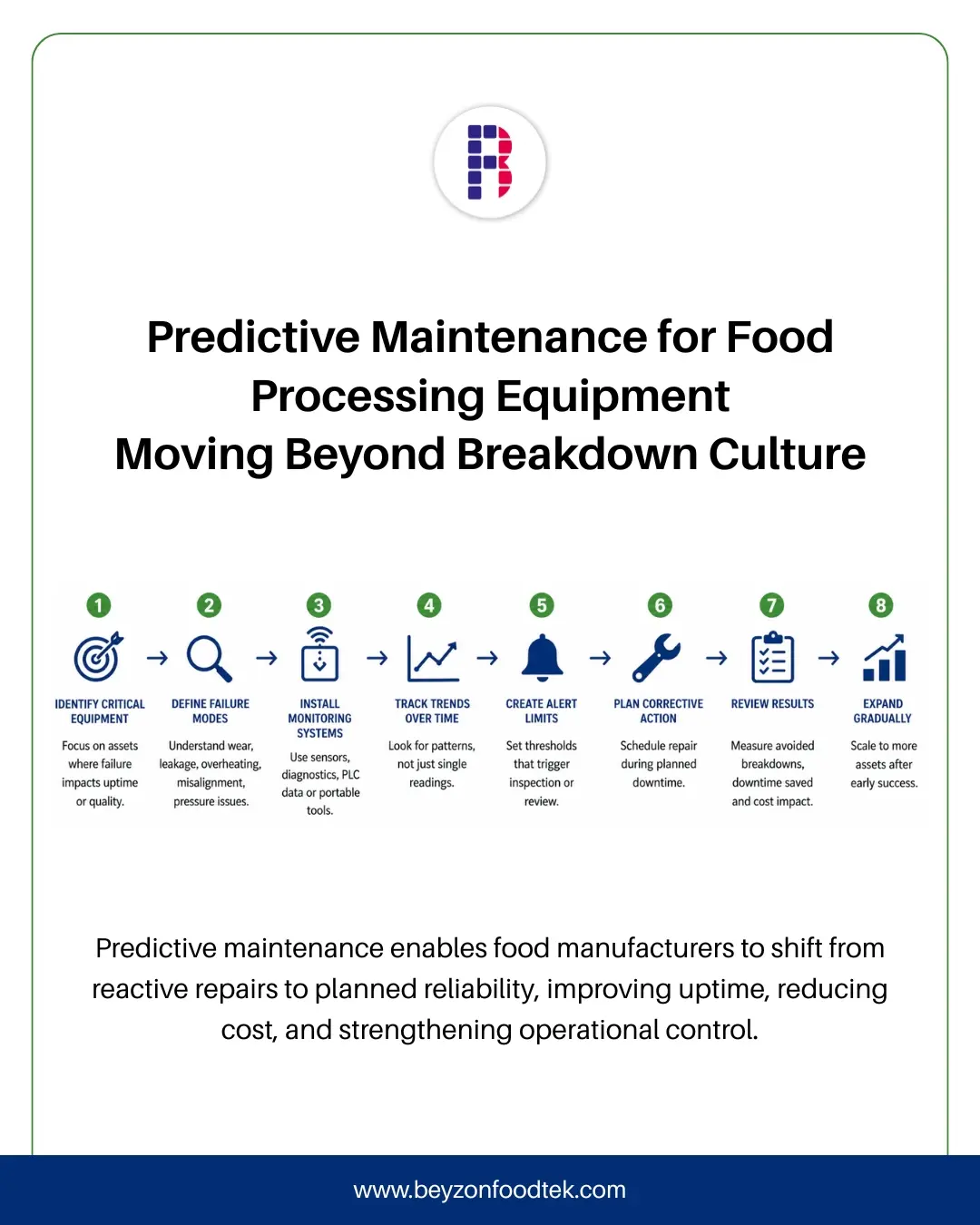
Typical implementation steps include:
- Identify Critical Equipment
Focus first on machines where failure causes major downtime or quality risk.
- Define Failure Modes
Understand common issues such as bearing wear, seal leakage, overheating, misalignment, or pressure instability.
- Identify Critical Equipment
Focus first on machines where failure causes major downtime or quality risk.
- Install Monitoring Systems
Use sensors, machine diagnostics, PLC data, or portable condition tools.
- Track Trends Over Time
The value is often in patterns, not one isolated reading.
- Create Alert Limits
Define thresholds that trigger inspection or maintenance review.
- Plan Corrective Action
Schedule intervention during planned downtime.
- Review Results
Track avoided breakdowns, downtime saved, and cost impact.
- Expand Gradually
Roll out to more assets once early wins are established.
Technologies Driving Predictive Maintenance
Modern food factories increasingly use digital tools to support equipment reliability.
Common technologies include:
- IoT sensors
- SCADA and PLC data integration
- Cloud dashboards
- AI-based anomaly detection
- CMMS maintenance software
- Mobile inspection systems
- Utility meter analytics
- Thermal imaging tools
These systems help convert maintenance from guesswork into measurable decision-making.
Best Practices for Successful Adoption
Predictive maintenance works best when integrated with operations discipline.
Best practices include:
- Start with highest-value equipment first
- Combine engineering knowledge with data signals
- Train operators to report early symptoms
- Maintain accurate maintenance history
- Link alerts to action, not just dashboards
- Coordinate production and maintenance schedules
- Keep hygiene and food safety standards central
- Measure ROI regularly
Technology alone does not solve reliability problems. Process ownership matters equally.
Common Reasons Programs Fail
Some predictive initiatives fail because tools are purchased without management discipline.
Common failure points include:
- Monitoring too many assets too early
- No response plan for alerts
- Poor sensor quality or bad installation
- Lack of maintenance ownership
- Ignoring operator observations
- No spare-part readiness
- Treating dashboards as the result
- No KPI review system
When this happens, predictive maintenance becomes a display screen instead of a performance system.
How Beyzon Foodtek Pvt. Ltd. Can Support Predictive Maintenance Programs
For food manufacturers, predictive maintenance should be part of broader operational excellence.
In practical terms, Beyzon Foodtek can support manufacturers by helping them:
- Identify reliability losses across critical assets
- Build maintenance systems around production priorities
- Integrate sensors and digital monitoring frameworks
- Improve maintenance planning discipline
- Connect maintenance KPIs with management review systems
- Support automation and efficiency improvement projects
- Align maintenance practices with food safety requirements
- Build scalable future-ready plant systems
This supports stronger uptime, better capacity utilisation, and lower recurring loss.
Conclusion
Predictive Maintenance for Food Processing Equipment is a major shift away from breakdown culture and toward planned reliability. It helps plants reduce downtime, improve output consistency, lower maintenance cost, and build stronger operational confidence. Rather than waiting for failure, manufacturers gain the ability to act early and intelligently.
For Beyzon Foodtek Pvt. Ltd., the subject directly connects with a wider commitment to operational excellence, automation, food safety, digitalization, and manufacturing performance improvement. In that context, predictive maintenance is not just a maintenance tool. It is a competitive advantage.
FAQs
1. What is predictive maintenance in food manufacturing?
It is a maintenance approach that uses condition data and equipment monitoring to detect issues before breakdown happens.
2. How is predictive maintenance different from preventive maintenance?
Preventive maintenance is time-based or schedule-based. Predictive maintenance is based on actual equipment condition.
3.Why is predictive maintenance important for food plants?
It reduces downtime while protecting production continuity, quality, hygiene, and delivery schedules.
4. What equipment is best for predictive maintenance first?
Critical assets such as compressors, fillers, pumps, chillers, conveyors, mixers, and packaging machines.
5. How can Beyzon Foodtek Pvt. Ltd. help?
Beyzon Foodtek can help design maintenance systems, improve planning discipline, support automation, and build predictive frameworks aligned to plant performance goals.