Every successful packaged food product begins as an idea, but only standardized recipes become commercially successful products. While chefs can rely on experience, intuition, and small adjustments in a kitchen, food manufacturers require documented formulations and validated processes that consistently produce the same product across thousands of batches.
Recipe standardization is the process of converting a kitchen formulation into a repeatable manufacturing process by defining ingredient specifications, processing parameters, quality standards, and operating procedures. It enables manufacturers to produce food with consistent taste, texture, yield, nutritional value and shelf life regardless of production volume or operating personnel. International food standards such as the Codex Alimentarius emphasize standardized practices, codes of practice, and food control systems to ensure consumer protection and fair food trade.
For Beyzon Foodtek Pvt. Ltd., recipe standardization is not merely a product development activity—it forms the foundation for operational excellence, production scalability, quality consistency, and efficient manufacturing.
What Is Recipe Standardization?
A standardized recipe is far more than a list of ingredients. It is a controlled manufacturing document that defines exactly how a product should be produced under specified operating conditions.
A standardized manufacturing recipe typically includes:
- Ingredient specifications
- Raw material quantities
- Batch size
- Mixing sequence
- Processing temperatures
- Cooking or holding times
- Equipment requirements
- Critical process parameters
- Yield expectations
- Packaging specifications
- Storage conditions
- Quality acceptance criteria
The objective is to ensure that every production batch delivers identical product characteristics while maintaining food safety and regulatory compliance. Standardized recipes are widely recognized as essential for ensuring consistent quality, predictable yield, effective training, and operational control.
Why Kitchen Recipes Cannot Be Used Directly in Manufacturing
Many food entrepreneurs begin with recipes developed in home kitchens or restaurant environments. However, commercial manufacturing introduces process variables that significantly influence the final product.
As production volume increases, manufacturers must account for changes in:
- Heat transfer rates
- Mixing efficiency
- Ingredient dispersion
- Shear forces
- Cooking time
- Cooling rates
- Equipment geometry
- Batch loading
For example, a tomato sauce prepared in a 10-litre kettle may reach the target viscosity within minutes. The same formulation produced in a 1,000-litre steam-jacketed vessel may require different agitation speeds, heating profiles, and holding times to achieve identical consistency.
Recipe standardization ensures that processing parameters evolve alongside production scale.
From Formula Development to Manufacturing Process
Successful recipe standardization follows a structured development pathway rather than a single production trial.
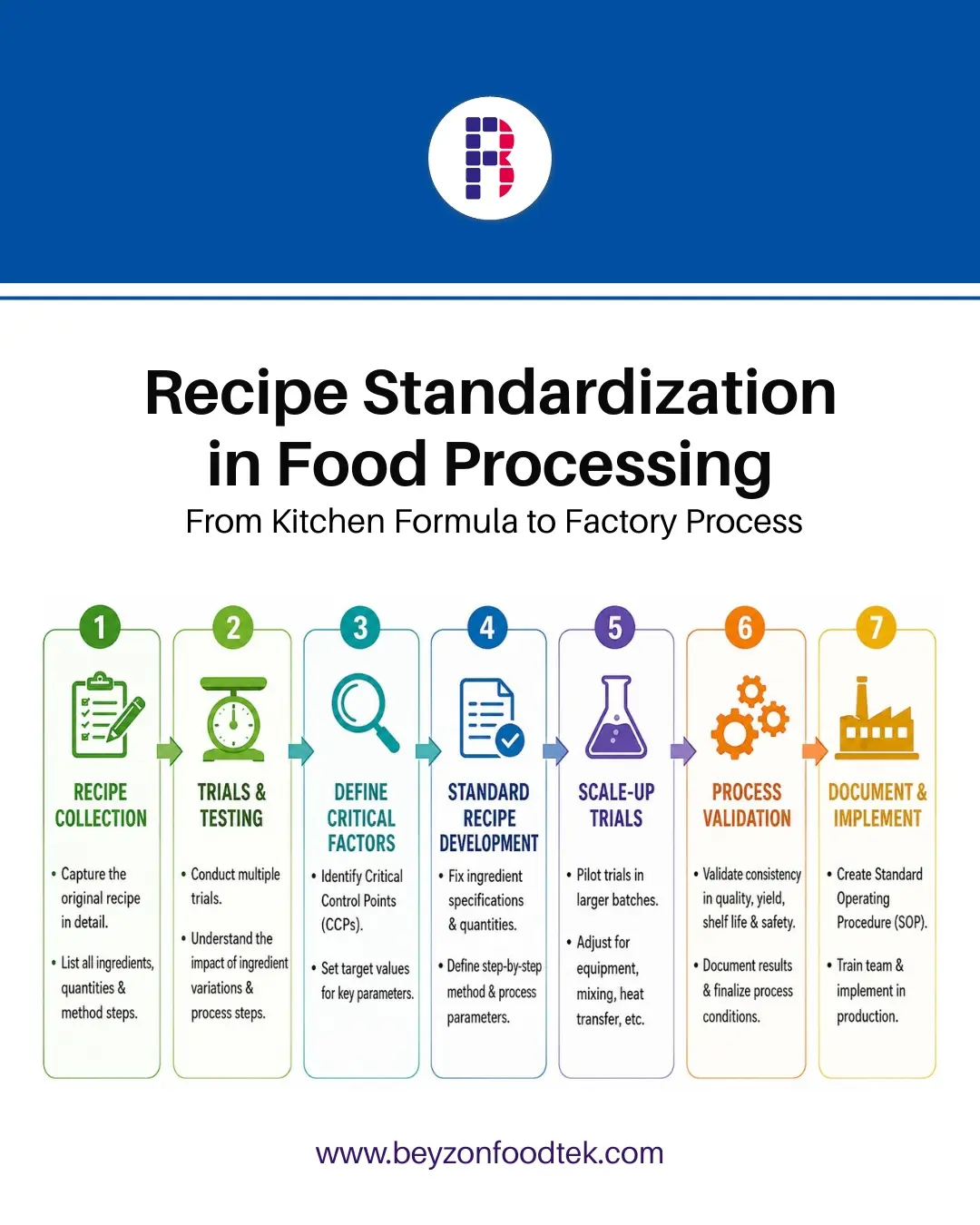
The typical progression includes:
- Laboratory formulation
- Trial batches
- Pilot-scale validation
- Commercial-scale validation
- Process optimization
- Routine commercial production
At each stage, manufacturers collect technical data on product quality, processing behaviour, production yield, and equipment performance before progressing to larger production volumes.
This systematic approach reduces technical risk and improves manufacturing readiness.
Critical Elements of a Standardized Recipe
Modern food manufacturers standardize both the formulation and the manufacturing process.
Key technical elements include:
Ingredient Specifications
Every ingredient should be clearly defined by grade, quality specifications, supplier requirements, and functional characteristics rather than simply by name.
Batch Formula
Ingredient quantities should be expressed by weight wherever possible to improve accuracy and simplify scaling between batch sizes.
Process Parameters
Critical processing conditions should be documented, including:
- Mixing speed
- Processing temperature
- Holding time
- Filling temperature
- Cooling conditions
- Metal detection requirements
These parameters directly influence product quality and process repeatability.
Critical Quality Attributes
Manufacturers typically establish measurable acceptance criteria such as:
- pH
- Brix value
- Moisture content
- Water activity (aw)
- Viscosity
- Net weight
- Sensory characteristics
- Microbiological specifications
Monitoring these attributes ensures that products consistently meet customer and regulatory expectations.
Standardization Improves Manufacturing Performance
Recipe standardization contributes directly to operational performance beyond product consistency.
Well-standardized processes help manufacturers:
- Reduce startup losses
- Improve first-pass quality
- Increase manufacturing throughput
- Reduce batch-to-batch variation
- Improve production planning
- Reduce raw material wastage
- Simplify operator training
- Improve inventory accuracy
For example, inconsistent spice addition sequences or variable mixing times can result in flavour variation and product rework. A standardized manufacturing process minimizes these variations and improves production efficiency.
Documentation and Regulatory Compliance
Recipe standardization also strengthens documentation systems required for food safety and quality management.
Typical manufacturing documents include:
- Master Formula Records (MFR)
- Batch Manufacturing Records (BMR)
- Standard Operating Procedures (SOPs)
- Process validation reports
- Cleaning procedures
- Quality inspection records
- Product specifications
These documents support traceability, internal audits, customer requirements, and regulatory inspections.
In India, manufacturers must also ensure that formulations comply with applicable Food Safety and Standards Regulations governing food composition, additives, labelling, and product standards.
Recipe Standardization and Scale-Up Challenges
One of the biggest challenges in food manufacturing is maintaining product consistency during scale-up.
Common technical issues include:
- Uneven ingredient dispersion
- Changes in emulsion stability
- Inconsistent cooking profiles
- Higher evaporation losses
- Variable product viscosity
- Reduced production yield
- Packaging compatibility issues
For instance, a mayonnaise emulsion that remains stable during laboratory production may separate during commercial-scale manufacturing if mixer tip speed, emulsification sequence, or ingredient addition rates are not adjusted appropriately.
These challenges highlight why recipe standardization extends beyond formulation to include process engineering.
Performance Metrics That Support Standardization
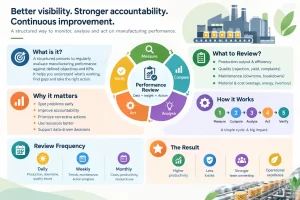
Manufacturers should continuously monitor operational performance after recipe standardization.
Common indicators include:
- Batch yield percentage
- First-pass quality
- Manufacturing throughput
- Overall Equipment Effectiveness (OEE)
- Material utilization
- Rework percentage
- Customer complaints
- Batch cycle time
Performance data allows manufacturers to identify process variation and continuously improve operational efficiency.
The Role of Beyzon Foodtek Pvt. Ltd.
Beyzon Foodtek Pvt. Ltd. helps food manufacturers convert product formulations into scalable manufacturing systems through structured Operations Management & Excellence frameworks.
By integrating recipe standardization with process validation, operational readiness, performance tracking, and manufacturing optimization, Beyzon helps organizations improve manufacturing throughput, reduce wastage, optimize inventory levels, improve product quality, reduce process time, and build sustainable production systems that support long-term business growth.
Conclusion
Recipe Standardization in Food Processing is the critical link between product innovation and commercial manufacturing success. A well-standardized recipe defines not only what ingredients are used, but also how they are processed, measured, monitored, and controlled throughout production.
Manufacturers that invest in structured recipe standardization are better equipped to scale production, maintain product consistency, improve operational efficiency, and meet regulatory expectations. For Beyzon Foodtek Pvt. Ltd., recipe standardization is a key component of building reliable, data-driven, and future-ready food manufacturing operations.
FAQs
1. What is recipe standardization in food processing?
Recipe standardization is the process of documenting and validating a formulation and its manufacturing process to ensure every production batch delivers consistent quality, yield, safety, and performance.
2. Why can’t commercial manufacturers use kitchen recipes directly?
Kitchen recipes do not account for large-scale processing variables such as heat transfer, mixing dynamics, equipment capacity, process controls, and production efficiency, all of which influence the final product.
3. What documents are created during recipe standardization?
Manufacturers typically develop Master Formula Records (MFR), Batch Manufacturing Records (BMR), Standard Operating Procedures (SOPs), product specifications, and process validation reports.
4. Which quality parameters are commonly standardized?
Common parameters include pH, Brix, moisture content, water activity, viscosity, microbiological limits, sensory characteristics, net weight, and production yield.
5. How does recipe standardization improve manufacturing performance?
It reduces process variation, improves first-pass quality, minimizes wastage, simplifies operator training, increases manufacturing throughput, and creates a reliable foundation for commercial-scale production.